
 Worksheets
Electricity
Total questions: 25
Worksheet time: 25mins
Who was the first person to investigate electricity in depth?
William Gilbert
Alessandro Volta
Benjamin Franklin
Michael Faraday
Damian felt a shock from electricity when he touched the metal knob on a door after walking across the carpet in his bedroom. Which statement correctly describes the type of electricity that caused the shock Damian received?
The shock is an example of static electricity which occurred because of the buildup of electrons that were discharged when he touched the door knob.
The shock is an example of current electricity which occurred because his hand intercepted the steady flow of electrons that are traveling through the door knob.
The shock is an example of static electricity which occurred because his hand intercepted the steady flow of electrons that are traveling through the door knob.
The shock is an example of current electricity which occurred because of the buildup of electrons that were discharged when he touched the door knob.
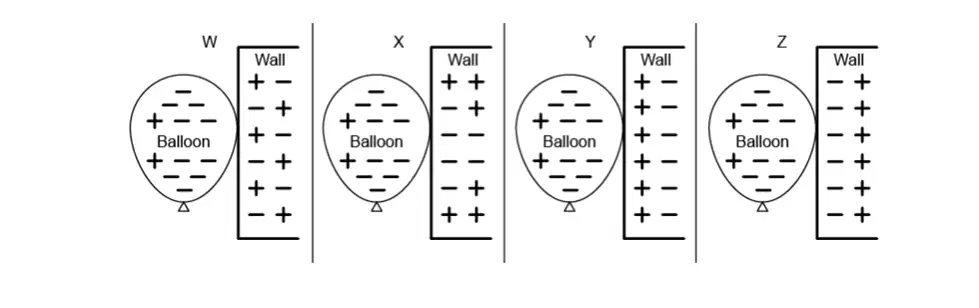
The pictures show four balloons that have gained negative charges after being rubbed against hair. The four balloons are placed next to a wall. Which balloon will most likely stick to the wall?
W because the negative charges in the balloon are attracted to the pattern of charges in the wall
X because the negative charges in the balloon are attracted to the mixture of charges in the wall
Y because the negative charges in the balloon are attracted to the positive charges in the wall
Z because the negative charges in the balloon are attracted to the negative charges of the wall
What is the term for electricity that moves from one place to another?
Force
Magnetism
Static Electricity
Current Electricity
The flow of electric charge.
water flow
electricity
air pressure
magnetic field
A device that opens or closes a circuit, allowing or stopping the flow of electricity.
Button
Remote control
Battery
Switch
Who discovered the relationship between electricity and magnetism?
A) Nikola Tesla
B) James Clerk Maxwell
C) Hans Christian Ørsted
D) Thomas Edison
What is the primary source of electricity in most homes?
A) Solar panels
B) Wind turbines
C) Power plants
D) Batteries
Which of the following is a non-renewable source of electricity?
A) Coal
B) Solar
C) Wind
D) Hydroelectric
What is the unit of electric current?
A) Volt
B) Ampere
C) Ohm
D) Watt
Which device is used to measure electric current?
A) Voltmeter
B) Ammeter
C) Ohmmeter
D) Thermometer
What is the function of a transformer in an electrical circuit?
A) To increase or decrease voltage
B) To store electrical energy
C) To convert AC to DC
D) To measure electrical resistance
Which of the following materials is a good conductor of electricity?
A) Rubber
B) Glass
C) Copper
D) Wood
What is the role of a circuit breaker in an electrical system?
A) To generate electricity
B) To prevent overload by breaking the circuit
C) To store electrical energy
D) To convert electricity to magnetism
Which of the following is an example of a renewable source of electricity?
A) Natural gas
B) Nuclear
C) Wind
D) Oil
What is the term for materials that do not allow electricity to flow through them easily?
A) Conductors
B) Insulators
C) Semiconductors
D) Resistors
Who is known for inventing the electric light bulb?
A) Nikola Tesla
B) Thomas Edison
C) Alexander Graham Bell
D) Guglielmo Marconi
What is the main purpose of a fuse in an electrical circuit?
A) To increase current
B) To decrease voltage
C) To protect the circuit by breaking it when overloaded
D) To convert AC to DC
Which of the following is a form of static electricity?
A) Lightning
B) Battery power
C) Solar energy
D) Wind energy
What is the effect of resistance in an electrical circuit?
A) It increases current
B) It decreases current
C) It has no effect on current
D) It converts current to voltage
Which of the following is a device that stores electrical energy?
A) Resistor
B) Capacitor
C) Inductor
D) Transformer
What is the main component of a solar panel that converts sunlight into electricity?
A) Silicon cells
B) Copper wires
C) Glass cover
D) Aluminum frame
Which scientist is known for the law of electromagnetic induction?
A) Albert Einstein
B) Isaac Newton
C) Michael Faraday
D) James Watt
What is the purpose of grounding in an electrical system?
A) To increase voltage
B) To prevent electric shock
C) To store electrical energy
D) To convert AC to DC
Which of the following is a device that converts mechanical energy into electrical energy?
A) Generator
B) Motor
C) Transformer
D) Battery

