
 Worksheets
Chemistry IGCSE
Total questions: 212
Worksheet time: 4hrs 27mins
How many moles of oxygen are consumed if 8 moles H2 are used?
How many moles of oxygen are produced when 6.7 moles of KClO3 decompose completely?
How many grams of hydrogen are produced if 120 g of Na are available?
I need to add 8 moles of Carbon to the reaction. How many grams of Carbon should I weigh?
How many grams of potassium chloride can be produced from 356 g of chlorine and 356 g of potassium bromide?
How many moles of carbon dioxide are produced from the combustion of 110 g of CH4?
12.00 moles of NaClO3 will produce how many grams of O2?
What mass of O2 will be needed to burn 36.1 g of B2H6?
What coefficients are needed to balance the reaction?
What coefficient would go in front of the O2?
What coefficient goes in front of H2?
What is the name of the element with an atomic number of 3?
Lithium
Magnesium
Sodium
Potassium
The atomic mass of an element tells you
The number of protons and neutrons
The number of protons and electrons
The number of neutrons and electrons
The number of neutrons only
The atomic number tells you
The number of electrons
The number of protons
The number of neutrons
The number of nucleons
The electronic configuration of a magnesium ATOM is
2, 8
2, 8, 3
2, 6
2, 8, 2
The electron configuration of a magnesium ION is
2, 8, 6
2, 8, 8
2, 8, 2
2, 8
Elements from groups 1-3
Are metals and lose electrons in a chemical reaction to become CATIONS
Are metals and lose electrons in a chemical reaction to become ANIONS
Are metals and gain electrons in a chemical reaction to become CATIONS
Are metals and gain electrons in a chemical reaction to become ANIONS
Which element has an electronic configuration of 2, 7
Chlorine
Bromine
Fluorine
Iodine
Phosphorus does the following in a chemical reaction
LOSES 3 electrons to become an ANION
LOSES 3 electrons to become a CATION
GAINS 3 electrons to become a CATION
GAINS 3 electrons to become an ANION
When lithium and potassium react, they would undergo which type of bonding
Ionic
Metallic
Covalent
Diamagnetic
When hydrogen and sulfur react together, they undergo which type of bonding?
Metallic
Ionic
Teronic
Covalent
When sodium and bromine undergo a chemical reaction, ionic bonding takes place. Which description best matches what occurs?
Sodium is from group 1. It gives its 1 valence electron to chlorine. Chlorine is from group 7. It received the 1 valence electron from sodium.
Sodium is from group 7. It gives its 1 valence electron to chlorine. Chlorine is from group 1. It received the 1 valence electron from sodium.
Sodium is from group 1. It receives 1 valence electron from chlorine. Chlorine is from group 7. It gives 1 valence electron to sodium.
Sodium is from group 7. It receives 1 valence electron from chlorine. Chlorine is from group 1. It gives 1 valence electron to sodium.
Metallic bonding takes place between
A metal and non-metal
Elements from groups 1-3 and transition metals
Two non-metals
A non-metal and a noble gas
Which statement best describes the following species: Al3+
This is an aluminium cation. It has lost 3 electrons
This is an aluminium cation. It has gained 3 electrons
This is an aluminium anion. It has lost 3 electrons
This is an aluminium anion. It has gained 3 electrons
Which statement best describes the following species: O2-
This is an oxygen anion. It is called oxygen
This is an oxygen anion. It is called oxide
This is an oxygen cation. It is called oxygen
This is an oxygen cation. It is called oxide
How would you name the following compound? MgS2
Magnesium sulfur
Dimagnesium sulfide
Magnesium sulfide
Magneside sulfide
Write the formula for calcium chloride
CaCl
Ca2Cl
CaCl2
Ca3Cl2

Write the electronic configuration of the Boron atom (as an ion)
2, 3
3, 2, 1
1
2
Which of the following statements regarding halogens is true?
Halogens are from group 6. They lose 2 electrons in a chemical reaction
Halogens are from group 7. They gain 1 electron in a chemical reaction.
Halogens are from group 6. They gain 2 electrons in a chemical reaction.
Halogens are from group 7. They lose 1 electron in a chemical reaction.

According to the chemical symbol... Which statement is correct?
This is potassium. It's from group 1. It has 19 protons, 19 electrons and 20 neutrons.
This is potassium. It's from group 1. It has 19 protons, 20 electrons and 20 neutrons.
This is potassium. It's from group 7. It has 19 protons, 20 electrons and 19 neutrons.
This is potassium. It's from group 7. It has 19 protons, 19 electrons and 20 neutrons.

The following structure can be described as...
An element as it only has 1 type of atom present. It has covalent bonding.
A compound as it has more than 1 type of atom present. It has covalent bonding.
An element as it has more than 1 type of atom present. It has metallic bonding.
An element because it has more than 1 type of atom present. It has covalent bonding.

What is this process called?
Distillation
Fractional Distillation
Reverse Distillation
Destructive Distillation

This process is based of the fact that all compounds being separated have
A boiling point
Same boiling points
Different boiling points
No boiling points

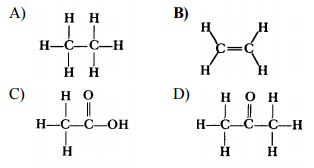

What chemical is this? (C5H10)
Pentene
Pentane
Hexane
Heptene
Complete the equation C16H34 ---> __________ + C2H4
C16H34
C2H30
C10H20
C14H30
When testing for alkenes (unsaturation) bromine water turns from...
orange --> blue/black
colourless --> pink
orange --> colourless
orange --> clear
Alkenes have the general formula:
CnH2n
CnH2n+1
CnH2n+2
CnHn
Alkanes have the general formula:
CnH2n
CnH2n+1
CnH2n+2
CnHn
Compounds that are composed of the same number and type of atoms but have them arranged in different ways are ___________.
isomers
isotopes
polymers
alkanes


Fill in the blank:
What are the Reactants of the combustion reaction?
_______ + _______ --> CO2 + H2O + Energy
Carbon Dioxide (CO2) + Water (H2O)
Fuel (C2H6) + Oxygen (O2)
Carbon Dioxide (CO2) + Oxygen (O2)
Fuel (C2H6) + Water (H2O)
What is the atomic number of an element?
The atomic number of an element is the number of neutrons in its nucleus.
The atomic number of an element is the number of electrons in its nucleus.
The atomic number of an element is the number of protons in its nucleus.
The atomic number of an element is the number of isotopes it has.
Choose a suitable test to test the presence of hydrogen gas.
Lighted splint test
Glowing splint test
Lime water test
Bromine test
Explain the difference between an atom and an ion.
An atom and an ion are the same thing.
An atom is smaller than an ion.
An atom has a charge, while an ion is neutral.
An atom is neutral, while an ion has a positive or negative charge.
How do ionic bonds form?
By sharing protons between atoms.
By forming covalent bonds.
By releasing neutrons during a reaction.
By one atom transferring electrons to another atom.
What is the colour change of anhydrous copper (II) sulphate when added with water?
Blue to pink
Blue to white
White to blue
White to pink
Describe the process of neutralization.
Neutralization is a chemical reaction between an acid and a base, resulting in the formation of water and a salt.
Neutralization results in the formation of oxygen and carbon dioxide.
Neutralization is a biological process involving plants and animals.
Neutralization is a physical reaction between an acid and a base.
What is the difference between exothermic and endothermic reactions?
Exothermic reactions occur in cold environments while endothermic reactions occur in hot environments
Exothermic reactions absorb energy while endothermic reactions release energy
Exothermic reactions release energy, usually in the form of heat, while endothermic reactions absorb energy from their surroundings.
Exothermic reactions are slower than endothermic reactions
What is the role of catalysts in chemical reactions?
Catalysts slow down reactions by increasing activation energy.
Catalysts speed up reactions by lowering activation energy.
Catalysts change the products of reactions.
Catalysts have no effect on the speed of reactions.
Explain the concept of oxidation and reduction in electrolysis.
Oxidation and reduction both happen at the same electrode.
Oxidation occurs at the cathode and reduction at the anode.
Electrons are gained at the anode and lost at the cathode.
Oxidation happens at the anode, where electrons are lost, and reduction occurs at the cathode, where electrons are gained.
What are hydrocarbons?
Synthetic materials used in construction.
Minerals found in the ocean.
Organic compounds consisting of hydrogen and carbon atoms.
Inorganic compounds consisting of hydrogen and carbon atoms.
Choose the colour and state of chlorine at room temperature
Orange-brown gas
Orange-brown liquid
Green-yellow liquid
Green-yellow gas
What is the difference between saturated and unsaturated hydrocarbons?
Saturated hydrocarbons are solid at room temperature, while unsaturated hydrocarbons are liquid.
Saturated hydrocarbons have only double bonds, while unsaturated hydrocarbons have only single bonds.
Saturated hydrocarbons are more reactive than unsaturated hydrocarbons.
Saturated hydrocarbons have all single bonds, while unsaturated hydrocarbons have at least one double or triple bond.
Arrange these elements from the lowest reactivity to the highest reactivity.
Cu, Ag, K, Mg, Zn
Ag, K, Mg, Zn, Cu
K, Mg, Cu, Ag, Zn
Ag, Cu, Zn, Mg, K
Cu, Zn, Ag, Mg, K
How does temperature affect the rate of a reaction?
Temperature has no effect on the rate of a reaction.
Temperature increases the rate of a reaction by providing more kinetic energy to the reactant molecules.
Temperature causes the reaction to stop completely.
Temperature decreases the rate of a reaction by slowing down the reactant molecules.
Explain the concept of activation energy.
Activation energy is the energy required to stop a reaction.
Activation energy is the energy released during a reaction.
Activation energy is the minimum energy required for a reaction to occur.
Activation energy is the energy stored in reactants before a reaction.
What are the factors that can affect the rate of a reaction?
Temperature, concentration of reactants, catalysts, surface area, pressure
Volume of the container
Time of day
Color of the reactants
The formula of magnesium ion is Mg2+ while nitrate is NO3-. What is the formula for magnesium nitrate?
MgNO32
Mg(NO3)2
MgNO3
Mg3NO2
Which one is the general formula for alkanes?
CnH2n+2
CnH2n
CnH2n+1
CnH2n+3
What is the colour change if bromine water is added to a sample of propene?
No colour change
Clear to brown
Brown to clear
Brown to white
Choose a greenhouse gas.
CO
CO2
CH4
NO2
Choose the colour of bromine gas.
Yellow
Green
Brown
Purple
What is the product of the following reaction:
Cl2 + MgBr2 --->
Br2 + MgCl
no change
Br2 + MgCl2
Cl2 + MgCl2
Choose the general formula of alkene
CnH2n+1
CnH2n+2
C2H2n
CnH2n
Which one is NOT a condition needed for cracking to happen?
High temperature
High pressure
Catalyst
High volume
What are the ions present in aqueous sodium bromide?
Na+, Br-, H+ and OH-
Na+, Br-, H+ and O2-
Na+, Br2-, H+ and O2-
Na+, Br2-, H+ and OH-
What is this process called?
Distillation
Fractional Distillation
Reverse Distillation
Destructive Distillation
This process is based of the fact that all compounds being separated have
A boiling point
Same boiling points
Different boiling points
No boiling points
What chemical is this? (C5H10)
Pentene
Pentane
Hexane
Heptene
Complete the equation C16H34 ---> __________ + C2H4
C16H34
C2H30
C10H20
C14H30
When testing for alkenes (unsaturation) bromine water turns from...
orange --> blue/black
colourless --> pink
orange --> colourless
orange --> clear
Alkenes have the general formula:
CnH2n
CnH2n+1
CnH2n+2
CnHn
Alkanes have the general formula:
CnH2n
CnH2n+1
CnH2n+2
CnHn
Compounds that are composed of the same number and type of atoms but have them arranged in different ways are ___________.
isomers
isotopes
polymers
alkanes
Fill in the blank:
What are the Reactants of the combustion reaction?
_______ + _______ --> CO2 + H2O + Energy
Carbon Dioxide (CO2) + Water (H2O)
Fuel (C2H6) + Oxygen (O2)
Carbon Dioxide (CO2) + Oxygen (O2)
Fuel (C2H6) + Water (H2O)

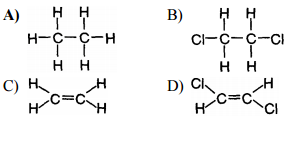
In which pair are both molecules unsaturated?
A
B
C
D
A filtration is used to remove sand from a mixture of water, salt and sand. What will be in the filtrate?
a mixture of an element and a compound
a mixture of two compounds
one compound only
one element only
Which types of substance do the chemical symbols C, CO2 and O2 represent?
C: compound, CO2: compound, O2: element
C: compound, CO2: element, O2: compound
C: element, CO2: compound, O2: element
C: element, CO2: element, O2: compound
Which element forms an ionic compound with a sodium?
Magnesium
Chlorine
Helium
Potassium
Electrolysis is used separate lead(II) bromide. Lead is formed at cathode. Which statement about the electrolysis is correct?
A green gas is given off at anode
Anode is connected to negative end of the battery
Only a physical change takes place when a current is passed
The electrolyte is in the molten state
What happens during all endothermic changes?
A gas is produced
Solids melt
The temperature decreases
There is a colour change
Which statement describes a redox reaction?
An acid reacts with a base
Only oxidation takes place
Oxygen is transferred from one substance to another
Two substances are both reduced
Dilute hydrochloric acid is added to solid X.
Hydrogen gas is produced.
What is X?
zinc
zinc carbonate
zinc hydroxide
zinc oxide
Which test is used to identify ammonia?
A glowing splint relights
Damp blue litmus paper is bleached
Damp red litmus paper turns blue
Limewater turns milky

A soft metal reacts vigorously with cold water. What is the position of this metal in the Periodic Table?
A
B
C
D
Which statement describes a transition element?
a metal that forms white compounds
a metal with a high melting point
a metal with a low density
a non-metal that forms coloured compounds
P, Q, R and S are four metals.
P forms bubbles of gas with dilute acid but does not react with cold water.
Q reacts slowly with cold water.
R does not react with dilute acid.
S reacts rapidly with cold water.
What is the order of reactivity from most to least reactive?
R → P → Q → S
R → Q → P → S
S → P → Q → R
S → Q → P → R
A colourless liquid is tested with blue cobalt chloride paper.
The paper turns pink.
Which statement about the liquid must be correct?
it contains water
it is acidic
is is anhydrous
it is pure water
Which reaction involves combustion?
calcium carbonate → calcium oxide + carbon dioxide
methane + oxygen → carbon dioxide + water
sodium carbonate + hydrochloric acid → sodium chloride + water + carbon dioxide
sodium hydroxide + hydrochloric acid → sodium chloride + water
What is the name of the type of compound containing only carbon and hydrogen?
carbohydrate
carbonate
hydrocarbon
hydroxide

Question in the picture
A
B
C
D
A beaker contains vinegar is put in a bowl with water. Solid sodium carbonate is added to vinegar in the beaker and stirred. The water in the bowl freezes.
Which statement about the reaction explains why the water freezes?
it is a redox reaction
it is an endothermic reaction
it is catalysed by sodium carbonate
it is thermal decomposition
Carbon dioxide reacts with carbon.
carbon dioxide + carbon → carbon monoxide
Which describes what happens to the carbon dioxide and to the carbon during the reaction?
carbon dioxide: oxidised, carbon: oxidised
carbon dioxide: oxidised, carbon: reduced
carbon dioxide: reduced, carbon: oxidised
carbon dioxide: reduced, carbon: reduced
Which element reacts with dilute sulfuric acid to form a salt?
carbon
copper
sulfur
zinc
The results of two tests on substance Q are shown.
test 1: add dilute hydrochloric acid to solid Q
result: bubbles of colourless gas, R, which turns limewater milky
test 2: add aqueous sodium hydroxide to a solution of Q
result: green precipitate
Which cation is present in Q and what is gas R?
Q: iron (II), R: carbon dioxide
Q: iron (II), R: chlorine
Q: iron (III), R: carbon dioxide
Q: iron (III), R: chlorine
Which metal reacts with dilute hydrochloric acid but does not react with cold water?
potassium
calcium
sodium
zinc
What is a chemical test for water?
it boils at 100oC
it turns blue cobalt chloride paper pink
it turns blue copper sulfate crystals white
it turns pink litmus paper blue
Petroleum is a mixture of hydrocarbon molecules.
Which describes the method of separation of petroleum and the type of bond in hydrocarbon molecules?
distillation; covalent bond
distillation; ionic bond
fractional distillation; covalent bond
fractional distillation; ionic bond
Which describes an element and a compound?
element: contains more than one type of atom
compound: contains elements chemically combined
element: contains more than one type of atom
compound: contains elements mixed together
element: contains only one type of atom
compound: contains elements chemically combined
element: contains only one type of atom
compound: contains elements mixed together
Which temperature changes occur during exothermic and endothermic reactions?
exo: decrease, endo: increases
exo: decrease, endo: no change
exo: increases, endo: decreases
exo: increases, endo: no change
What is a catalyst?
a substance that decreases the rate of reaction and is chemically changed at the end of the reaction
a substance that decreases the rate of reaction and is chemically unchanged at the end of the reaction
a substance that increases the rate of reaction and is chemically changed at the end of the reaction
a substance that increases the rate of reaction and is chemically unchanged at the end of the reaction
Which word equation represents the reaction of an acid with a carbonate?
acid + carbonate → salt + carbon dioxide
acid + carbonate → salt + carbon dioxide + water
acid + carbonate → salt + hydrogen + water
acid + carbonate → salt + water
The results of two tests on substance R are shown.
test 1: add aqueous sodium hydroxide
result: red-brown precipitate formed, insoluble in excess
test 2: dilute nitric acid added followed by silver nitrate solution
result: white precipitate formed
What is R?
iron(II) carbonate
iron(III) carbonate
iron(II) chloride
iron(III) chloride
W, X, Y and Z are four metals.
W forms a compound that is used to speed up chemical reactions.
X forms coloured compounds.
Y has a high melting point.
Z has a low density.
Which metals are transition elements?
W, X and Y
W and X only
X, Y and Z
Y and Z only
Which element does not produce a gas when added to dilute hydrochloric acid?
copper
iron
magnesium
zinc
Which processes are used in the purification of the water supply?
fractional distillation and chlorination
fractional distillation and crystallisation
filtration and chlorination
filtration and crystallisation
Which fuel is not obtained from petroleum?
coal
gasoline
diesel
refinery gas

Question on the picture
A
B
C
D

Question on the picture
P is a single substance
Q contains two substances
R contains two substances
S is a single substance
Which particle has the smallest mass?
atom
electron
neutron
proton
Which statement about compounds is correct?
An ionic compound contains two metallic elements bonded together.
In an ionic compound, metal ions are negatively charged.
When metals combine with non-metals, electrons are shared between the atoms.
When two non-metals combine, molecules are formed.
Solid calcium oxide reacts with cold water forming calcium hydroxide.
As the cold water is added, steam is seen coming from the solid.
Which statement describes the reaction?
It is endothermic and the temperature decreases.
It is endothermic and the temperature increases.
It is exothermic and the temperature decreases.
It is exothermic and the temperature increases.
Hydrochloric acid reacts with aqueous sodium hydroxide to form a neutral solution of sodium chloride.
Which process must be used to obtain dry crystals of sodium chloride from this solution?
distillation
evaporation
filtration
neutralisation
Which statement describes a trend in the elements going down Group VII?
They are darker in colour.
They are displaced from their salts by elements lower down the group.
They are more reactive.
They have lower boiling points.
Many coins are made of an alloy.
Which property of an alloy makes it suitable for coins?
conducts electricity
expensive to buy
resistant to corrosion
soft and malleable
What is formed during the complete combustion of a hydrocarbon?
carbon dioxide and water
carbon dioxide only
carbon monoxide and carbon dioxide
carbon monoxide only

A
B
C
D

A
B
C
D

A
B
C
D

A
B
C
D

A
B
C
D

A
B
C
D

A
B
C
D

A
B
C
D

A
B
C
D

A
B
C
D

A
B
C
D

A
B
C
D

A
B
C
D

A
B
C
D

A
B
C
D

A
B
C
D

A
B
C
D

A
B
C
D

A
B
C
D

A
B
C
D

A
B
C
D

A
B
C
D

A
B
C
D

A
B
C
D

A
B
C
D

A
B
C
D

A
B
C
D

A
B
C
D

A
B
C
D

A
B
C
D

A
B
C
D

A
B
C
D

A
B
C
D

A
B
C
D

A
B
C
D

A
B
C
D

A
B
C
D

A
B
C
D

A
A
B
C
D

A
B
C
D

A
B
C
D

A
B
C
D

A
B
C
D

A
B
C
D

A
B
C
D

A
B
C
D

A
B
C
D

A
B
C
D

A
B
C
D

A
B
C
D

A
B
C
D

A
B
C
D

A
B
C
D

A
B
C
D

A
B
C
D

A
B
C
D

A
B
C
D

A
B
C
D

A
B
C
D

A
B
C
D