
Font size
 Worksheets
Honors Cold War
Total questions: 26
Worksheet time: 13mins
Select the nations that were directly involved in the Cold War
United States
Germany
U.S.S.R.
Great Britain
What was the main goal of the Truman Doctrine?
Elimination of communism
Implementation of the "Domino Theory"
Containment of communism
Reconstruction of Western Europe after World War II
Assistance to British colonies in Africa
All of the following events contributed to Cold War tensions EXCEPT
the United States airlift of food to the citizens of Berlin
massive economic support for western Europe through the Marshall Plan
rejection of the Treaty of Versailles by the isolationist Senate
unified support of the Greek monarchy in 1947
the establishment of the defensive North Atlantic Treaty Organization
George Kennan's policy of containment was based on
belief that the communists would win the Chinese civil war
an understanding with Britain regarding the post-World War II German government
a belief that the Soviet Union would try to expand the reach of communism
a desire to keep the Republicans from regaining the White House in the 1948 election
a need to decrease government spending in an effort to halt inflation
Although the Cold War rapidly escalated with the end of World War II, the 1950s were marked by a period of "peaceful coexistence." Tensions between the Soviet Union and United States were alleviated temporarily. Which of the following reinvigorated Cold War hostilities?
Berlin Airlift
Iran Hostage Crisis
Cuban Missile Crisis
U-2 Incident
Suez Crisis
Which of the following countries was not a part of the Warsaw Pact?
Soviet Union
Albania
Czechoslovakia
West Germany
Hungary
Which of the following countries was not part of NATO?
France
East Germany
Austria
United States
Great Britain
The Allies had agreed to partition postwar Germany at the
Yalta Conference
Potsdam Conference
Tehran Conference
Casablanca Conference
The National Security Council’s 1950 document known as NSC-68 held that
the U.S. must increase its defense spending
the U.S. must maintain strong relations with the U.S.S.R.
the U.S. exaggerated the military power of the U.S.S.R.
the U.S. would be secure from attack by the U.S.S.R.
As a result of the Marshall Plan
the U.S. experienced an economic downturn in 1948
the U.S.S.R. increased military engagements in Western Europe
there was a growing effort isolate the U.S. from the rest of the world
there was a strengthening of the economic relationship between the United States and Western Europe
What was the name of the organization that hoped to promote peace and global cooperation following WWII?
League of Nations
North Atlantic Treaty Organization
Treaty of Versailles
United Nations

Who built the Berlin Wall?
Soviet Union
China
West Germany
The United States
Nations that were aligned with, but also under the influence and pressure of, the Soviet Union were called
Proxy nations
NATO
Warsaw Pact
Satellite nations

A conflict fought by two sides who are supported by two other, more powerful enemies who are involved in a larger struggle.
proxy war
hegemonic war
satellite offensive
total war
The spreading of ideas or beliefs to gain support for a cause is called
totalitarianism
arms control
propaganda
diplomacy
Which of the following led to the most significant escalation of United States military involvement in
Vietnam?
The Christmas Bombings of 1972
The Tet Offensive
The Gulf of Tonkin Resolution
The War Powers Act of 1973
In 1962, which of the following contributed most directly to a crisis in Soviet-American relations over
Cuba?
Cuban attacks on the United States naval base at Guantanamo
The failure of the Bay of Pigs invasion
Cuban withdrawal from the Organization of American States
The discovery of Soviet missile sites in Cuba

The situation depicted in the cartoon came into existence as a result of the pursuit of which of the following
policy goals?
Decolonization in Asia
Containment of communism
Nuclear supremacy
Détente with China and the Soviet Union

Which of the following developments is the most direct effect of the situation portrayed in the image?
Increased public opposition to the use of nuclear weapons
Expanded use of military force to achieve foreign policy goals in Eastern Europe
Reduced congressional oversight of United States military interventions
Reduced public trust in the federal government and the president

Which of the following was a key difference between the Korean War and the Vietnam War?
The chances of a direct military clash between the United States and the Soviet Union was greater in the
Vietnam War.
United States leaders could more easily argue that communist aggression led to the Vietnam War.
Public opposition was more significant for the Vietnam War than for the Korean War.
The press was more adversarial toward United States policy during the Korean War.
The Vietnam War differed from the Korean War in that the Vietnam War
generated criticism of the government’s military policies
involved United States troops without a formal congressional declaration of war
involved the United States in an indirect confrontation with the Soviet Union
ended with the collapse of the government that the United States had supported
In his farewell address, President Dwight D. Eisenhower warned Americans about the dangers of
presidential candidate Richard M. Nixon
insufficient federal spending on the needs of the poor
communist subversion of the civil rights movement
the military-industrial complex
the lack of a national health insurance program
The New Look military (JFK), brinkmanship (IKE), and massive retaliation (IKE) were all instances of
shifts to a more confrontational stance toward the Soviet Union during the early years of the Cold War
plans to win the war in Vietnam using superior technology and manpower
United States strategies employed during the Korean War
attempts to minimize United States casualties in future wars, in the wake of popular opposition to the
Vietnam War
Nixon justified expanding the Vietnam War into neighboring Cambodia as a result of
Increased attacks against Americans in Cambodia
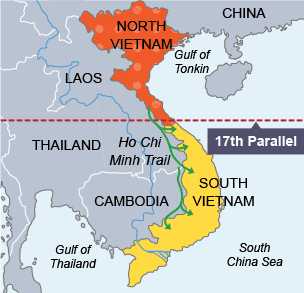
NVA Supply lines and attacks via the Ho Chi Minh Trail
The presence of Soviet forces on the Cambodian/Vietnamese border.
Gerber was there.

