
 Worksheets
Periodic trends
Total questions: 18
Worksheet time: 2hrs 30mins
Name
Class
Date
1.
As you move down a group, atomic radius increases because -
a)
you add more and more neutrons
b)
you add more and more protons
c)
you add more and more shells (energy levels)
d)
you add more atomic mass
2.
The atom with the largest atomic radius in Group 18 is -
a)
Ar
b)
He
c)
Kr
d)
Rn
3.
As you move across the periodic table from left to right, the atomic radius decreases. This is because -
a)
the number of protons increases, so attraction to electrons increases
b)
the number of energy levels increases
c)
the number of electrons increases
d)
the atomic mass increases
4.
The atom with the largest atomic radius in Period 4 (row 4) is -
a)
K
b)
Kr
c)
Fe
d)
Fe
5.
Francium (Fr) has the lowest ionization energy in Group 1 because -
a)
it has the smallest number of valence electrons
b)
it has the greatest atomic mass
c)
it has the greatest number of protons, so it attracts its electrons the strongest
d)
its 1 valence electron is very far from the nucleus, so little energy is needed to remove it
6.
The element with the smallest ionization energy in Period 6 is -
a)
Rn
b)
Cs
c)
Os
d)
Tm
7.
As you move across the periodic table atoms tend to get smaller because, ______________.
a)
the atoms have more mass.
b)
the atoms have less mass
c)
the atoms have more protons.
d)
the atoms have less electrons.
8.
The energy required to remove electrons is the definition of:
a)
Electronegativity
b)
Atomic Number
c)
Atomic Radius
d)
Ionization
9.
What is the name of family I
a)
Alkaline Earth Metals
b)
Boron Family
c)
Alkali Metals
d)
Halogen Family
10.
Electronegativity is...
a)
the ability of an atom to attract/ accept electrons
b)
the ability of an atom to lose electrons
c)
the energy required to remove an electron from a specific atom
d)
how easy it is to make friends.
11.
Which has the greater Electronegativity:
N or C?
N or C?
a)
C
b)
N
12.
Electronegativity __________ from left to right within a period and __________ from top to bottom within a group.
a)
decreases, increases
b)
increases, increases
c)
increases, decreases
d)
stays the same, increases
13.
The electronegativity of Cl is the highest in Period 2. Why?
a)
Cl is the largest and has the greatest effective nuclear charge
b)
Cl is the smallest and has the lowest effective nuclear charge
c)
Cl is the largest and has the lowest effective nuclear charge
d)
Cl is the smallest and has the greatest effective nuclear charge
14.
What term is used to describe "an atom's tendency to attract electrons to itself when is is chemically combined with another element"
a)
electronation
b)
electron affinity
c)
electronegativity
d)
electrolysis
15.
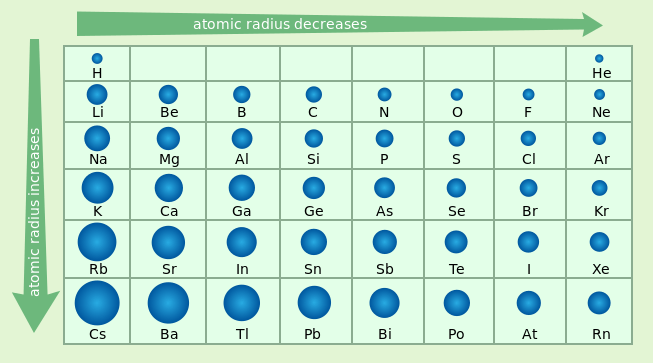
As you move across the periodic table atoms tend to get smaller because, ______________.
a)
the atoms have more mass.
b)
the atoms have less mass
c)
the atoms have more protons.
d)
the atoms have less electrons.
16.

As you move down the periodic table atoms get bigger. This is because ____________.
a)
The atoms have more mass.
b)
The atoms have more protons.
c)
The atoms have more energy levels
d)
The atoms have more nuetrons
17.

Which atom has the largest atomic radius?
a)
potassium
b)
rubidium
c)
francium
d)
cesium
18.
Which periodic group has the smallest atomic radius?
a)
Alkali metals
b)
Halogens
c)
Noble Gases
d)
Transition metals
100 %

