
NEW
Font size
S
M
L
XL
 Worksheets
Chapter 8 Matter 8
Total questions: 47
Worksheet time: 24mins
Name
Class
Date
1.

Is the following an example of a physical or chemical property?
a)
Physical Property
b)
Chemical Property
2.
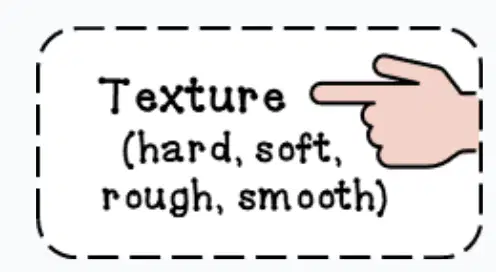
Is the following an example of a physical or chemical property?
a)
Physical Property
b)
Chemical Property
3.

Is the following an example of a physical or chemical change?
a)
Physical Change
b)
Chemical Change
4.

Is the following an example of a physical or chemical change?
a)
Physical Change
b)
Chemical Change
5.
What is the definition of matter?
a)
Anything that has mass and takes up space
b)
A substance that cannot be separated
c)
A mixture of two or more substances
d)
A fixed composition of elements
6.
Substances that CANNOT be broken down chemically into other substances are
a)
elements
b)
compounds
c)
mixtures
d)
solutions
7.
How do liquid water, ice and water vapor differ from each other
a)
They are different states of matter
b)
They are different compounds
c)
They are made of different kinds of molecules
d)
They are made of different kinds of atoms
8.
Soil, a salad, and sugar water are all examples of __
a)
Elements
b)
Compounds
c)
Mixtures
d)
Atoms
9.
Which type of substance does Pascal's principle deal with
a)
soilds
b)
fluids
c)
powders
d)
metals
10.
What scientific rule describes why water squirts from a plastic bottle when it is squeezed
a)
Bernoulli's principle
b)
Archimedes' principle
c)
Pascal's principle
d)
Newton's 1st law of motion
11.
Bernoulli's principle helps to explain
a)
bouyancy
b)
momentum
c)
tooth paste coming out when squeezed
d)
flight
12.
Which state of matter do the particles spread apart and fill all the space available to them
a)
crystal
b)
liquid
c)
gas
d)
solid
13.
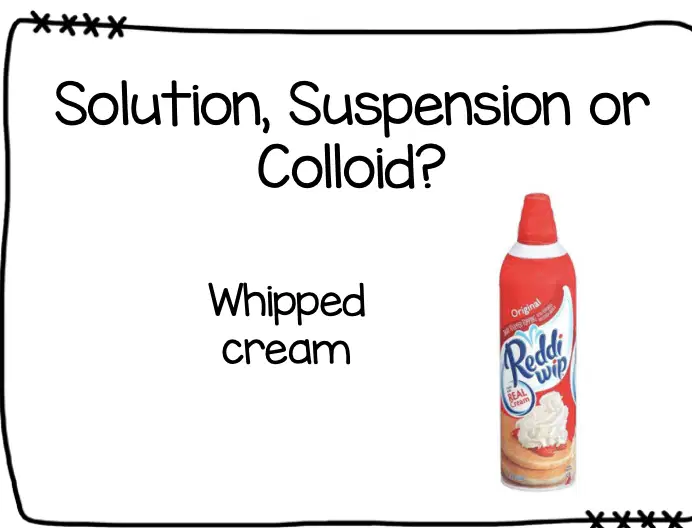
Is the following an example of a solution, suspension or colloid?
a)
Solution
b)
Colloid
c)
Suspension
14.
The only homogenous mixture
a)
Solution
b)
Suspension
c)
Colloid
15.
What causes phase changes in matter?
a)
A. Changes in color
b)
B. Adding or removing heat, which changes kinetic energy
c)
C. Changes in size of the molecules
d)
D. The amount of space in the container
16.
In which state of matter do molecules have the least kinetic energy?
a)
A. Solid
b)
B. Liquid
c)
C. Gas
d)
D. Plasma
17.
What happens to the kinetic energy of molecules when a solid turns into a liquid?
a)
A. It decreases
b)
B. It stays the same
c)
C. It increases
d)
D. It disappears
18.
Which of the following is an example of a homogeneous mixture?
a)
Pizza
b)
Fruit salad
c)
Vinegar
d)
Granite
19.
What distinguishes a compound from an element?
a)
A compound has one type of atom
b)
A compound can be separated by physical means
c)
A compound consists of two or more types of atoms
d)
A compound has a varied composition
20.
Which type of mixture has materials that are mixed unevenly?
a)
Homogeneous mixture
b)
Heterogeneous mixture
c)
Compound
d)
Element
21.
What happens to the particles in a solid when it is heated?
a)
They move faster and spread apart
b)
They slow down and come closer together
c)
They remain stationary
d)
They change into a gas
22.
What is the process called when a solid changes to a liquid?
a)
Vaporization
b)
Melting
c)
Condensation
d)
Freezing
23.
Which of the following statements is true about colloids?
a)
They have visible particles that settle
b)
They scatter light
c)
They are homogeneous mixtures
d)
They can be easily separated by filtration
24.
What is the term for a mixture where the components can be easily distinguished?
a)
Homogeneous mixture
b)
Heterogeneous mixture
c)
Solution
d)
Colloid
25.
In which state of matter do particles have the most energy?
a)
Solid
b)
Liquid
c)
Gas
d)
Plasma
26.
Which law states that the volume of a fluid increases with an increase in temperature?
a)
Boyle's Law
b)
Charles's Law
c)
Pascal's Principle
d)
Avogadro's Law
27.
What is the term for the upward force exerted by a fluid on an object immersed in it?
a)
Pressure
b)
Buoyant force
c)
Gravity
d)
Density
28.
Which of the following is an example of a chemical property?
a)
Color
b)
Density
c)
Flammability
d)
Melting point
29.
What happens during condensation?
a)
A gas turns into a liquid
b)
A liquid turns into a solid
c)
A solid turns into a gas
d)
A gas turns into a plasma
30.
Which of the following best describes a physical property?
a)
It indicates how a substance reacts chemically
b)
It can be observed without changing the substance
c)
It involves a change in the identity of the substance
d)
It is only applicable to solids
31.
What is the main difference between a mixture and a substance?
a)
A mixture has a fixed composition
b)
A substance can be separated by physical means
c)
A mixture can be separated by physical means
d)
A substance has a varied composition
32.
What occurs during the process of freezing?
a)
A liquid turns into a gas
b)
A solid turns into a liquid
c)
A liquid turns into a solid
d)
A gas turns into a liquid
33.
Which of the following is NOT a state of matter?
a)
Solid
b)
Liquid
c)
Gas
d)
Energy
34.
What is the effect of increasing pressure on a gas at constant temperature?
a)
Volume increases
b)
Volume decreases
c)
Temperature increases
d)
Density decreases
35.
What is the term for a heterogenous mixture in which particles do not settle out over time?
a)
Solution
b)
Suspension
c)
Colloid
d)
Compound
36.
Which of the following best describes the arrangement of particles in a liquid?
a)
Fixed positions
b)
Random and far apart
c)
Close together but able to move
d)
Vibrating in place
37.
Which of the following is an example of a pure substance?
a)
Air
b)
Seawater
c)
Gold
d)
Milk
38.
What is the process called when a liquid changes to a gas at the surface?
a)
Evaporation
b)
Boiling
c)
Condensation
d)
Sublimation
39.
Which of the following best describes a suspension?
a)
Particles never settle
b)
Particles are visible
c)
Particles are evenly distributed
40.
What happens to the volume of most substances when they are heated?
a)
Decreases
b)
Increases
c)
Stays the same
d)
Becomes zero
41.
Which of the following is an example of a physical change?
a)
Burning wood
b)
Rust forming on iron
c)
Melting ice
d)
Baking a cake
42.
Which of the following mixtures is an example of a colloid?
a)
Saltwater
b)
Milk
c)
Sand and water
d)
Air
43.
Which of the following best describes an element?
a)
A pure substance made of only one type of atom
b)
A combination of two or more substances
c)
A mixture that can be separated by physical means
d)
A substance that can be broken down into simpler substances
44.
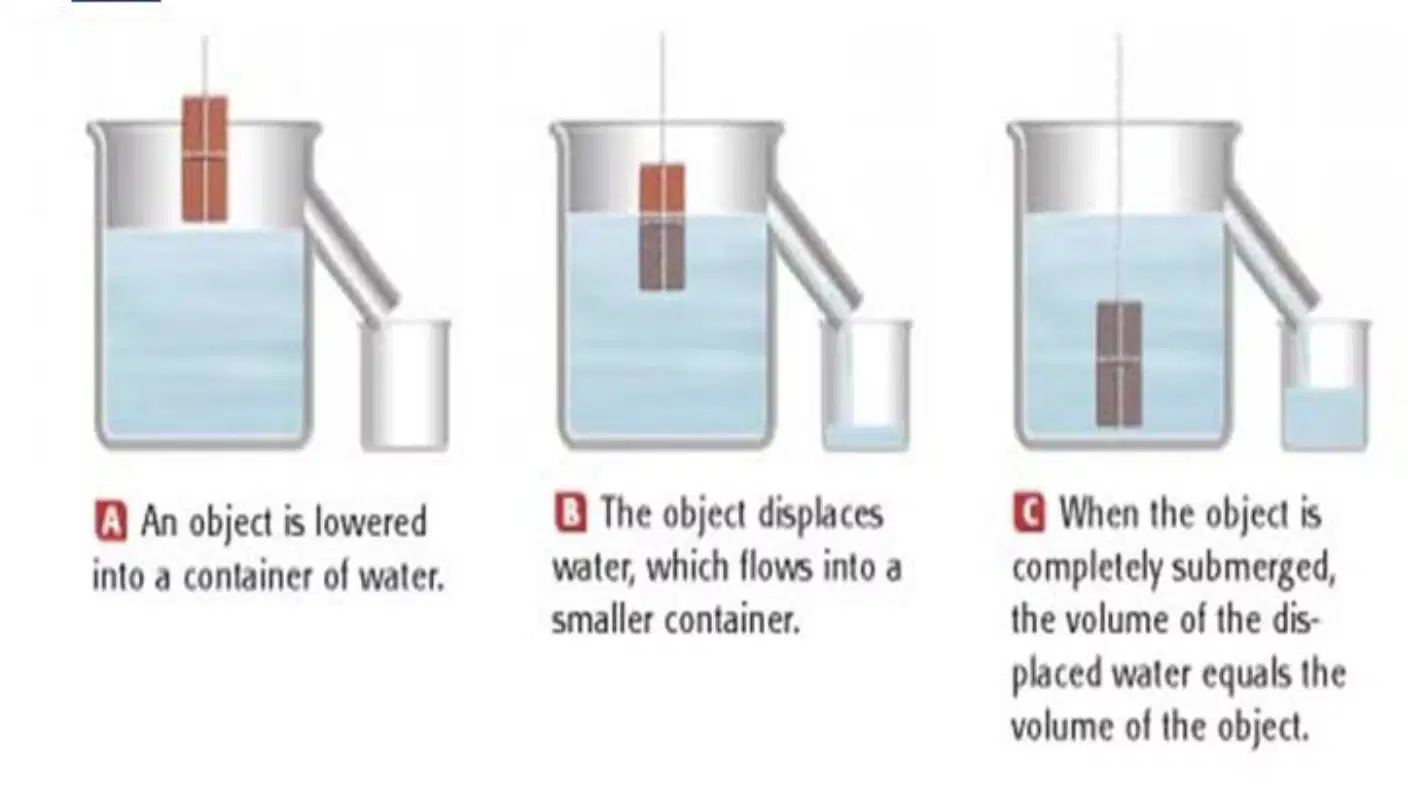
Who's law states that the amount of water displaced by an object is the same mass of the object?
a)
Bernoulli's
b)
Archimedes
c)
Pascal
d)
Charles
45.
What happens to the particles in a liquid when it is heated?
a)
They move slower
b)
They move faster
c)
They stay the same
d)
They become solid
46.
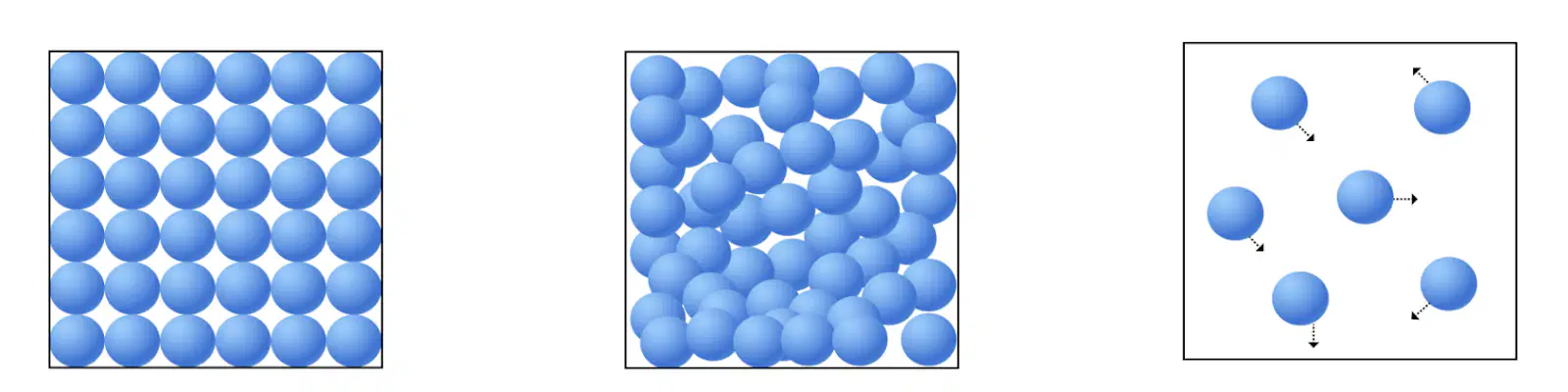
From left to right according to the molecules that make up each substance which state of matter does each picture represent
a)
Gas, liquid, solid
b)
liquid, solid, gas
c)
solid, liquid, gas
d)
solid, gas, liquid
47.

If the substance below is heated which of the other 2 states would it more closely resemble?
a)
Solid
b)
liquid
c)
gas
Reset

