
 Worksheets
ELECTRICITY
Total questions: 15
Worksheet time: 8mins
Two lamps with A and B with power ratings 12W and 6W respectively and connected in a domestic circuit. If the amount of current that passes through lamp A is 0.12A, how much passes through lamp B?
A beam of protons and electrons collide. If the number of protons is double that of the electrons, what is the total net charge after the collision?
A rheostat can be described as a variable resistor. If the device somehow faults and reduces the resistance tremendously, what happens to the fuse that is connected to it.

If the ammeter is connected to a battery of 12V and a resistor made of an insulator. How far is the ammeter from the correct answer?
1A
What is the charge of a neutron?
(a)
A current of 1 A is drawn by a filament of an electric bulb. Number of electrons passing through a cross section of the filament in 16 seconds would be roughly
Electrical resistivity of a given metallic wire depends upon
Temperature of the wire
Dimensions of the material
What is the minimum resistance which can be made using five resistors each of 1/2 Ω?
Two Cuboidal and cylindrical wires are taken simultaneously, if they have the same radius, same length and are made of the same material. Which one will allow more current to flow through it?
Unit of electric power may also be expressed as
Joule-hour
Ohm-Ampere
Watt-hour
Volt-Ampere
Three incandescent bulbs of 100 W each are connected in series in an electric circuit. In another circuit another set of three bulbs of the same wattage are connected in parallel to the same source, which one will glow brighter?
What happens when an ammeter is connected in parallel?
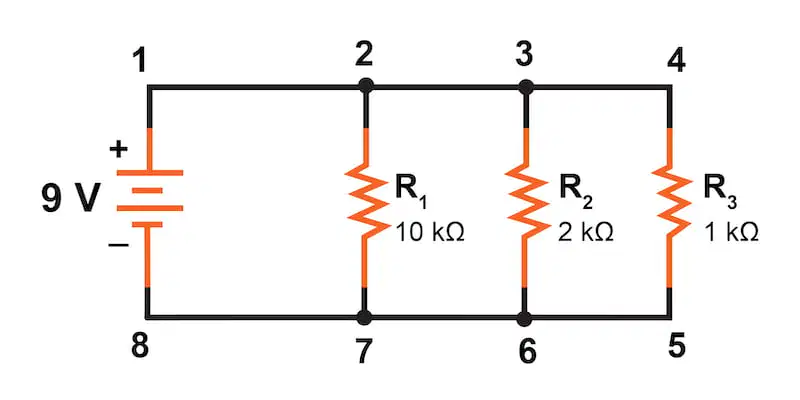
In the following picture, How do you express electric power in R3; given that the volatge is 9V and the current to be taken as whole?
Power = Q/t
Power = I^2*R3
Power = V^2/R3
Power = V3*I
A galvanometer of 100 Ohm resistance is converted to an ammeter of range (0-1)A with a resistance of 0.1 Ohm. The ammeter will show full scale deflection to about?
Assertion (A) : Electrons move from lower potential to higher potential in a conductor. Reason (R) : A dry cell maintains electric potential difference across the ends of a conductor.
Both Assertion (A) and Reason (R) are true and Reason (R) is the correct explanation of the Assertion (A)
Both Assertion (A) and Reason (R) are true but Reason (R) isn't the correct explanation of the Assertion (A)
Assertion (A) is true, but Reason (R) is false.
Assertion (A) is false, but Reason (R) is true.

