wayground logo

Free Printable Worksheets

NEW

Font size

S
M
L
XL
Worksheets

DNA, RNA, Human Genome

Total questions: 30

Worksheet time: 19mins

Name
Class
Date
1.

A section of DNA has these bases: TAG CAG TAC. What mRNA sequence is produced fro this DNA section?

a)

ATC GTC ATG

b)

AUC GUC AUG

c)

AUG CUG AUC

d)

UTC GTC UTG

2.

Which best summarizes the role of DNA in the production of proteins?

a)

DNA moves to the cytoplasm to build proteins.

b)

DNA transports amino acids to the ribosomes to make proteins.

c)

DNA contains the instructions used to make proteins.

d)

DNA breaks hydrogen bonds between amino acids.

3.

A segment of a DNA strand has the following bases: TAC GAT. What is the complementary strand of DNA?

a)

UAG CA

b)

TAG CAT

c)

ATG CTA

d)

AUG CUA

4.
What are the nucleotides made of?
a)
Sugar, Phosphate, nitrogen base
b)
Phosphate, Adenine, nitrogen base
c)
Thymine, Adenine, Cytomine
d)
Phosphate, Nitrogen, Adenine
5.
Which of the following best describes a DNA molecule?
a)
double helix
b)
contains ribose
c)
made of amino acids
d)
contains Uracil
6.
Adenine bonds with ______________.
a)
Guanine
b)
Thymine
c)
Cytosine
d)
Adenine
7.
Guanine bonds with ______________.
a)
Adenine
b)
Guanine
c)
Cytosine
d)
Thymine
8.
Which 2 molecules forms the sides (backbone) of the DNA ladder?
a)
deoxyribose and adenine
b)
deoxyribose and a hydrogen bond
c)
sugar and the nucleus
d)
deoxyribose (sugar) and phosphate
9.
Which shows the correct complementary base pairing for DNA?
a)
C-A, T-G
b)
A-G, C-T
c)
C-G, U-A
d)
T-A, G-C
10.
What does DNA do?
a)
a.  It carries genetic codes from parents to offspring.
b)
a.  It carries oxygen from the lungs to the body.
c)
a.  It tells you who you are.
d)
a.  It defines the organism.
11.
Adenine, Cytosine, Guanine and Thymine are examples of
a)
DNA structure
b)
DNA bases
c)
DNA double helix
d)
Paired bases
12.
How does RNA differ from DNA?
a)
RNA contains uracil and deoxyribose
b)
RNA contains ribose and thymine
c)
RNA contains uracil and ribose
d)
RNA contains adenine and ribose
13.
In a strand of DNA, if it contains 20% of Thymine, then how much Guanine would be present?
a)
30%
b)
20%
c)
80%
d)
10%
14.
Where does transcription take place?
a)
nucleus
b)
cytoplasm
c)
ribosome
15.
what does mRNA do?
a)
carry info from genes to ribosomes
b)
carry amino acids to ribosomes
c)
help with RNA splicing
d)
make up ribosomes
16.
How would the DNA sequence GCTATA be transcribed to mRNA?
a)
GCUAUA
b)
CGATAT
c)
CGAUAU
d)
GCUTUT
17.

What is the correct order to make a protein?

a)

Protein, DNA, RNA

b)

RNA, DNA, Protein

c)

DNA, RNA, Protein

d)

Protein, RNA, DNA

18.

What amino acid does the mRNA codon AGG code for?

a)

Arg

b)

Lys

c)

Ser

d)

Met

19.

Transcription occurs before Translation

a)

True

b)

False

20.

6 mRNA nucleotides equals...

a)

6 codons

b)

2 codons

c)

1 protein

d)

6 amino acids

21.
DNA molecule segment is : TTACGCAAG
The mutated DNA segment is TTCGCAAG. This is an example of ___ mutation.
a)
Substitution
b)
Deletion
c)
Insertion
d)
Inversion
22.
Normal-
GAG-CTC-GAC-AGA
Mutant
GAG CTC-CAC-AGA
a)
no mutation
b)
substitution
c)
insertion
d)
deletion
23.

Trisomy 21, or having 3 copies of chromosomes 21 is known as which type of mutation?

a)

Point

b)

Trinucleotide Repeat Expansion

c)

Nondisjunction

d)

Gene Translocation

24.

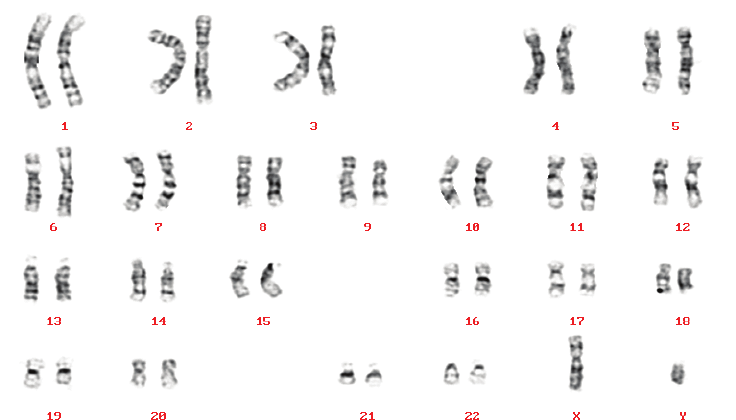
What type of mutation is shown?

a)

Point Mutation

b)

Trisomy

c)

Monosomy

d)

Gene Translocation

25.

By looking at the chromosomes is this individual biologically male or female? How do you know?

a)

Female, because they have two X chromosomes

b)

Male, because they have one X and one Y chromosome
26.

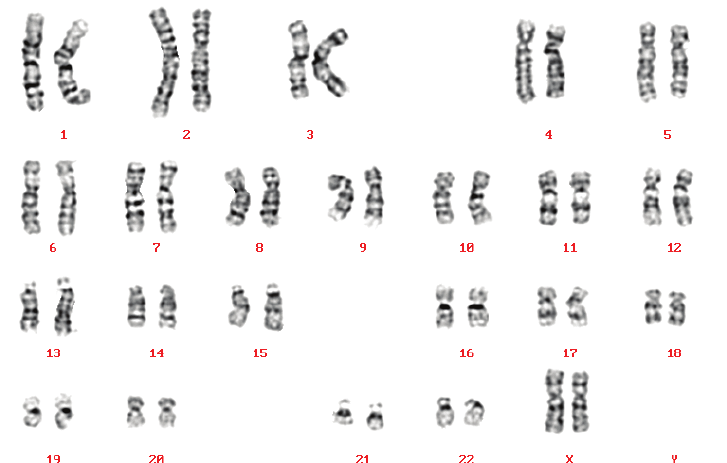
By looking at the chromosomes how can you tell that this person is biologically female?

a)

Because there are two X chromosomes

b)

Because there are more chromosomes than in a male

27.

The process of separating DNA fragments to produce DNA fingerprints is called

a)

cloning

b)

genetic splicing

c)

gel electrophoresis

d)

DNA fingerprinting

28.
molecular scissors that "cut' DNA
a)
plasmid
b)
restriction enzymes
c)
recombinant DNA
d)
gene
29.

This laboratory procedure is known as

a)

CLONING

b)

gel electrophoresis

c)

chromatography

d)

use of a dichotomous key

30.
What do we use pedigrees for?
a)

To determine the phenotype of the offspring

b)

To determination the genotype of the offspring

c)

To trace traits in families

d)

To determine which gene is dominante