
 Worksheets
DNA Structure/Replication Test
Total questions: 20
Worksheet time: 10mins
Name
Class
Date
1.
What does DNA stand for?
a)
Dematerialized Nucleic Acid
b)
Deoxyribonucleic Acid
c)
Deoxyribonitrogen Arsenic
d)
Detailed Instructions of All things
2.
What is the purpose of DNA?
a)
To help the cell make proteins
b)
To regulate the body’s metabolic processes
c)
To store genetic information/instructions
d)
To hold water
3.
What organelle stores DNA?
a)
Vacuole
b)
Endoplasmic Reticulum
c)
Nucleus
d)
Chloroplast
4.
________________ was the first scientist to capture an image of DNA, however, the work was stolen and given to ________________________ who were given credit for the discovery.
a)
Franklin ; Watson & Crick
b)
Watson & Crick ; Franklin
c)
Chargaff ; Watson & Crick
d)
Watson & Crick ; Chargaff
5.

The tightly condensed form of DNA is called a _________________.
a)
Nucleus
b)
X-DNA
c)
Shell
d)
Chromosome
6.
Small molecules (that end in -ase) called __________________ help DNA go through the process of DNA replication.
a)
Vesicles
b)
Enzymes
c)
Ribosomes
d)
Atoms
7.
According to Chargaff’s Rule, in DNA, Adenine always pairs with ____________ and Cytosine always pairs with _____________.
a)
Thymine ; Guanine
b)
Cytosine ; Adenine
c)
Guanine ; Thymine
d)
Adenine ; Cytosine
8.
What structural term best describes the structure of DNA?
a)
Double Helix
b)
Ladder
c)
Rung and Bone
d)
Twisted Chart
9.
What type of sugar is found in the backbone of DNA?
a)
Ribose
b)
Glucose
c)
Sucrose
d)
Deoxyribose
10.
Which enzyme is responsible for adding complementary nucleotides to a DNA strand?
a)
Replicase
b)
Helicase
c)
DNA Polymerase
d)
Topoisomerase
11.
Which best describes the function of a DNA molecule?
a)
regulates cellular metabolism
b)
provides quick energy
c)
stores hereditary information
d)
delivers nutrients to the body
12.
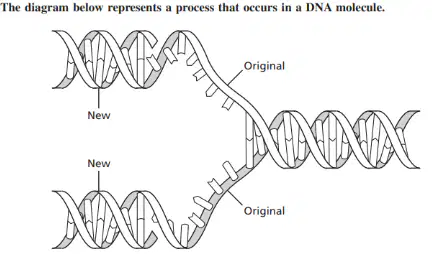
Which best identifies this process?
a)
Replication
b)
Mutation
c)
Transcription
d)
Translation
13.

In the image above, what enzyme is most likely responsible for the splitting of the DNA double helix to allow for the formation of new strands to be synthesized?
a)
Spliticase
b)
Helicase
c)
Polymerase
d)
Topoisomerase
14.
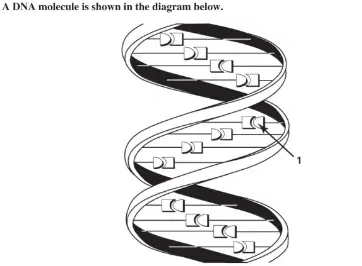
What part of the DNA molecule’s structure is labeled by the number ‘1’?
a)
A nucleotide
b)
An amino acid
c)
A nitrogenous base
d)
A phosphate group
15.
If X represents Adenine, what molecule is its complementary base?
a)
Cytosine
b)
Thymine
c)
Guanine
d)
Uracil
16.
The double strands of a DNA molecule are connected to one another by bonds between:
a)
Complex sugars
b)
Simple fatty acids
c)
Phosphate groups
d)
Nitrogen bases
17.
What must occur in order for genetic material to be passed to cells during cell division?
a)
DNA Replication
b)
RNA Synthesis
c)
Osmosis
d)
Diffusion
18.
Traits are determined by the proteins that are synthesized according to instructions coded in DNA. Which sequence of bio-molecules is responsible for the coded instructions?
a)
Enzymes
b)
Nucleotides
c)
Glycoproteins
d)
Carbohydrates
19.
During DNA Replication, a complementary DNA strand is synthesized from one strand of DNA.
GCG TTA CCT
What is the complementary DNA strand to the DNA strand shown?
a)
TCC ATT GCG
b)
ATA CCG TTG
c)
CGC AAT GGA
d)
CGC AAC GGA
20.
DNA Replication is called ‘semi-conservative’. What is the best reason for why it is given this name?
a)
DNA Replication creates two completely new sets of DNA
b)
DNA Replication creates two sets of DNA, each with four strands of old, parent DNA.
c)
DNA Replication creates one set of DNA with one new strand and one old strand.
d)
DNA Replication creates two identical sets of DNA using two parent strands as templates to synthesize two new, complementary strands.
100 %

