wayground logo

Free Printable Worksheets

Font size

S
M
L
XL
Worksheets

8th grade science Unit 3 and supporting review

Total questions: 189

Worksheet time: 6hrs 59mins

Name
Class
Date
1.

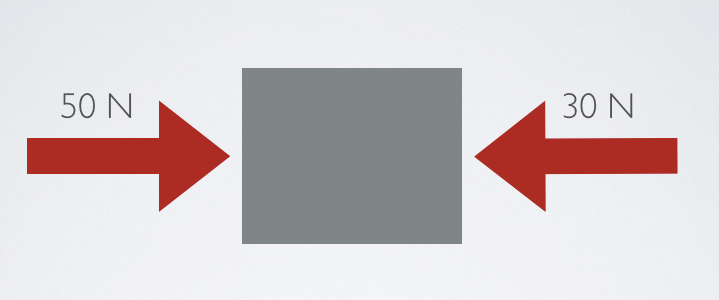
Is this force balanced or unbalanced?

a)

Balanced

b)

Unbalanced

2.

A balanced force causes an object to...

a)

Stay in place

b)

Accelerate in speed

c)

Decelerate in speed

d)

Move in a constant speed

3.

Is this force balanced or unbalanced? (a)  

Which way will it move? (b)  

Choose from the below words

Balanced

Unbalanced

It won't move

Right

Left←
4.

The net force is (a)   which means the object ​ (b)  

Choose from the below words
will move left
will move right

2 N

0 N
won't move
10 N
25 N
5.

Which of the following is an example of a balanced force?

a)

An aeroplane taking off.

b)

Kicking a football.

c)

A car slowing down.

d)

A boy standing still.

6.

Which of the following is an example of an unbalanced force?

a)
b)
c)
d)
7.
Question Image

Match the units

a)

seconds (s)

1.

time

b)

Newtons (N)

2.

force, weight

c)

meters (m)

3.

length

d)

kilogram (Kg)

4.

mass

e)

m/s2

5.

acceleration

8.

How will this object move?

a)

The object will move to the left, as the forces are balanced.

b)

The object will move to the right, as the forces are unbalanced.

c)

The object will move to the left, as the forces are unbalanced.

d)

The object will move to the right, as the forces are balanced.

9.

In the tug of war image, if both teams are pulling with the same amount of force, what will happen?

a)

The green team will win

b)

The blue team will win

c)

Neither team will move

10.
How will this object move? 
a)
It won't move. 
b)
It will move to the right. 
c)
It will move to the left. 
d)
It will move up. 
11.
How will this object move? 
a)
It won't move. 
b)
It will move to the right. 
c)
It will move to the left. 
d)
It will move in both directions. 
12.
How will this object move? 
a)
It won't move. 
b)
It will move to the right. 
c)
It will move to the left. 
d)
It will move up. 
13.

______________ do not cause an object to move.

a)

Balanced forces

b)

Unbalanced forces

14.

______________ forces cause an object to move.

a)

Balanced

b)

Unbalanced

15.

If force is applied to an object on two sides, and that force is NOT the same, then the object will move in the direction of the greater force. Which type of force is responsible for this?

a)

Balanced Force

b)

Unbalanced Force

16.

A lot of people think that balanced means not moving and unbalanced means moving. THIS IS NOT TRUE!!! When talking about the forces acting on an object, an object can have balanced forces acting on it and be in motion. When thinking about balanced and unbalanced forces, you should think about whether the motion of the object is changing.

If the forces acting on an object are balanced, it will remain at rest or moving at a constant speed. Constant speed means the object is moving, but not speeding up or slowing down. If the forces acting on an object are unbalanced, it will speed up, slow down or change direction.

a)

I don't get it.

b)

GOT IT!

17.

Are the forces acting on the object balanced or unbalanced? Mario is running fast but STEADY. His speed is 10 mi/hr.

a)

balanced

b)

unbalanced

18.

Are the forces acting on the objects balanced or unbalanced? The hamster is maintaining his position on the wheel.

a)

balanced

b)

unbalanced

19.

What is the sum of all forces acting on an object?

a)

Unbalanced force

b)

Net force

c)

Friction

d)

Balanced force

20.

What unit do scientist use to measure force?

a)

Grams

b)

Newtons

c)

Meters

d)

Liters

21.

You and your friend are moving a couch from one side to another. You push with a force of 20 N to the right and your friend pushes with a force of 25 N to the right.

a)

5 N to the right

b)

45 N to the left

c)

45 N to the right

22.

What is the net force?

a)

10 N to the right

b)

10 N to the left

c)

130 N to the left

d)

130 N to the right

23.

What is the net force?

a)

10 N to the left

b)

10 N to the right

c)

50 N to the right

d)

60 N to the left

24.

A change in motion is caused by

a)

Balanced forces

b)

Unbalanced forces

25.

Is this a balanced or unbalanced force?

a)

Balanced

b)

Unbalanced

26.

What is the net force?

a)

0 N

b)

10 N to the left

c)

20 N to the right

d)

20 N to the left

27.

Omar and Katey reach for the same toy car at the same time. Omar pulls the toy away from Katey with a force of 10 N. Katey is pulling back with a force of 6 N. What is the net force?

a)

4 N

b)

6 N

c)

10 N

d)

16 N

28.

What is a PUSH or a PULL of an object?

a)

Motion

b)

Friction

c)

Force

d)

Gravity

29.
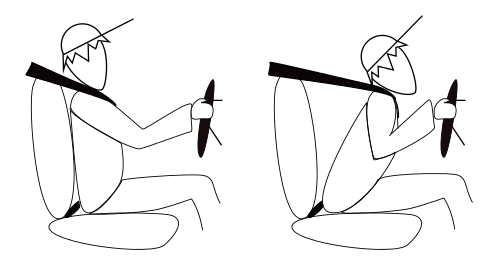
Which is the best example of Newton's First Law of Motion?
a)
a basketball thrown in the air falls to the ground
b)
a soccer ball remains motionless until it is kicked by a player
c)
a baseball player swings at an approaching ball
d)
an ice skater pushes back from a wall and moves backwards
30.
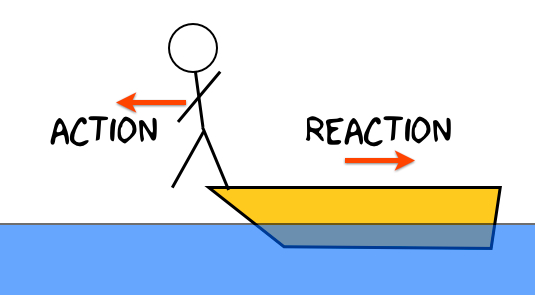
What law of motion does this picture represent?
a)
Newtons 1st law
b)
Newtons 4th law 
c)
Newtons 3rd law 
d)
Newtons 2nd law
31.
Which example best explains Newton's Third Law of Motion?
a)
When a glass slid across a table, it spilled water when it stopped suddenly.
b)
An engine used less work to move a lighter car than when it moved a heavier car.
c)
When you sit on a chair, your body exerts a downward force on the surface of the chair, while the chair exerts an equal and upward force on your body. 
32.

If an object has a small mass, it wouldn't need as strong of a force to accelerate it. Which law does this describe?

a)

Newton's 1st Law

b)

Newton's 2nd Law

c)

Newton's 3rd Law

d)

Newton's 4th Law

33.

What happens when two objects, such as a baseball and a bat, collide?

a)

They hit each other with the same force in the same direction.

b)

They hit each other with the same force in opposite directions.

c)

One remains still while the other one moves in the same direction.

d)

They hit each other with unequal force in opposite directions.
34.
What is the standard unit force is measured in?
a)
Newtons
b)
pounds
c)
grams
d)
meters
35.
Forces always act in equal and opposite pairs.
a)
Newton's 1st Law
b)
Newton's 3rd Law
c)
Newton's second law
36.

Which of Newton's laws does this picture represent

a)

Newtons 2nd law

b)

Law of gravity

c)

Newtons 1st law

d)

Newtons 5th law

37.

The resistance when a surface of an object moves over another surface is known as what?

a)

gravity

b)

force

c)

friction

d)

acceleration

38.

What causes a ball rolling across a rug to slow to a stop?

a)

The rug doesn't have enough force to hold the ball.

b)

Friction resists the ball's forward motion.

c)

The rug doesn't have enough momentum to keep the ball moving.

d)

The ball isn't moving fast enough.

39.

Who developed the 3 laws of motion?

a)

Bill Nye

b)

Charles Darwin

c)

Albert Einstein

d)

Sir Isaac Newton

40.
What is Newtons 1st law of motion?
a)
Force= Mass multiplied by acceleration 
b)
An object at rest stays at rest unless acted on an unbalanced force. (inertia)
c)
For every action there is a equal and opposite  re-action.
d)
law of gravity 
41.

What law of motion does this picture represent?

a)

Newton's 3rd law

b)

Newton's 4th law

c)

Newton's 1st law

d)

Newton's 2nd law

42.

What is Newton's 2nd law of motion?

a)

Inertia

b)

Force= Mass multiplied by acceleration

c)

For every action there is a equal and opposite re-action.

d)

Law of gravity

43.

Newton's 2nd Law says the acceleration of an object depends on its _______ and ______. (Choose two answers)

a)

force or applied force

b)

weight

c)

gravity

d)

mass

44.

Net force is a combination of all ________ acting on an object.

a)

forces

b)

speeds

c)

accelerations

d)

velocities

45.

What is Newton's 3rd Law?

a)

For every action there is an equal and opposite reaction.

b)

Acceleration depends on two variables, the mass of the object and the amount of force.

46.

The reason a boat bounces off the dock when it hits it.

a)

The boat and the dock repel each other.

b)

When the boat exerts a force on the dock, the dock exerts a force on the boat.

47.
 What is the unit called that measures force?
a)
Isaac
b)
Yee
c)
Newton
d)
kilogram
48.
When a cannon fires a cannonball we observe Newton's third law. Which force is the reaction force?
a)
The cannon moving forward
b)
The cannonball moving forward
c)
The cannon moving backward
d)
The cannonball moving backward
49.
Why is the net force 0 in the image?
a)
Because the elephants are the same size
b)
Because they are both pulling the same amount of force in opposite directions
c)
Because they are elephants
d)
Because they are pulling away from each other.
50.

A sports car speeds up much faster than a dump truck when a traffic light turns from red to green. Which law is this?

a)

Law 1

b)

Law 2

c)

Law 3

51.

A rocket pushes burning gases DOWN which causes the rocket to launch UP. Which law is this?

a)

Law 1

b)

Law 2

c)

Law 3

52.

When a truck stops suddenly, "the untied down" packages on its truck bed continue to move forward. Which law is this?

a)

Law 1

b)

Law 2

c)

Law 3

53.

1 Newton = 1 kg x 1 m/ s2

a)

true

b)

false

54.
The momentum of an object depends upon the object's ___________&_____________.  
a)
size and shape
b)
mass and speed
c)
mass and veloctiy
d)
mass and energy
55.
Determine the momentum of 1000-kg car moving northward at 20 m/s......... 
a)
20000 N
b)
20000 Joules
c)
20000 Kg * m/s
d)
20000 kg * m/s north
56.
The definition of momentum is
a)
Mass in Motion
b)
The size of an object
c)
The velocity of an object
d)
A comparison between two objects
57.
The equation to calculate momentum is
a)
p=mv
b)
p=1/2mv2
c)
p=mgh
d)
p=mg
58.
If a 10 kilogram object accelerates suddenly at 15 m/s^2, how much force was applied to the object?
a)
150 Newtons
b)
15 Newtons
c)
150 kilograms
d)
100 kilograms
59.
If a force of 50 Newton's was applied to an object with a mass of 500 grams, what will the object's acceleration be?
a)
10 m/s^2
b)
.1 m/s^2
c)
100 m/s^2
d)
1 m/s^2
60.
45 m/s2 is the... 
a)
Mass
b)
Force 
c)
Acceleration
d)
weight
61.
If a force of 26 N is exerted on two balls, one with a mass of 0.52 kg and the other with a mass of 0.78 kg, which ball will have the greater acceleration?  (F=ma)
a)
The one with a mass of .78 kg will have the greatest acceleration.
b)
The one with a mass of .52 kg will have the greatest acceleration.
c)
They will both accelerate at the same rate.
62.
A 20 kg bike accelerates at 10 m/s2.  what was the force?
a)
25 Newtons
b)
20 Newtons
c)
200 Newtons
d)
10 Newtons
63.
Unit of mass
a)
m/s 2
b)
m/s
c)
newtons
d)
kg
64.
The mass of a car is 1000 kg.  How much force would be required to accelerate the car at a rate of 3 m/s2? 
a)
1000 ÷ 3
b)
3 ÷ 1000
c)
1000 x 3
65.
A force of 250 N is applied to an object that accelerates at a rate of 5 m/s2.  What is the mass of the object? To solve this problem you must do - 
a)
250 ÷ 5
b)
5 ÷ 250
c)
250 x 5
66.
A 5 kg block is pulled across a table by a net force of 32 N. Calculate the acceleration of the object. To solve this problem you must do - 
a)
32 ÷ 5
b)
5 ÷ 32
c)
32 x 5
67.
A skier needs to apply a force of 132 N to accelerate at a rate of 2 m/s2. What is the mass of the skier? To solve this problem you must do - 
a)
132 ÷ 2
b)
2 ÷ 132
c)
132 x 2
68.
A skier needs to apply a force of 132 N to accelerate at a rate of 2 m/s2. What is the mass of the skier? The answer to this question is most likely (HINT: Look at the units!!!) - 
a)
66 N
b)
66 m/s2
c)
66 kg
69.
The masses of four objects are given in this table. If all objects are struck with the same amount of force, which one will have the greatest acceleration?
a)
Object 1
b)
Object 2
c)
Object 3
d)
Object 4
70.
Examine the table provided. Which of the objects is producing the greatest force?
a)
Soccer Ball
b)
Tennis Ball
c)
Marble
d)
Ping-Pong Ball
71.
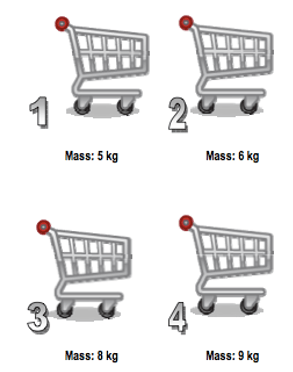
A force of 90N is applied to each cart below, which one will accelerate the fastest?
a)
Cart 1
b)
Cart 2
c)
Cart 3 
d)
Cart 4
72.
What is the SI unit used to measure force? 
a)
pounds 
b)
grams 
c)
newtons 
d)
kg/ m2
73.
Unbalanced forces make an object:
a)
Come to rest
b)
move at constant velocity
c)
accelerate
d)
explode
74.
A basketball with a mass of 0.60 kg is accelerated with a force of 10.8 N. If resisting forces are ignored, what is the acceleration of the basketball to the nearest m/s2?
a)
16 m/s2
b)
17 m/s2
c)
18 m/s2
d)
19 m/s2
75.
All of the following are examples of speed except:
a)
A car traveling at 55 km/hr
b)
A snail hightailing it 45 mm/sec
c)
Jube timing himself at 23 seconds
d)
Lonnie running down the hall at 45 mph
76.
All of the following are units of speed except:
a)
Seconds
b)
m/s
c)
Km/s
d)
m/min
77.
Calculate the speed:
A Car traveled 240 Km in 5 Hours
a)
48 Km/Hr
b)
1200 Km/Hr
c)
4.8 Km/Hr
d)
0.02 Km/Hr
78.
Calculate the speed:
A Motorcycle traveled 368 Km in 8 Hours
a)
2944 Km/hr
b)
4.5 Km/hr
c)
46 Km/hr
d)
0.02 Km/hr
79.
Calculate the speed:
A truck traveled 208 Km in 4 Hours
a)
52 Km/hr
b)
25 Km/hr
c)
0.019 Km/hr
d)
832 Km/hr
80.
Calculate the speed:
A bus traveled 98 Km in 2 Hours
a)
94 Km/hr
b)
49 Km/hr
c)
196 Km/hr
d)
0.02 Km/hr
81.

A boy jogs 250 meters in 110 seconds. What is his average speed in m/s?

a)

227 m/s

b)

22.7 m/s

c)

2.27 m/s

82.

You arrive in my class 45 seconds after leaving math, which is 90 meters away, How fast did you travel?

a)

3 m/s

b)

2 m/s

c)

4 m/s

83.

It takes a freight train 2.3 seconds to move 26 meters. Calculate its average speed.

a)

11.3 m/s

b)

1.13 m/s

c)

22 m/s

84.

Calculate the average speed of a car that travels 60 km in 2 hours.

a)

12 km/h

b)

30 km/h

c)

25 km/h

d)

35 km/h

85.

If Steve throws the football 50 meters in 3 seconds, what is the average speed of the football?

a)

16.7 m/s

b)

15.5 m/s

c)

25.3 m/s

d)

22 m/s

86.
Marlon decided to visit Dallas, which is 210 miles away from Houston. His trip took him 3 hours to complete. Calculate his average speed. 
a)
60 mph
b)
64 mph
c)
70 mph
d)
3 mph
87.
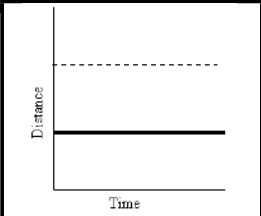
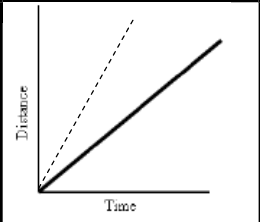
What does this graph represent?
a)
Constant speed
b)
Acceleration
c)
Not moving
88.
What does this graph represent?
a)
Constant Speed
b)
Acceleration
c)
Not moving
89.
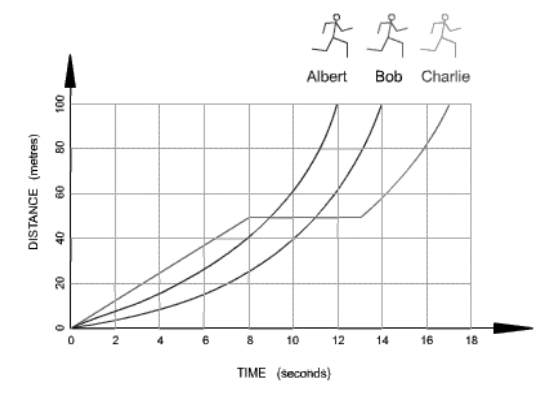
Which runner stopped for a rest?
a)
Albert
b)
Bob
c)
Charlie
90.
Which runner stopped for a rest?
a)
Albert
b)
Bob
c)
Charlie
91.

How far did each runner travel?

a)

A)100 seconds

b)

B)100 meters

c)

C)18 meters

d)

D)18 seconds

92.
Which runner had a head start?
a)
A
b)
B
c)
C
93.
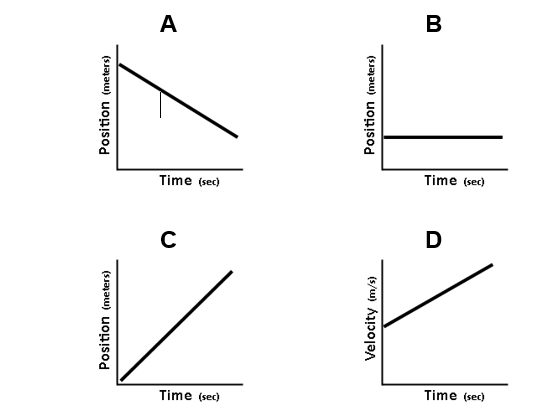
Which graph shows the object standing still?
a)
A
b)
B
c)
C
d)
D
94.

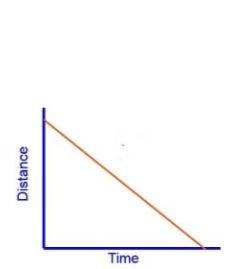
What is this line of this graph showing?

a)

moving away from starting point at a constant speed

b)

moving back towards the starting point at a constant speed

c)

acceleration (getting faster)

d)

deceleration (getting slower)

95.
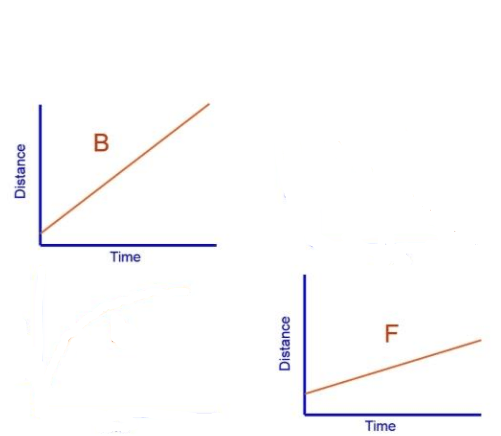
Which graph is showing a faster constant speed?
a)
B
b)
F
c)
They show the same speed
96.

What is the formula for speed?

a)

speed = distance x time

b)

speed=distance / time

c)

speed = time / distance

d)

speed = distance + time

97.

A car drove 500 miles over 5 hours. What was the average speed?

a)

50 miles per hour

b)

25 miles per hour

c)

100 miles per hour

d)

75 miles per hour

98.

Describe the motion in the graph:

a)

Constant Speed (positive slope)

b)

Stopped (at rest)

c)

Acceleration (increasing speed)

d)

Return Home (negative slope)

99.

Describe the motion in the graph:

a)

Constant Speed (positive slope)

b)

Stopped (at rest)

c)

Acceleration (increasing speed)

d)

Return Home (negative slope)

100.

A cart carrying a brick is pulled up an inclined plane. At what point does the cart have the greatest amount of potential energy?

a)

A

b)

B

c)

C

101.

Roller coasters use potential and kinetic energy to move carts around the track. Which selection below organizes the points of potential energy from GREATEST to LEAST?

a)

C, D, H, K, N

b)

B, D, H, J, L

c)

A, D, H, K, M

d)

A, E, G, I, M

102.

A rock falls over a waterfall as shown in the diagram. At which point does the rock have the most potential energy?

a)

2

b)

3

c)

4

103.

In the classroom demonstration shown below, a rubber ball is dropped from Position 1. The ball bounces as shown. At which of these positions does the ball have both the greatest kinetic energy and the least PE?

a)

1

b)

2

c)

3

d)

4

104.

According to the above diagram, at what point would the roller coaster car have the greatest kinetic energy?

a)

3

b)

4

c)

5

d)

6

105.

The drawing shows two identical airplanes at an air show. The airplanes are flying at the same speed. Airplane W is flying 50 m higher than Airplane X. Which statement best describes the energy of the two airplanes?

a)

Airplane W has a greater kinetic energy than Airplane X.

b)

The two airplanes have the same gravitational potential energy but different kinetic energies.

c)

Airplane X has more gravitational potential energy than Airplane W.

d)

The two airplanes have the same kinetic energy but different gravitational potential energies.

106.

A bicycle rider is traveling up a hill. When the rider reaches the top of the hill, she stops to rest. Then she travels down the hill. The diagram shows the rider in the three different positions.Which of these correctly

a)

When the rider is at the top of the hill, her potential energy is the greatest, and her kinetic energy is the least.

b)

As the rider moves up the hill, her kinetic energy increases, and her potential energy decreases.

c)

When the rider goes down the hill, her potential energy increases, and her kinetic energy decreases.

d)

As the rider reaches the bottom of the hill, her kinetic energy and her potential energy decrease.

107.

Potential energy depends on the ________ and ________ of the object.

a)

Speed and Direction

b)

Height and Mass

c)

State of Matter and Properties

108.

When a pendulum swings, at which point is potential energy at its greatest?

a)

5

b)

4

c)

3

d)

2

e)

1

109.

When the pendulum swings, at which point is potential and kinetic energy are 50%?

a)

1

b)

2

c)

3

110.

When the pendulum swings, at which point is maximum kinetic energy?

a)

1

b)

2

c)

3

111.

How many different elements are present in H2C2H3O2?

a)

1

b)

2

c)

3

d)

4

112.

Which of these elements is not present in NaNO3?

a)

sodium

b)

hydrogen

c)

oxygen

d)

nitrogen

113.

How many magnesium atoms are found in MgCl2?

a)

1

b)

2

c)

3

d)

4

114.

How many aluminum atoms are found in Al2O3?

a)

1

b)

2

c)

3

d)

4

115.

How many sulfur atoms are present in Al2(SO4)3

a)

1

b)

2

c)

3

d)

4

116.

A subscript will tell you the number of atoms of the element ___ it

a)

after

b)

before

117.

A subscript behind a set of parentheses belongs to

a)

the element right before it

b)

all the elements within the parentheses before it

c)

all the elements in the parenthese after it

d)

the element right after it

118.

If there is no subscript, how many atoms of that element are there?

a)

1

b)

2

c)

3

d)

0

119.

How many atoms of carbon are in this compound?

H2C3O4N5

a)

2

b)

3

c)

4

d)

5

120.

How many oxygen atoms are found here?

Mg(NO3)2

a)

2

b)

4

c)

6

d)

8

121.
A chemical reaction is balanced when
a)

both sides have the same elements

b)

Both sides have the same  number of atoms

c)

Same subscripts

d)

Same coefficients

122.
Which of these is not a chemical reaction?
a)
Burning of wood
b)
Milk going bad
c)
Mixing vinegar and baking soda
d)
Melting of ice
123.
A precipitate is a 
a)
liquid that forms when two solids are reacted
b)
a solid that forms when two liquids are mixed
c)
a gas that forms when vinegar and baking soda react
d)
a change of color in a solution
124.
If reaction starts with 20g of reactants it should produce 
a)
a total of 40g of products
b)
a total of 10g of products
c)
a total of 80 g of products
d)
a total of 20g of products
125.
What is the Law of Conservation of mass?
a)
Mass is created in a chemical reaction
b)
Mass is created in a physical change
c)
New chemicals formed from a chemical reaction have a larger overall mass than the original reactants
d)
Mass is never created or destroyed
126.

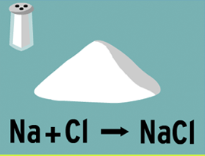
When sodium and chlorine combine to form sodium chloride, sodium chloride is the:

a)

Originator

b)

Reactant

c)

Product

d)

Produce

127.
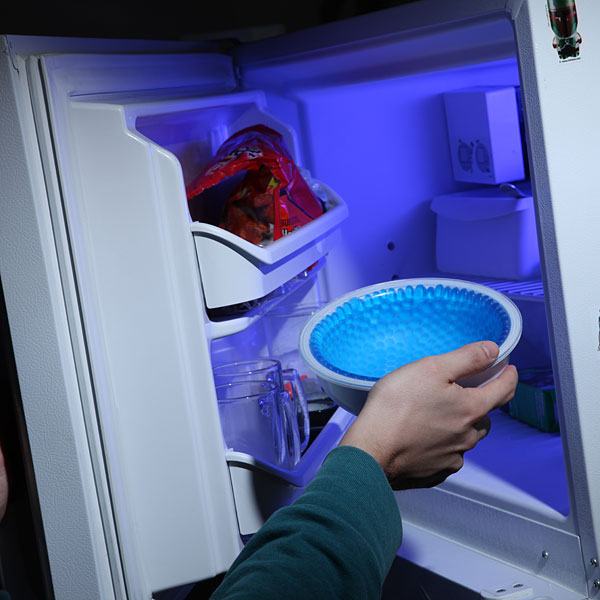
Maria fills a bowl with 200 g of water. She puts the bowl of water in the freezer, and the water freezes. Which will most likely be the mass of the frozen water?
a)
50 g
b)
100 g
c)
200 g
d)
400 g
128.

Does the equation H2+O2 →H2O follow the Law of Conservation of Mass?

a)

Yes, because the atoms are equal.

b)

No, because more info is needed.

c)

No, because there are more atoms in the product.

d)

No, because there are more atoms in the reactant.

129.

According to the Law of Conservation of Mass, what happens to the wood and oxygen when it is burned?

a)

The wood disappears.

b)

It stays the same chemically.

c)

The atoms in the wood and oxygen rearrange and form smoke and ash.

d)

Nothing.

130.

How many grams of OXYGEN would be needed to show conservation of mass in the example below?

a)

100 g

b)

93 g

c)

7 g

d)

0 g

131.

How many grams of coal were present at the start of the chemical change?

a)

Unknown

b)

100 g

c)

200 g

d)

50 g

132.

How many grams of CHOCOLATE POWDER are shown in the example of conservation of mass below?

a)

450 g

b)

465 g

c)

0 g

d)

15 g

133.

How many kilograms of SMOKE are shown in the example of conservation of mass?

a)

1 kg

b)

30 kg

c)

28 kg

d)

3 kg

134.
In a reaction A + B ----> C,  reactant A has 5g and product  C has 9g. How many grams does reactant B should have? 
a)
4g
b)
5g
c)
9g
d)
14g
135.

Which Chemical Equation is Balanced?

a)

CH₄+O₂------CO₂+2H₂O

b)

H₂+O₂-----2H₂O₄

c)

4Al+3O₂-----2Al₂O₃

136.
Bob puts 200 grams of ice into a pitcher with 900 grams of water. He gets distracted and comes back later to find that the ice has melted in the water. How many grams of water does Bob now have in the pitcher?
a)
200 g
b)
700 g
c)
1,100 g
137.
24 g of magnesium reacts with 38 g of fluorine to produce _____ g magnesium fluoride
a)
62 
b)
38
c)
24
d)
14
138.

Which Chemical Equation is Balanced?

a)

4O2 + 2H2 + S2------ 2H2SO4

b)

4H2+O2-----2H2O2

c)

3Cr+4O₂-----2Cr₂O₃

139.

How many Hydrogen atoms are present in the product of the following equation: 2SO2 + 2H2O2 ----> 2H2SO4

a)

2

b)

3

c)

4

d)

8

140.

How many Oxygen atoms are present in the product of the following equation: 2SO2 + 2H2O2 ----> 2H2SO4

a)

2

b)

3

c)

4

d)

8

141.
Photosynthesis is an example of a
a)
physical change
b)
chemical change
142.
Dissolving sugar in water is an example of a 
a)
physical change
b)
chemical change
143.
Cutting a log in to small pieces is a chemical change.
a)
true
b)
false
144.
Which is a physical change?
a)
melting ice
b)
burning wood
c)
rotting food
d)
rusting iron
145.
Which is a chemical change?
a)
freezing fruit juice
b)
slicing a potato
c)
boiling water
d)
copper metal turning green
146.
Which word does NOT describe a chemical change?
a)
Precipitate
b)
Bubbles, production of gas
c)
Color change
d)
Evaporate
147.
Which of the following describes a precipitant?
a)
a liquid forms when a block of metal is heated
b)
a solid forms when one liquid is poured into another
c)
a gas forms when a solid is placed in a liquid
d)
bubbles form when an acid is poured on a rock
148.
Dissolve
Is this a chemical or physical change?
a)
Physical change
b)
Chemical change
149.
Which word does NOT describe a physical change?
a)
Color change
b)
Evaporate
c)
Grind, chew, masticate
d)
Break
150.
A clear liquid is poured into an Erlenmeyer flask that contains a second clear liquid.  As the two chemicals meet a solid is formed, that is yellow in color?  What are the signs that help you to identify the type of change? 
a)
Precipitate and change in color, Physical Change.
b)
Color change, Physical Change
c)
There are two liquids, Chemical change.
d)
and made a new substance (percipitant and change in color, Chemical Change. 
151.
Color Change
Gas bubble
Light
Temperature change
Odor or Oxidation
Percipitant
Which sign of chemical change is missing from the listing?
a)
Shatter
b)
Evaporation
c)
Sublime
d)
Make a new substance
152.
Which word below is a chemical change?
a)
Swallow
b)
Chew/masticate
c)
Digestion
d)
Tear
153.
Which word below is NOT a physical change?
a)
Swallow
b)
Chew/masticate
c)
Digestion
d)
Tear
154.
A mad scientist was experimenting in his lab.  He bad mixing chemicals together and a new substance was formed?
What type of change occurred? 
a)
Physical Change
b)
Chemical Change
155.
Two guys were trying out one of Science Bob's at home experiments.  The instructions said to dissolve a substance in water.  What type of change occurred?
a)
Chemical change, because they mixed two substances.
b)
Physical change, because the substance dissolved.
c)
Chemical change, because the substance dissolved.
d)
Physical change, because they made a new substance. 
156.
Which best describes what a food chain shows you?
a)
Energy flow through an ecosystem
b)
Food flowing through an ecosystem
c)
Consumers going into other consumers
d)
Who eats who
157.
What are the organisms that break down dead stuff?
a)
Producers
b)
Consumers
c)
Decomposers
d)
Organisms
158.
Where does the energy start in this food chain?
a)
Plant
b)
Sun
c)
Deer
d)
Wolf
159.
What is the role of a producer?
a)
Use sunlight to make food
b)
Gain energy from eating other organisms
c)
Keep other species from overpopulating
d)
Breaking down dead stuff 
160.
What's the role of consumers in a food chain?
a)
Use sunlight to make food 
b)
Eat other species and keep them from overpopulating
c)
Break down dead stuff
d)
Add nutrients to the soil
161.
Which of these organisms would receive energy from the snake?
a)
Plant
b)
Rabbit
c)
Mouse
d)
Hawk
162.
In the energy pyramid here, how much of the energy in each level gets lost as heat or used by the organism for survival?
a)
80%
b)
90%
c)
10%
d)
20%
163.
The diagram represents a pyramid of energy in an ecosystem.  Which level would most likely contain members of the plant kingdom?
a)
A
b)
B
c)
C
d)
D
164.
What trophic level has the most energy?
a)
Autotrophs
b)
Heterotrophs
c)
Omnivores
d)
Consumers
165.
In the energy pyramid below, which organism has the least amount of energy available?
a)
Producers
b)
Herbivores
c)
Carnivores
d)
Top Predator
166.

Organisms that is able to convert the energy from the sun into chemical energy (glucose).

a)

Heterotroph

b)

Autotroph

c)

Carnivore

d)

Omnivore

167.

Organisms that eat other organisms to gain energy.

a)

Autotroph

b)

Heterotroph

c)

Producer

168.

What is ecological succession?

a)

A series of predictable changes that occur in a community over time.

b)

It is the number of fish increasing.

c)

It is the seasons of the year.

d)

It is that rain follows cloud formation.

169.

Primary succession begins where there was no ecosystem and no soil such as

a)

a severe storm

b)

a volcanic eruption

c)

an old farm is abandoned

d)

a forest fire

170.
What is a pioneer organism? It is the ______ organism in _________ succession. 
a)
is the first , in primary succession
b)
is the last in secondary succession, 
171.

Secondary succession (thnk soil) forms after a catastrophic event like a forest fire and has a ___________ growth rate than primary succession because soil already exists.

a)

extremely slower

b)

slower

c)

faster

172.

So, how does an ecosystem start if there is no soil?

a)

Moss and lichen break down rock and lava and produce soil.

b)

Moss and lichen are air borne and they move by the wind to start in a secondary succession environment.

c)

Moss and lichen are simple living organism that can start growing almost anywhere.

d)

All answers

173.

What is a pioneer species?

a)

Pioneer means first- so it must be the first thing to grow where nothing has grown before.

b)

Pioneer means last -it's the last thing in an ecosystem

c)

Pioneer has to do with covered wagons and traveling west during the 1800s.

174.
the first organisms that appear in an ecological community
a)
ecological succession 
b)
primary succession 
c)
secondary succession
d)
pioneer speciles
175.
a stable ecological community that has reached equilibrium
a)
ecological succession 
b)
climax community
c)
secondary succession
d)
pioneer speciles
176.
reaches a climax community quicker because soil is already present
a)
primary succession 
b)
secondary succession
c)
both types of succession
177.
The picture shows what type of succession?
a)
primary
b)
secondary
c)
tertiary
d)
quadanary
178.
What type of succession is shown going from figure A to figure B?
a)
primary succession
b)
eutrophication
c)
secondary succession
d)
intermediate
179.

After a volcanic eruption, lava covers the land. What is the order that plants grow to repopulate the area?

a)

Lichens → Shrubs → Grasses → Trees

b)

Lichens → tree → shrubs→Grasses

c)

Grasses → Lichens → Shrubs → Trees

d)

Lichens → Grasses → Shrubs → Trees

180.
9. Which of the following would not result in secondary succession?
a)
A. Forest fire
b)
B. Flood
c)
C. Logging
d)
D. Volcanic eruption in the ocean
181.
10. Which of the following is an example of a pioneer species in primary succession?
a)
A. Lichens
b)
B. Grass
c)
C. Insects
d)
D. Shrubs
182.
11. Which of the following is an example of a pioneer species in secondary succession?
a)
A. Lichens
b)
B. Grass
c)
C. Insects
d)
D. Shrubs
183.
12. Primary succession begins in an area that -
a)
A. does not have soil
b)
B. already has soil
c)
C. already has grass
d)
D. already has trees
184.
14. Which of the following is the final stage in ecological succession?
a)
A. Pioneer community
b)
B. Climax community
c)
C. Final community
d)
D. None of the above
185.

After a volcanic eruption, volcanic rock is present (but no soil). Label the following illustrations with the correct order of succession.

186.

Label the Primary Succession

187.
This is the process that forms a new ecosystem where no organisms lived before.
a)
resource
b)
invasive (non- native) species
c)
primary succession
d)
competition
188.

The progression of life in an area that starts with bare rock or sand but no soil. Example: a volcanic island.

a)

Climax Community

b)

Pioneer Species

c)

Secondary Succession

d)

Primary Succession

189.

After a volcanic eruption the lava cools and becomes rock. Which succession must take place in order for vegetation (plants) to return?

a)

Primary Succession

b)

Secondary Succession