
 Worksheets
Unit 4 Study Guide
Total questions: 20
Worksheet time: 10mins
The remains or trace of an organism that lived long ago.
trace fossil
fossil
body fossil
plates
A fossil that formed when an organism pressed into mud, leaving behind a shape that hardened in rock.
trace fossil
fossil
body fossil
mold
The movement of weathered materials by water, wind, or ice.
erosion
deposition
weathering
volcanoes
The process in which weathered materials eroded by water, wind, or ice are dropped in a new place.
erosion
deposition
weathering
volcanoes
The breaking down and wearing away of rock.
erosion
deposition
weathering
volcanoes
Something an organism does or how it acts.
organism
habitat
migration
behavior
A behavior that an animal inherits from its parents.
organism
instinct/instinctual behavior
learned behavior
behavior
A behavior that an animal develops by observing other animals or by being taught.
organism
instinct/instinctual behavior
learned behavior
behavior
A structure or behavior that helps an organism survive in its surroundings.
survival
hibernate
habitat
adaptation
The act of living or continuing longer than another person or thing.
survival
hibernate
habitat
adaptation
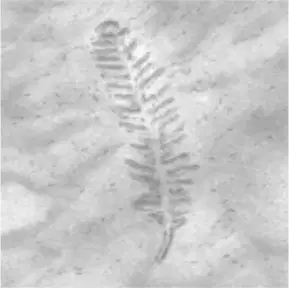
This fossil was found beneath layers of rock. What does this fossil have in common with a living leaf?
It has the same shape.
It has tissues made of plant cells.
It stores energy for growth and repair.
It was dug out of the surface of the earth.
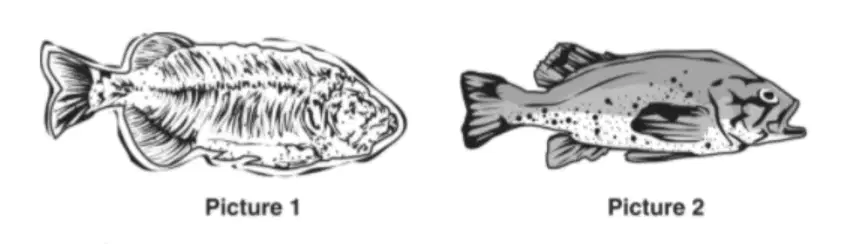
In which habitat would both of these animals be able to survive?
grassland
ocean
desert
forest
Based on these fossils, how had the area changed?
It used to be warmer.
It used to be colder.
It used to be in an ocean.
It used to be in a desert.
Scientists study fossils to learn about extinct plants and animals. Which of these is the best example of a fossil?
a footprint in a rock
a seashell under water
a leaf in a mudpuddle
a bone on top of a sand pile
The fossils of extinct sea animals called trilobites are found in Ohio. The means that Ohio was once covered by
grass
water
forests
mountains
What advantage do some plants have over animals in a drought?
Plants can use underground water.
Plants can live without water.
Plants release oxygen.
Plants cannot move.
The long neck of a giraffe is an adaptation mostly for
feeding in high treetops.
chewing on thorny vines.
keeping track of enemies.
defending itself against predators.
The color of which animal allows it to blend into its environment?
penguin
squirrel
cardinal
polar bear
Which animal would most likely stay where it is?
a fox in forest fire
a frog whose pond has dried up
a beaver that just finished building its dam
a rabbit whose food is gone because of a drought
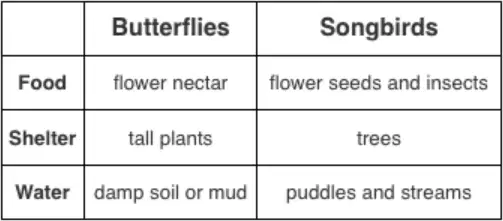
How do the flowers most help the birds and butterflies?
The flowers make food for the butterflies and shelter for the birds.
The flowers make food for the butterflies and water for the birds.
The flowers make food for the butterflies and the birds, and water for the birds.
The flowers make food for the butterflies and the birds, and shelter for the butterflies.

