
 Worksheets
Atoms & Periodic Table Qs
Total questions: 30
Worksheet time: 15mins
Name
Class
Date
1.
(SC.8.P.8.1) Solid, liquid, and gas are three states of matter. Which of the following correctly pairs a state of matter and its description?
a)
gas – particles that do not move about freely
b)
liquid –particles that are the closest together of all three states
c)
solid – vibrating particles that are fixed in place
d)
gas – slowest-moving particles of all three states
2.
(SC.8.P.8.7) The nucleus of an atom is the densest part of an atom. Why is the nucleus so dense?
a)
The nucleus is at the center of the atom.
b)
The nucleus contains all of the subatomic particles that have significant mass.
c)
The nucleus contains all of the positively charged particles in the atom.
d)
Electrons surround the nucleus.
3.
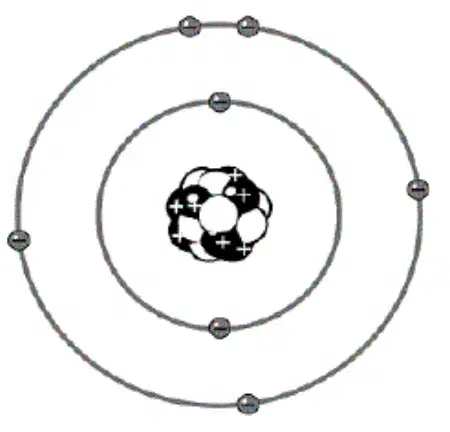
(SC.8.P.8.7) Study the illustration of an atom shown below.
How many electrons are found in this atom?
a)
7
b)
5
c)
2
d)
6
4.
(SC.8.P.8.7) The total number of protons and neutrons in an atom determines its mass number. Some carbon atoms have a mass number of 13, and contain six protons. How many neutrons would this atom have in its nucleus?
a)
13
b)
19
c)
7
d)
6
5.
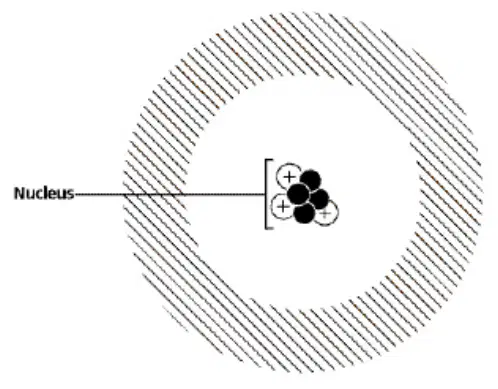
(SC.8.P.8.7) Study the illustration below of an atom.
Which two subatomic particles make up the nucleus of an atom?
a)
proton and electron
b)
neutron and proton
c)
electron and neutron
d)
ion and proton
6.
(SC.8.P.8.7) Neutrally charged atoms have no net charge because they contain the same number of protons and electrons. What would happen to an atom if it were to lose one electron?
a)
The atom would then have a positive charge.
b)
The atom would then have a negative charge.
c)
The atom would still have no net charge.
d)
The atom would automatically also lose a proton from its nucleus.
7.
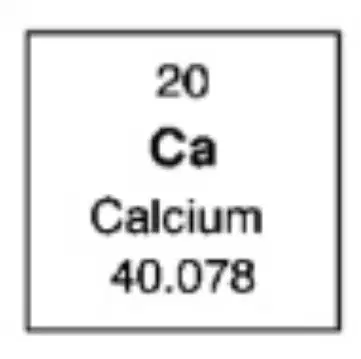
(SC.8.P.8.7) Each element is identified by an atomic number. The atomic number indicates how many protons are found in one atom of that element. For example, calcium (Ca) has an atomic number of 20 as shown below. What is the net charge of the nucleus of this calcium atom?
a)
+20
b)
+1
c)
none
d)
+40
8.
(SC.8.P.8.7) Atoms are composed of subatomic particles including protons, neutrons, and electrons. It takes more than 1,800 electrons to equal the mass of one proton. What can you conclude about the mass of an electron based on this fact?
a)
An electron’s mass is extremely small compared to a proton’s mass.
b)
An electron has the same mass as the nucleus.
c)
An electron’s mass is extremely large compared to a proton’s mass.
d)
An electron has the same mass as a neutron.
9.
(SC.8.P.8.7) The diameter of an atom is about 100,000 times greater than the diameter of its nucleus. What can you conclude from this fact?
a)
The mass of an atom is related to its diameter.
b)
Most of the volume of an atom is found in its electron cloud.
c)
Most of the volume of an atom comes from protons and neutrons.
d)
The nucleus takes up most of the space in an atom.
10.
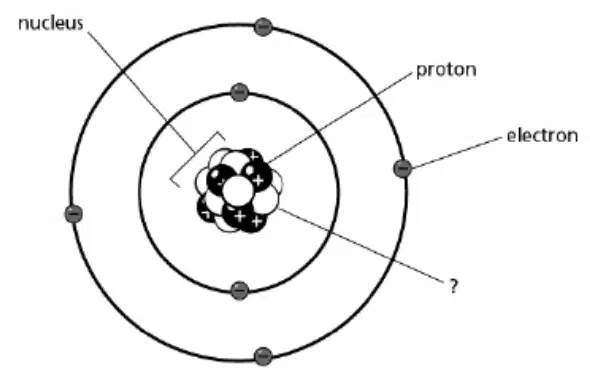
(SC.8.P.8.7) While Elisa and Carmen were studying together for science class, Elisa created a drawing of an atom as shown below. Elisa decided to test Carmen’s knowledge of subatomic particles by asking her to fill in the missing label in her drawing. Which of the following should Carmen choose for the missing label?
a)
element
b)
neutron
c)
electron cloud
d)
isotope
11.
(SC.8.P.8.7) According to atomic theory, elements are made up of small units. What is the name for the smallest unit of an element that can still be classified as that element?
a)
a molecule
b)
a mixture
c)
an atom
d)
a compound
12.
(SC.8.P.8.1) Atoms and molecules are constantly in motion. The more energy the atom or molecule contains, the faster they move about. In which state of matter do the atoms and molecules have the most energy?
a)
in a liquid
b)
in a solid
c)
in a gas
d)
in both a liquid and a solid
13.
(SC.8.P.8.6) Elements are grouped according to their properties in the periodic table. What does the term periodic mean?
a)
contains a group of similar objects or things
b)
organized into rows and columns
c)
based on evidence and organized in a logical way
d)
occurs at regular intervals
14.
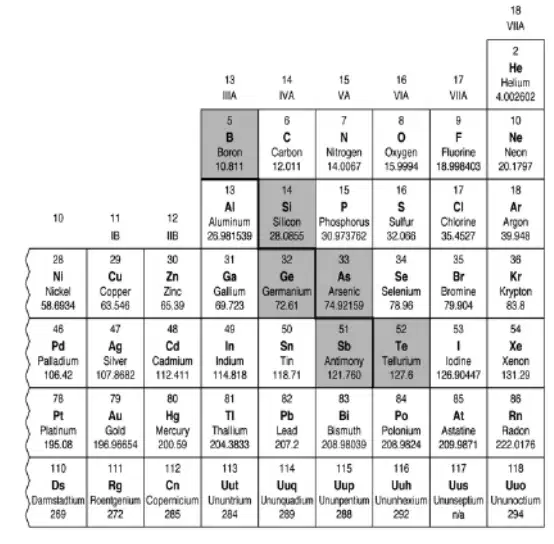
(SC.8.P.8.6) Look closely at part of the periodic table shown below. Notice that the element selenium (Se) has the number 34 directly above its chemical symbol and the number 16 at the top of its row. What do these numbers represent?
a)
34 is the atomic number, and 16 is the group number.
b)
34 is the atomic number, and 16 is and the average atomic mass.
c)
34 is the period number, and 16 is the average atomic mass.
d)
34 is the group number, and 16 is the period number.
15.
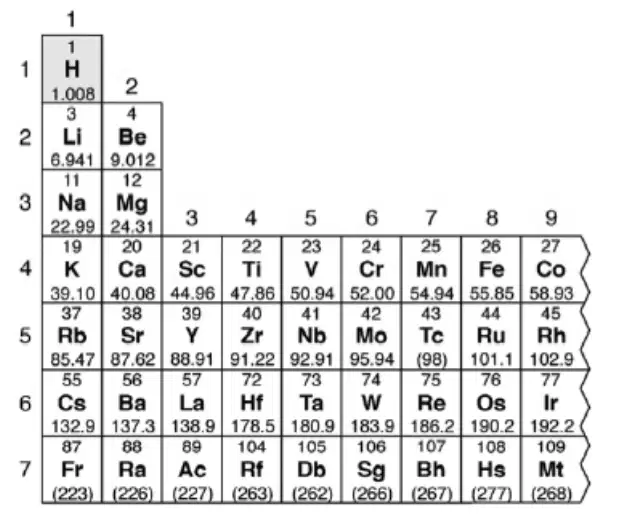
(SC.8.P.8.6) A part of the Periodic Table is shown below. The elements in the periodic table are ordered according to which of the following?
a)
atomic number
b)
color
c)
melting point
d)
atomic size
16.
(SC.8.P.8.6) Mario discovered that sodium (Na) is found in Group 1, Period 3 on the periodic table. Where should Mario look for another element that has similar properties?
a)
on the opposite side of the periodic table
b)
in Period 3
c)
in Group 1
d)
for any other element that begins with the letter N
17.
(SC.8.P.8.6) Elements in the periodic table are grouped into columns and rows. What is the name given to rows in the periodic table?
a)
periods
b)
groups
c)
families
d)
clusters
18.

(SC.8.P.8.6) Look closely at part of the periodic table shown below. Which of the following pairs of elements have properties that are the least similar?
a)
He and Xe
b)
Cl and I
c)
Ge and Br
d)
N and P
19.
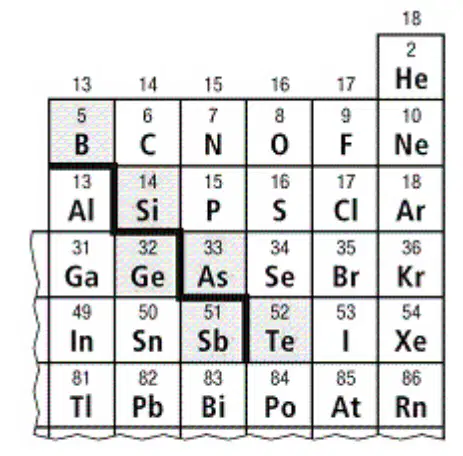
(SC.8.P.8.6) The halogens are a group of elements on the periodic table that have similar properties. The illustration below shows the right side of the periodic table, including the halogens, group 17. Br (bromine) is in Period 4. Which element is in Period 2?
a)
I
b)
F
c)
At
d)
Cl
20.
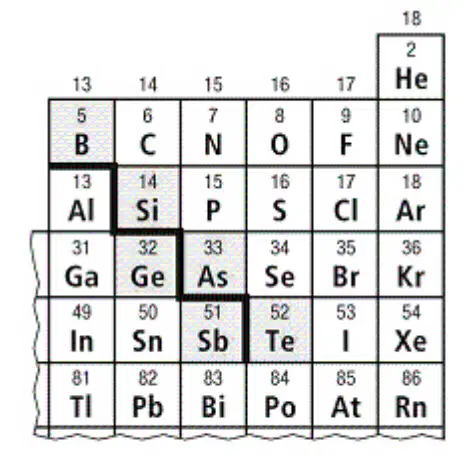
(SC.8.P.8.6) Most versions of the periodic table contain a zigzag line that runs down and to the right as on the part of the table shown below. This zigzag line separates this part of the periodic table into two sections. Aluminum (Al) and tin (Sn) are on the left side of the line, while oxygen (O) and helium (He) are on the right side. What is the purpose of the line?
a)
to separate magnetic elements from nonmagnetic elements
b)
to separate the gases from the solids
c)
to separate the metals from the nonmetals
d)
to separate the solids from the liquids
21.
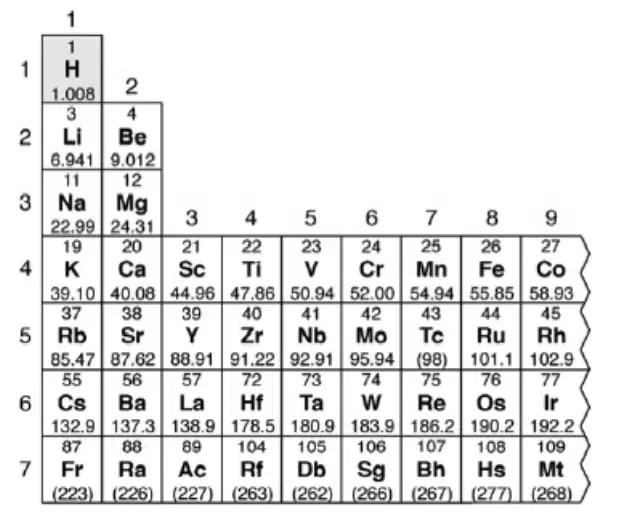
(SC.8.P.8.6) Look closely at a part of the periodic table shown below. What element is located in Period 5, Group 4?
a)
V
b)
Zr
c)
Nb
d)
Ti
22.
(SC.8.P.8.6) Elements are grouped in the periodic table according to the similarities of their properties. For example, the metals are grouped together. Where are the metals located on the periodic table?
a)
on the left and in the center
b)
on the right and in the center
c)
toward the top of the periodic table
d)
toward the bottom of the periodic table
23.
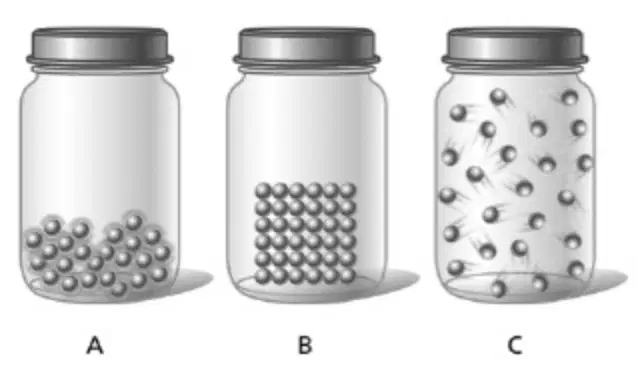
(SC.8.P.8.1) The illustration below shows three states of matter in separate jars.
Which statement about these jars is correct?
a)
Jar C contains particles that vibrate in position.
b)
Jar A contains a gas.
c)
Jar B contains a liquid.
d)
Jars A and C have particles that move more than those in Jar B.
24.

(SC.8.P.8.1) Ida made the following table to show the differences between solids, liquids, and gases.
Unfortunately, Ida made one mistake. What should be changed so that all the descriptions are accurate?
a)
liquid – shape definite
b)
gas – shape varies
c)
solid – volume varies
d)
liquid – volume varies
25.
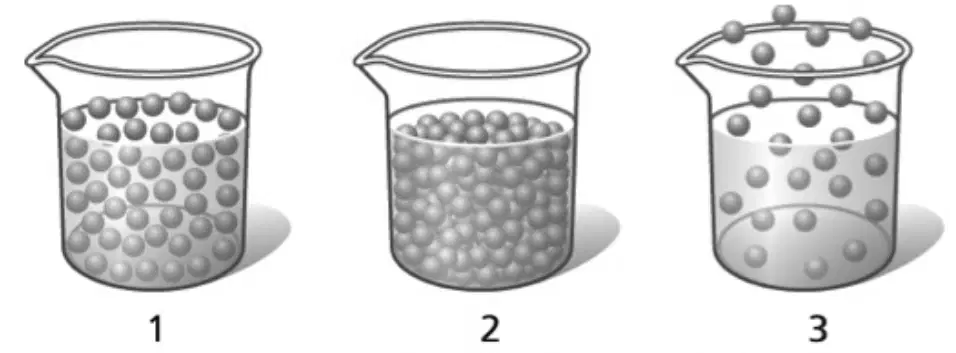
(SC.8.P.8.1) Melinda drew an illustration of the three states of matter. The illustration below shows what she drew.
Melinda wanted to replace the numbers with labels identifying the correct state of matter. How should she change the numbers?
a)
1 --> liquid; 2 --> solid; 3 --> gas
b)
1 --> gas; 2 --> liquid; 3 --> solid
c)
1 --> liquid; 2 --> gas; 3 --> solid
d)
1 --> solid; 2 --> liquid; 3 --> gas
26.
(SC.8.P.8.1) Jessica did an investigation about the states of matter. As part of the investigation, Jessica wanted to change a liquid into a solid. What must she do to bring about this change in state?
a)
Stir the liquid as quickly and thoroughly as possible.
b)
Increase the energy of the liquid so that its particles move faster.
c)
Place the liquid in a different container.
d)
Remove energy from the liquid so that its particles slow down.
27.
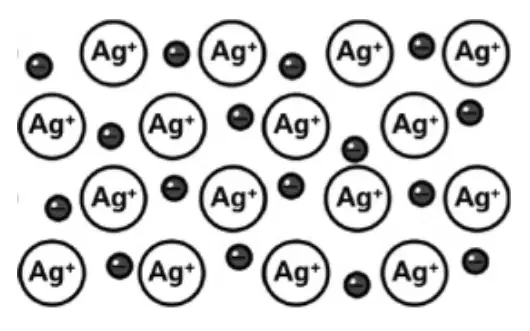
(SC.8.P.8.1) The illustration below shows a molecular model of solid silver, (Ag). The Ag+ particles are silver ions, and the small gray particles are electrons.
How would this model change if the solid silver metal were heated?
a)
The individual Ag+ particles would increase in number.
b)
The particles would not move.
c)
The smaller, darker particles would disappear.
d)
The individual Ag+ particles would move farther apart.
28.
(SC.8.P.8.1) At room temperature, mercury metal exists as a liquid. In contrast, silver metal exists as a solid. Imagine that you had a sample of silver and a sample of mercury, both at room temperature. What can you predict about the two samples?
a)
Mercury atoms have more kinetic energy than the silver atoms.
b)
Both silver atoms and mercury atoms do not move from one location to another but simply vibrate while remaining in position.
c)
Both silver atoms and mercury atoms move fast enough to overcome almost all the attractive forces between them.
d)
Silver atoms move more freely about compared to the movement of the mercury atoms.
29.
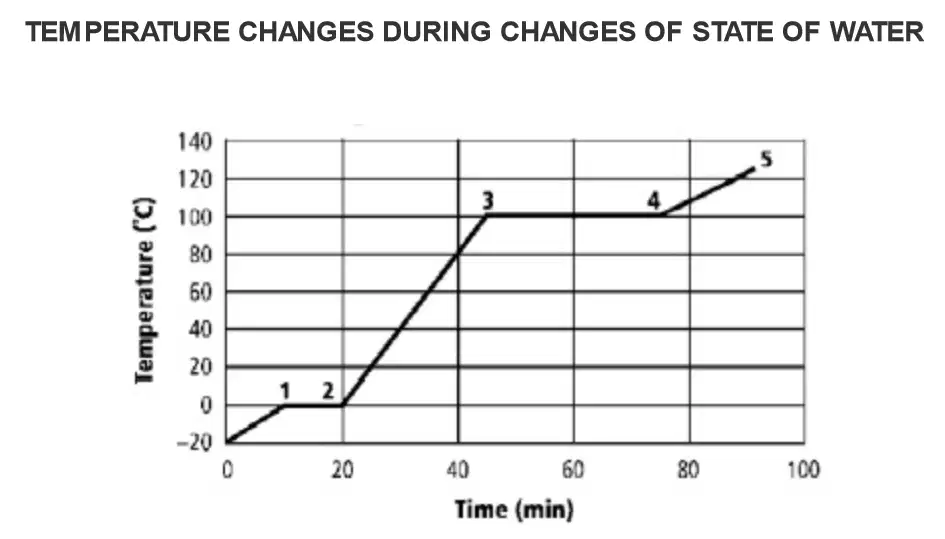
(SC.8.P.8.1) Theresa measured the temperature of a water sample as it underwent changes in state. She drew the graph below to include in her lab report.
Between which two numbers was the motion of the water molecules the greatest?
a)
between 3 and 4
b)
between 4 and 5
c)
between 1 and 2
d)
between 2 and 3
30.
(SC.8.P.8.1) Solids have a definite shape. Solids also have a definite volume. Which statement best explain why solids have both a definite shape and volume?
a)
The particles of a solid move fast enough to overcome some of the attractive force between them.
b)
The particles in a solid move fast enough to overcome almost all of the attractive forces between them.
c)
The particles of a solid remain in fixed positions and are very close together.
d)
The particles of a solid have very weak attractive forces between them.
100 %

