
 Worksheets
Thermal Energy and Matter Quiz-7th
Total questions: 15
Worksheet time: 15mins
What happens to particles that make up an object when you add heat to it?
They move slower.
They move faster.
They move backward.
They stop moving.
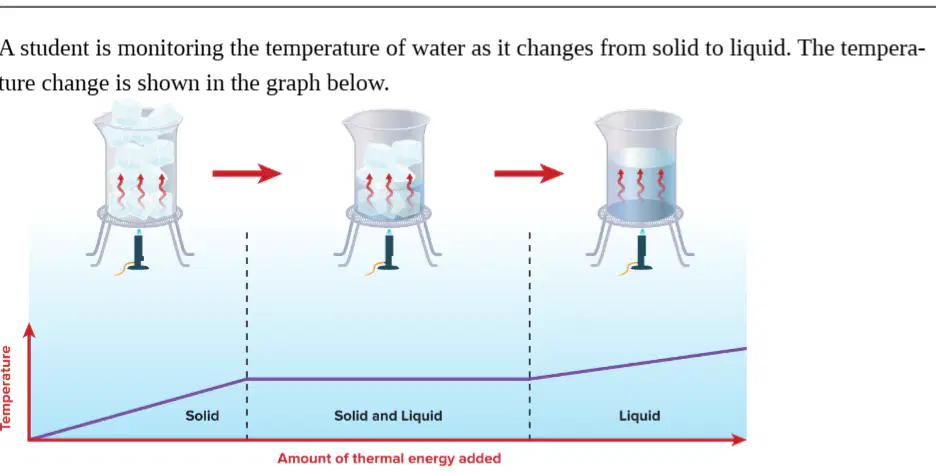
A student is monitoring the temperature of water as it changes from solid to liquid. The temperature change is shown in the graph below. What is the explanation for the portion of the graph where the temperature does not change?
The water is not absorbing any thermal energy as it changes from solid to liquid.
The temperature has reached 100°C. Added thermal energy is causing the solid to melt.
The temperature has reached 0°C. Added thermal energy is causing the solid to melt.
The water particles have stopped moving because the solid is changing to a liquid.
Which of the following changes will NOT occur when a solid is heated?
melting
condensation
sublimation
temperature increase
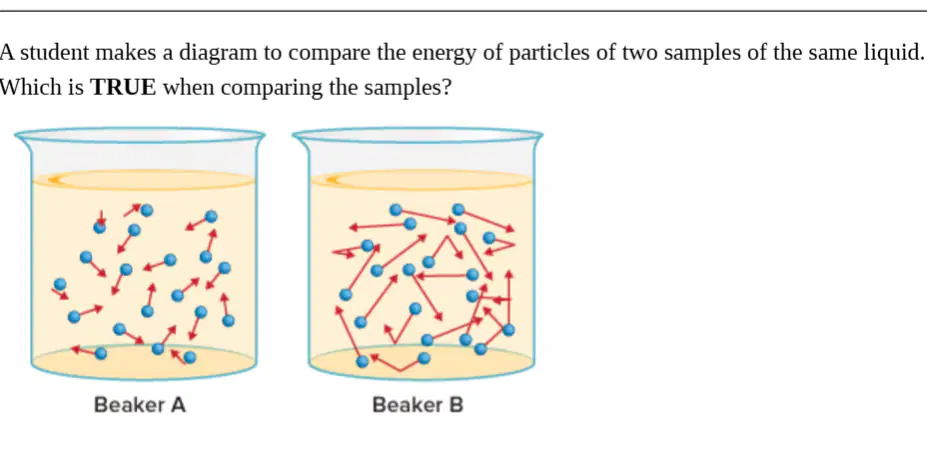
A student makes a diagram to compare the energy of particles of two samples of the same liquid. Which is TRUE when comparing the samples?
The particles in Beaker A have greater kinetic energy.
The liquid in Beaker A has a lower temperature.
The particles in Beaker A have less potential energy.
The temperatures of the liquids cannot be compared based on this diagram.
A small amount of water in a bowl is left outside on a sunny day. What do you predict will happen?
The water will evaporate because heat is being added to it.
The water will increase in temperature but will not turn to water vapor.
The water will evaporate because heat is being removed from it.
No change will occur to the water.
Which choice may cause a liquid to change state?
removing heat from it
putting it in a different container
observing it
stirring it
Dry ice is solid carbon dioxide. When left out at room temperature, dry ice seems to disappear, producing a fog. This process can be used for special effects in movies. Which is NOT true about this process?
The dry ice sublimates at room temperature.
As the dry ice sublimates, it releases heat to the air.
The surrounding air is cooled by the dry ice.
Water vapor in the air condenses in the air, forming fog.
Which of the following changes are NOT caused by heating an object?
sublimation
melting
increase in temperature
freezing

The melting points of substances can help identify them. Which of these substances are solids at 500°C?
ice, sulfur, and lead
lead and aluminum
aluminum and gold
none of them

Removing thermal energy from a substance causes its particles/atoms to move ______.

Where on the graph are phase changes taking place?
1
2
3
4
5

Convert 89°F into °C.
7.2°C
32°C
32°F
212°F
Convert 24°C into °F.
7.2°C
32°C
75.2°F
°68
What is the measure of the average kinetic energy of the particles in a material known
as?
heat transfer
radiation
temperature
thermal expansion

