
NEW
Font size
S
M
L
XL
 Worksheets
Unit 4 Review "Weather and Climate"
Total questions: 25
Worksheet time: 13mins
Name
Class
Date
1.
1. In recording data, it is important to use the proper unit. Which unit is used to measure how warm or cool the air is?
a)
Liters(L)
b)
Grams(g)
c)
Millmeters(mm)
d)
Degrees Celsius (C)
2.
2. Which of the following is a direct result of differences in air pressure?
a)
Humidity
b)
Precipitation
c)
Temperature
d)
Wind
3.
3. Beryl reads a thermometer. The pointer is between the 24 and the 25. Which of these would be an appropriate unit of measurement for this reading?
a)
C
b)
cm
c)
kL
d)
mg
4.
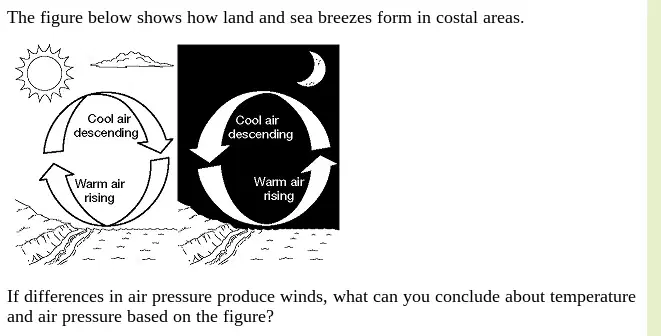
If differences in air pressure produce wind, what can you conclude about temperature and air pressure based on the figure?
a)
As warm air rises, it creates an area of lower pressure, and cooler air flows in as wind
b)
Warm air is denser than cold air is, creating an area of high pressure the produces wind.
c)
Winds flow from areas of low pressure to areas high pressure when temperature is warmer.
d)
Air pressure decreases at night because temperature is lower, producing land and sea breezes.
5.
5. Condensation is part of the water cycle. During condensation, water vapor cools and changes from a gas to a liquid. What happens when this process occurs near Earth's surface?
a)
Fog forms
b)
Precipitation falls.
c)
Water runs off into lakes and streams.
d)
Water evaporates from oceans and lakes.
6.
6. A barometer measures the air pressure. Imagine that the barometer in Key West is falling. What does this indicate about the weather?
a)
A low-pressure system is moving toward Key West
b)
A high-pressure system is moving toward Key West.
c)
A cold air mass is heading in the direction of Key West.
d)
A warm air mass is heading in the direction of Key West.
7.
7. Visitors to Florida sometimes complain about the high humidity. What does high humidity indicate?
a)
a cool temperature
b)
a high-pressure system
c)
an approaching cold front
d)
a high amount of water vapor in the air
8.
8. Ocean currents influence weather. Which ocean current directly affects the weather along the southernmost coast of the eastern United States?
a)
Gulf Stream
b)
Monsoon Current
c)
North Atlantic Drift
d)
South Pacific Equatorial Current
9.
9. The polar jet stream influences the weather in North America. Which of the following illustrations shows the jet stream pulling warm air into Canada?
a)
A.
b)
B.
c)
C.
d)
D.
10.
10. What causes wind?
a)
ocean currents
b)
differences in elevation
c)
condensation in the atmosphere
d)
the uneven heating of the Earth by the sun
11.
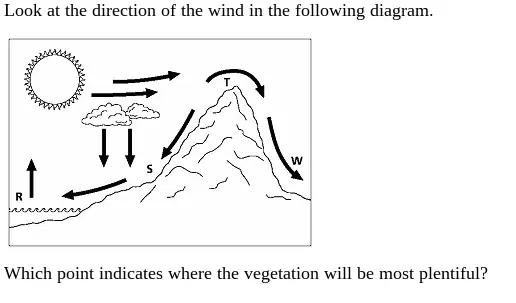
11.
a)
point R
b)
point S
c)
point T
d)
point W
12.
12. Eliana measures outdoor temperatures in an area each day for a week at exactly 2:00 p.m. The temperatures she records are all between 25 °C and 30 °C. Eliana concludes that the climate of the area is tropical. What is the most important reason why her conclusion might not be correct?
a)
She did not calculate the average of her data.
b)
She took the temperature readings at the same time each day.
c)
She made her conclusion based only on temperature and not also on precipitation.
d)
She made her conclusion based on only one week of data instead of over a long period of time.
13.
13. The latitude of a place affects its climate, in particular its temperature. Which sentence best describes how latitude and air temperature are related?
a)
The lower the latitude, the lower the air temperature.
b)
The lower the latitude, the colder the air temperature.
c)
The higher the latitude, the colder the air temperature.
d)
The higher the latitude, the warmer the air temperature
14.
14. Surface currents can affect climate and weather. What are surface currents?
a)
daily changes in the level of ocean water
b)
water that empties from rivers into the ocean
c)
slow mixing of warm and cold water near the surface of the ocean
d)
stream-like movements of water that happen near the surface of the ocean
15.
15. Which of the following is a human activity that can cause climate change?
a)
burning fossil fuels
b)
removing greenhouse gases
c)
using alternative energy sources
d)
increasing particulates from volcanoes
16.
16. How are the movements of tectonic plates related to natural climate change?
a)
Tectonic plate movement causes cyclical climate change.
b)
Tectonic plate movement has no connection to climate change.
c)
Tectonic plate movement causes change as continents move and oceans change
d)
Tectonic plate movement causes rapid climate change because it increases the levels of greenhouse gases.
17.
17. What is one challenge that comes with using alternative technologies to reduce greenhouse gas emissions?
a)
Alternative technologies are not yet available.
b)
Alternative technologies consume more fossil fuels.
c)
Alternative technologies work in certain areas only.
d)
Alternative technologies can be more expensive than traditional technologies
18.
18. What is the Kyoto Protocol?
a)
guidelines for the burning of fossil fuels
b)
guidelines for reducing all natural causes of climate change
c)
an international agreement to reduce greenhouse gas emissions
d)
an agreement by the United States to reduce its carbon dioxide emissions
19.
19. One measure of weather includes the maximum distance at which large objects can be seen and identified with the unaided eye. What does this describe?
a)
visibility
b)
wind speed
c)
air pressure
d)
temperature
20.
20. Zuri is a meteorologist. She is using a barometer. What feature of weather is Zuri studying with a barometer?
a)
humidity
b)
wind speed
c)
temperature
d)
air pressure
21.
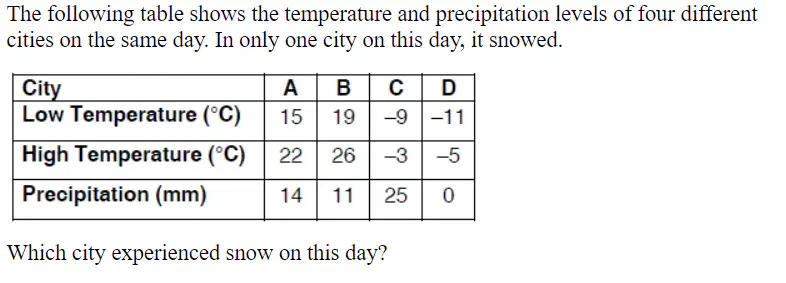
21.
a)
City A
b)
City B
c)
City C
d)
City D
22.
22. Which statement best explains why weather systems usually move from west to east across the United States?
a)
Fronts move from west to east.
b)
The jet stream flows from west to east.
c)
Pressure systems form over the Rocky Mountains and move east.
d)
Weather systems originate over the Pacific Ocean and move east.
23.
23. The sun’s energy influences climate in different ways. For example, the latitudes at the equator receive more intense energy from the sun and therefore have warmer temperatures. How does the sun’s energy most directly influence precipitation in an area?
a)
The sun’s energy drives the water cycle, which determines precipitation.
b)
The sun’s energy controls the amount of condensation and therefore precipitation.
c)
The sun’s energy powers the water cycle by causing runoff, which leads to precipitation.
d)
The sun’s energy creates surface currents in oceans that bring precipitation to different areas.
24.
24. Elevation is the measure of how high something is above a reference point. What is the most common reference point used to refer to the elevation of natural landforms?
a)
sea level
b)
lake level
c)
land level
d)
river level
25.
25. What are the two main factors that determine climate?
a)
temperature and wind
b)
temperature and precipitation
c)
air pressure and humidity
d)
wind and precipitation
Reset

