

Wayground logo

Free Printable Worksheets

Font size

S
M
L
XL
Worksheets

Electrochemistry Assignment 1

Total questions: 20

Worksheet time: 30mins

Name
Class
Date
1.
What is oxidation number of Fe in FeO ?
a)
+2
b)
-2
c)
0
d)
+1
2.
Which of the following is the balanced half -reaction for the oxidation of Cu to Cu+2?
a)
Cu   --> Cu+2
b)
Cu + 2 e-   --> Cu+2
c)
Cu  --> Cu+2  + 2 e-
d)
Cu - 2e-  --> Cu+2
3.
Oxygen always has an oxidation number of...
a)
-1
b)
1
c)
2
d)
-2
4.
A group of cells that are connected together
a)
anode
b)
battery
c)
salt bridge
d)
half cell
5.
The process in which electrical energy is used to bring about a chemical change
a)
fuel cell
b)
battery
c)
electrolysis
d)
voltaic cell
6.
An electrochemical cell that is used to convert chemical energy into electrical energy
a)
electrolysis
b)
electrode
c)
voltaic cell
d)
anode
7.
The electrode at which reduction occurs
a)
cathode
b)
anode
c)
salt bridge
d)
electrode
8.
What occurs to the mass of copper electrode in the following reaction?
Zn/Zn+2 // Cu+2/Cu
a)
increases
b)
decreases
c)
remains the same
9.
What occurs to the mass of zinc electrode in the following reaction?
Zn/Zn+2 // Ag+1 / Ag
a)
increases
b)
decreases
c)
remains the same
10.
Which type of electrochemical cell is used as a battery?
a)
voltaic
b)
electrolytic
11.
If the cell potential is negative, the reaction is?
a)
 a success
b)
spontaneous
c)
not spontaneous
12.

What is reduction?

a)

It is the gain of electrons.

b)

It is the loss of electrons.

c)

It is the creation of electrons.

d)

It is the destruction of electrons.

13.

What is oxidation?

a)

It is the gain of electrons.

b)

It is the loss of electrons.

c)

It is the creation of electrons.

d)

It is the destruction of electrons.

14.

Galvanic cells convert

a)

mechanical energy in to electrical energy

b)

potential energy in to electrical energy

c)

electrical energy in to chemical energy

d)

chemical energy in to electrical energy
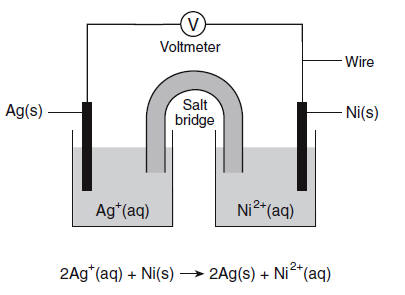
15.
What reaction occurs at the anode?
a)
Ag+ + e- →Ag
b)
Ag → Ag+ + e-
c)
Ni2+ + 2e- → Ni
d)
Ni → Ni2+ + 2e-
16.
What unit of measurement do we use to measure electrical potential?
a)
Watts
b)
Volts
c)
Amps
d)
Ohms
17.

the energy stored in chemical compounds is called

a)

chemical energy

b)

thermal energy

c)

potential energy

18.
The Law of Conservation of Energy states:
a)
Energy can created or destroyed but not transformed 
b)
Energy cannot be created or destroyed, it can only transformed
c)
Energy can't be created, destroyed or transformed
19.

Electrochemistry is

a)

Study of electron in atom

b)

Study of electricity in molecules

c)

The relationship between chemical reactions and electricity

d)

the study of electrons moving from one a tom to another

20.

Pb + 2Ag+ → Pb+2 + 2Ag


The chemical species being reduced is

a)

Ag

b)

Pb

c)

Pb+2

d)

Ag+
