
Font size
 Worksheets
Science T3
Total questions: 214
Worksheet time: 3hrs 7mins
polyatomic ions
an element from Group 7
Calcium Oxide, CaO
Covalent Bond
Ionic Bond
Calcium Chloride, CaCl2
Covalent Bond
Ionic Bond
Why do ionic bonds form?
so the number of protons equals the number of electrons
to fill the outermost energy level to make the atom stable
so an atom can become unstable
If an aluminum atom has 13 protons (+) and 10 electrons (-), what is it's charge?
Al+3
Al+13
Al+10
Al-10
if NONMETALS are more likely to GAIN electrons, they will form ...
anions
neutral atoms
cations
In the chemical formula for an ionic compound, which item is written first?
positive ion (cation)
negative ion (anion)
subscript
it's alphabetical

The transfer of Valence electrons from a metal to a non metal is known as
Covalent Bonding
Metallic bonding
Molecular bonding
Ionic Bonding
A(n) _________ is an ion with a positive (+) charge.
anion
cation
ion
solute

What is it called if there are three-pairs of electrons being shared?
Triple Bond
Three Single Bonds
Tribond
Double and Single Bond Combo
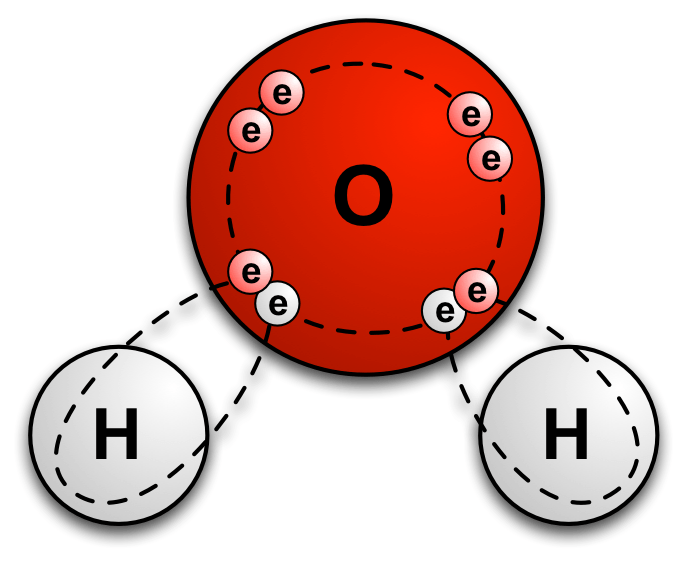

The correct name for CH4 is...
Carbon Hydrogen
Carbon Tetrahydride
Monocarbon hydride
Carbon Hydride
Which of the following is the chemical formula for sulfur hexachloride?
SCl6
S6Cl
S6Cl6
S1Cl6
What is the correct chemical formula for phosphorus trihydride?
P2H3
P4H2
PH3
P3H3
Which of the following names matches the chemical formula N2O3?
Dinitrogen triople oxide
Nitrogen oxide
Dinitrogen trioxide
Trioxide nitrogen
Which of the following would be called tetracarbon octahydride with our naming system?
C3H8
C3H10
C4H8
C4H9
Covalent bonds are formed between...
two or more metal atoms
two or more non-metal atoms
a metal and a non-metal atom
Covalent bonds are formed when electrons are transferred between atoms.
True
False
Atoms can only share electrons in the (a) shell.
Fluorine is a diatomic molecule. Fluorine is in Group 7. How many electrons are shared in this covalent bond?
(a)
Oxygen is a diatomic molecule. Oxygen is in Group 6. How many electrons are shared in this covalent bond?
(a)

The structure of ammonia is shown in the diagram. What is the formula for ammonia?
NH3
HN3
N3H
HN3
What are the disadvantages of using displayed formulae, like the one shown?
The 3D structure of the molecule is not shown.
They can show how atoms are bonded in large molecules.
They do not show which atom each electron comes from.
They can be used to find the structural formula of the molecule.
Select the properties of simple covalent substances.
Low melting and boiling points.
High melting and boiling points.
Do not conduct electricity.
Good conductors of electricity.
Why do simple covalent substances not conduct electricity?
They have low melting points.
They have low boiling points.
There are no delocalised electrons or free ions to carry the charge.
The molecules are too large.
Covalent structures have low melting and boiling points because it does not take much energy to break the _____ intermolecular forces.
weak
strong

Both plants and animals will benefit from adaptations to improve their chances to survive.
True
False
What adaptation helps penguins and seals stay warm?
long eyelashes
long necks
a thick layer of fat
long fur
Why do giraffes have long necks and rough tounges?
To look like trees
to reach leaves on trees
to hide in trees
to swing from trees
Which part of a camel’s body helps protect against sandstorms?
hump
eyelashes
feet
Why do some organisms, like butterflies, have bright colors?
to warn predators they are poisonous
to make it easier to find food
to help them fly long distances
to blend in with their surroundings
What is natural selection?
passing of hiding traits to future generations
passing of survival traits to future generations
passing of hunting traits to future generations

Why do camels have humps?
to store water.
to store fat.
to carry things on.
How do a camel’s feet help it walk on the sand?
They are wide and flat to stop it slipping.
They are small and can move quickly.
They have claws on their feet.
What is an adaptation?
a special feature that helps animals survive
the animal's environment
the way an animal hunts
predators eat prey
Armor is an adaptation that helps animals...
hunt
protect themselves from predators
run quickly
blend in with their surroundings
Having webbed feet is an adaptation. How do webbed feet help animals survive?
They stay cool in the summer.
They can swim faster.
They can blend in with their surroundings.
They can attack their prey.
Sharp teeth are an adaptation. How do sharp teeth help animals survive?
Animals can use them to attack their prey.
Animals can run away from danger.
Animals can avoid the cold weather.
Animals can fly away.

Polar bear get protection from severe cold from his
small eyes
thick fur
sharp claws
strong limbs
Thick layer of fat which protect animals form cold is called......
Fatty
Blubber
Fur
Feather
What is a habitat?
all of one kind of animal or plant in the same area
all the animals living in the ocean
living and nonliving things that interact in the same space
the space where a plant or animal lives
A phenotype that improves an organism’s chance of survival in their environment is considered a(n) ____________.
natural selection
adaption
speciation

Many different groups of organisms have wings, even though they do not share a recent common ancestor. This is because they evolved in environments with similar selective pressures. Wings are an example of a(n) ______________ structure.
vestigial
analogous
homologous
Which best describes the phrase survival of the fittest?
strongest in a population are most successful
fastest in a population are most successful
those that can survive and reproduce are most successful
those that can live the longest are most successful
Match the following pictures with the words they represent

Analogous Structure

Homologous Structure

Artificial selection

Natural selection

Organism

Population

Community

ecosystem

biosphere
Homologous structures and vestigial structures show evidence of
divergent evolution
convergent evolution
both divergent and convergent evolution
analogous structures


The female birds of paradise tend to look for the most colorful, best dancing males to make babies together.
Genetic Drift
Non-random mating
Gene flow
Mutation
Charles Darwin observed that finches of different species on the Galápagos Islands have many similar physical characteristics, this supports the hypothesis that these finches
are twins
acquired traits through use and disuse.
all eat the same type of food.
descended from a common ancestor.
What is speciation?
when a population reaches a balance and change is no longer occuring
when populations move away from each other
when species begin to pass on acquired traits and change their behavior
when two species can no longer interbreed
In a population of ladybugs, black bugs are more successful in escaping predators. Overtime, this gene becomes more popular in the population and the ladybug population loses its red color. This is an example of?
Natural Selection
Mutation
Genetic Drift
Gene Flow

According to the diagram, crocodiles evolved from dinosaurs and birds.
True
False

Humans evolved from chimpanzees
True
False
There was a forest fire that wiped out birch trees randomly and left a few dispersed throughout the forest. The surviving trees evolve overtime changing the gene pool. This is an example of?
genetic drift
gene flow
bottleneck effect
founders effect
genetic flow
The bottleneck effect and founder effect are results of
gene flow
genetic drift
natural selection
non-random mating
mutations
How do populations change due to genetic drift?
A random event occurs that reduces the population, and the new surviving population has a different allele frequency from the original population.
The population undergoes competition with each other for limited resources changing allele frequency from the original population.
The organism/animal with the most favorable trait will be able to produce more offspring than others creating the new population.
organisms within a population undergo symbiotic relationships with each other due to mutations
Traits that help an organism survive in a specific environment.
Variation
Adaptation
Behavior
Environment
What is the advantage of having different shaped beaks?
To be cool and look different from other species.
To be able to eat the specific
food that is available in the environment.
To protect itself against predators.
To protect itself against prey.
A theory that explains how life has changed over time.
natural selection
evolution
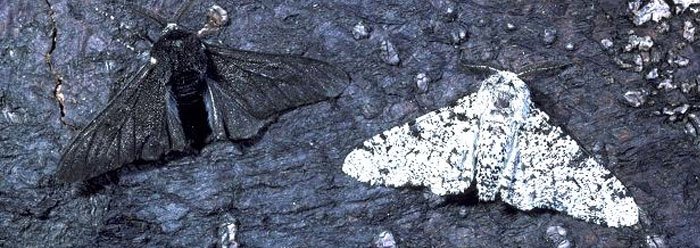
The trees these moths used to live on were white, but have been covered in soot(pollution) from coal factories. Which moth will be more successful in this environment?
Dark moth
Light moth
Both will be equally successful
Neither will be successful
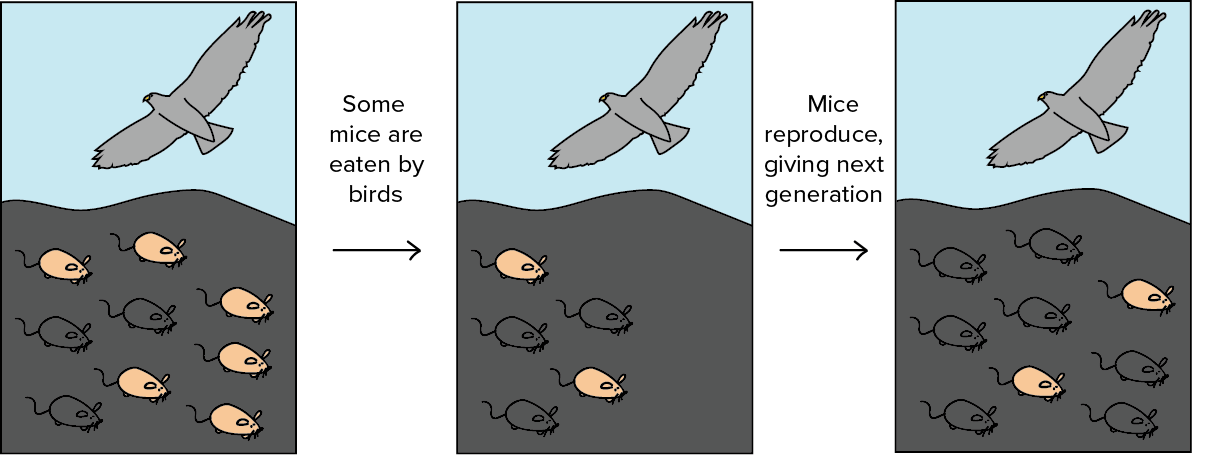
Why is the mouse population changing over time?
The light mice can reproduce more successfully than the dark mice
The hawks eat more dark mice than light mice because the dark mice taste better
The hawks eat more light mice than dark mice because they can see the light mice more easily
The hawks eat more dark mice than light mice because they can see the dark mice more easily


Scientist have created larger and sweeter strawberries for humans to consume (eat). What process was used?
Natural Selection
Artificial Selection

Artificial Selection = Man made
Mosquitoes and houseflies are examples of organisms that can spread disease. These types of organisms are refereed to as?
Vectors
Fungi
Pathogens
What are two viral diseases that do have a vaccine?
Measles and typhoid
Measles and malaria
Measles and chicken pox
This is the transmission of infectious disease through air.
Airborne transmission
Droplet spread
Contaminated Objects
Insect bites
The carrier of malaria causing protozoan is:
Female anopheles mosquito
cockroach
housefly
female Aedes mosquito
Which of the following is not caused by bacteria.
Cholera
Typhoid
Tuberculosis
Malaria
Which of the following is not a communicable disease
Cholera
cancer
Chicken pox
malaria
Which pathogen is non-living?
Virus
Bacteria
Fungi
Parasite/Protist
They are all alive
Which type of pathogen is responsible for causing the flu, chicken pox, and yellow fever?
viruses
parasites
fungi
bacteria
Which pathogen is treated with antibiotics?
virus
bacteria
parasite
fungi
Athlete's Foot is caused by:
fungus
bacteria
parasite
virus
A microbe that can cause harm is known as a
Pathogen
Pathogon
Virus
Bacteria

These magnets will...
Attract
Repel
Do nothing

These magnets will...
Attract
Repel
Do nothing

These magnets will...
Attract
Repel
Do nothing

These magnets will...
Attract
Repel
Do nothing
Which of these materials is magnetic?
Iron
Cobalt
Brass
Steel
Nickel
Which will turn a piece of steel into a permanent magnet?
Line it up with the Earth's magnetic field and tape along its length with a hammer
Stroke it with a magnet , same pole and same direction each time
Put it inside a magnetic field
Wash it
Heat it
Which of these will demagnetise a permanent magnet
Hit it
Heat it
Use it too much
Stroke it randomly with another magnet in different directions with different poles
Wash it

Here are the domains in a bar of steel. Which is true?
The steel is magnetic
The steel is a magnet

Here are the domains in a bar of steel. Which is true?
The steel is magnetic
The steel is a magnet
In magnetically hard materials...
Aligned domains stay aligned
Domains can be aligned, but become misaligned when the material is outside a magnetic field
In magnetically soft materials...
Aligned domains stay aligned
Domains can be aligned, but become misaligned when the material is outside a magnetic field
Which material is magnetically hard?
Iron
Steel
Brass
Copper
Which material is magnetically soft?
Iron
Steel
Brass
Copper

These two magnets are under a sheet of paper in a tray of iron filings. The magnets are...
Attracting
Repelling

These two magnets are under a sheet of paper in a tray of iron filings. The magnets are...
Attracting
Repelling

Which is true?
A is a north pole, B is south pole
B is a north pole, A is a south pole
Both A & B are north poles
Both A & B are south poles
If the magnet is removed, which way will the compasses point (if they are spread out)
North
East
South
West
Could be any direction
Magnets attract and (a)
What are the two magnetic poles called?
North
South
East
West
Like poles (a)
Unlike poles (a)
Name 3 magnetic materials out of the following
Iron
Steel
Nickel
Wood
You can find out the shape of a magnetic field in two ways. Which are they?
Use a ruler
Use a plotting compass
Dip it in water
Use iron filings
When magnetic field lines are closer together the magnetic field is:
Stronger
Weaker
North
South
What type of magnet has its own magnetic field?
(a)
The Earth has:
A bar magnet running through it
A magnetic field
No magnetic field
A forcefield around it
What has to flow through a wire to make it magnetic?
Water
An electric current
Liquid
Air
A solenoid is:
Coiled loops of wire
Coiled loops of string
If you run an electric current through a solenoid, it makes:
An electromagnet
A north pole
A south pole
the wire move
The magnetic material in the centre of the coil of an electromagnet is called the:
(a)
This material stops being magnetic when the electromagnet has no current running through it.
Iron
Steel
This material stays magnetic when the electromagnet has no current running through it.
Iron
Steel
3 things that effect the strength of an electromagnet are:
The number on loops on the coil
The current slowing in the wire
The temperature of the room
The type of core
Which one is not a use of an electromagnet?
Lightbulb
Electric bell
Circuit breaker
Loudspeaker
Which is stronger, a permanent magnet or an electromagnet?
(a)

Which transverse wave has the highest frequency?
1
2
3
4
The measurement of the length of a wave from one point of the wave to the next identical part of the wave (for example, top to top or bottom to bottom)
Crest
Amplitude
Frequency
Wavelength
The number of waves that passes a certain point in a set period of time
Frequency
Amplitude
Wavelength
Amplength


Which vocabulary term is used to identify the distance between points C & E?
Amplitude
Crest
Frequency
Wavelength
What are waves used for?
Transferring Energy
Storing Energy
Moving Objects
Removing Energy
What is transferred in waves?
Energy
Objects
Magic
Light
Which one is an example of a transverse wave
Punching a bag
Loud Music
Sneezing
Water Waves
In a transverse wave, how do the particles move?
They don't move
Sideways
Up and down
In a square
Which one shows the amplitude of a wave?


Which one shows the wavelength of a wave?


In a transverse wave, the vibrations are (a) to the direction of the wave.
Waves can transfer...
energy
matter
information
The vibrations in a longitudinal wave are (a) to the direction of energy transfer.
Select the transverse waves.
water waves
light
ultrasound
radio waves
P waves
Sound waves are (a) waves.
Seismic waves can be...
longitudinal
transverse
Sound waves can travel through a vacuum because they don't require particles.
True
False
Compare and contrast transverse and longitudinal waves, giving examples of each.

Which of the following has the shortest wavelength?
microwaves
UV rays
Infrared
the color blue

Which of the following has the most energy?
Red
Blue
Green
Violet

Which of the following has the shortest wavelength?
Gamma rays
The color blue
AM radio
Infrared


What is not a field that makes up an electromagnetic wave?
electric
magnetic
digitial
none of the above

Which of the following is not in the electromagnetic spectrum?
Light waves
Sound waves
Radio Waves
X-rays
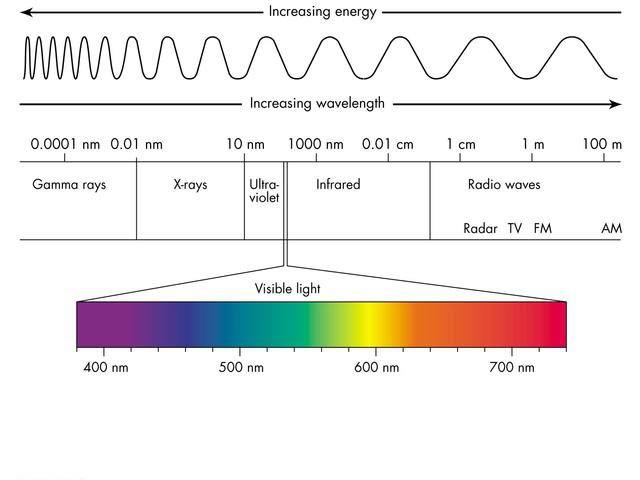
What is the correct order of the visible light spectrum starting with the longer wavelength?
Red, yellow, orange, blue, violet, indigo
Violet, indigo, blue, green, yellow, orange, red
Green, yellow, blue, indigo, red, orange
Red, orange, yellow, green, blue, indigo, violet
Which of the following does not use microwaves?
A mobile phone
Wifi
A speed Camera
A TV remote control
Identify the part of the electromagnetic spectrum from the following description. Used in cooking, used in short-range communication and has a typical wavelength of 900nm.
infrared
microwave
radio wave
gamma wave
Identify the part of the electromagnetic spectrum from the following description. Used in cooking, used in communication and has a typical wavelength of 150nm.
Infrared
Microwave
radiowaves
gamma wave
Where is the nucleus found in this picture?
Protons have what charge?
Positive
Neutral
Negative
Neutrons have what charge?
Protons
Neutral
Negative
Electrons have what charge?
Positve
Neutral
Negative
Where do you find protons?
Nucleus
Electrons cloud
Outside the nucleus
Where do you find neutrons?
Nucleus
Electrons cloud
Outside the nucleus
Where do you find electrons? Check all that apply.
Nucleus
Electrons cloud
Outside the nucleus
A proton is found in the (a) and has a (b) charge.
A electron is found in the (a) and has a (b) charge.
A neutron is found in the (a) and has a (b) charge.
Which arrow points to the protons?
Which arrow points to the neutrons?
Which arrow points to the electrons?
Drag the correct response to the appropriate box on the chart.
Same mass as a neutron
Same mass as a proton
much less mass then protons and neutrons
Nucleus
Nucleus
Electron Cloud
Positive
Negative
Neutral/No charge
Select the unit for energy.
Joules (J)
Newtons (N)
Pascals (Pa)
Watts (W)
Select the unit for work done.
Joules (J)
Newtons (N)
Pascals (Pa)
Watts (W)
Select the unit for power.
Joules (J)
Newtons (N)
Pascals (Pa)
Watts (W)
Select the correct equations.
Work done = Force x distance
Force = Work done x distance
distance = Force / Work done
distance = Work done / Force
Work done = Force / distance
A tyre is moved 5 m by a force of 340 N. Calculate the work done on the tyre.
(a)
Select the correct equations.
Power = Energy x time
Energy = Power x time
Power = Energy / time
time = Energy / Power
Energy = Power / time
A rock climber does 4.8 kJ of work scaling a rock face in 2 minutes. Find her power.
(a)
An engine transfers 400 J of energy in one second. What is the work done by the engine in this time?
(a)
How long would it take a 525 W motor to do 1344 J of work? Give your answer to 3 significant figures.
(a)
How much work is done by a machine with a power of 1240 W running for 35 seconds?
(a)

