
 Worksheets
Quiz 2: Revision on Electricity [NT Science]
Total questions: 30
Worksheet time: 18mins
What is the unit of current?
Watt
Ampere
Ohm
Volt
What is current?
something that opposes voltage in a circuit
rate of flow of electrical charges
rate of flow of voltage
something that opposes resistance in a circuit
Convert 0.77 A into mA.
(a)
In a closed circuit, current passes from ______________.
positive terminal to negative terminal
negative terminal to positive terminal
positive terminal to positive terminal
negative terminal to negative terminal
Which device(s) is/are used to measure current?
Multimeter
Voltmeter
Ammeter
Ohmmeter
To measure the current passing through a circuit, the ammeter should be connected in (a) .
What does voltage provide to an electrical circuit?
energy needed for resistance to pass through
energy needed for current to pass through
resistance to oppose current
current to oppose resistance
What is the symbol for the unit of voltage?
W
A
V
Ω
Convert 8250 mV into V.
(a)
Which device(s) is/are used to measure voltage?
Multimeter
Voltmeter
Ammeter
Ohmmeter
To measure voltage, a multimeter should be connected to the electrical circuit in (a) .
What is the unit of resistance?
Watt
Volt
Ohm
Ampere
Convert 15670 Ω to kΩ.
(a)
Which of the following electrical components provide resistance?
electric cell
switch
fixed resistor
variable resistor
Which device(s) is/are used to measure resistance?
Multimeter
Voltmeter
Ammeter
Ohmmeter
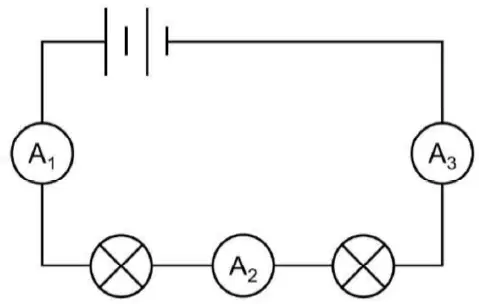
In this series circuit:
A1 = A2 + A3
A1 = A2 - A3
A1 = A2 = A3
A3 = A2 + A1
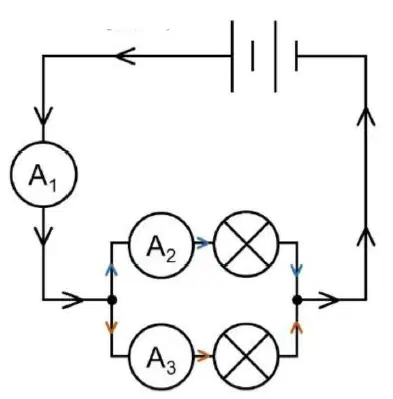
In this parallel circuit:
A1 = A2 + A3
A1 = A2 - A3
A1 = A2 = A3
A3 = A2 + A1
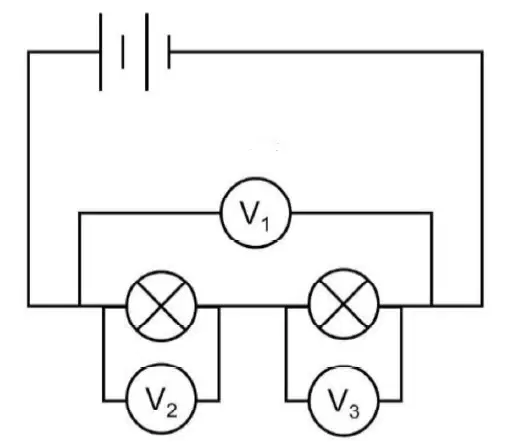
In this series circuit:
V1 = V2 = V3
V1 = V2 + V3
V2 = V1 + V3
V2 = V1 / V3
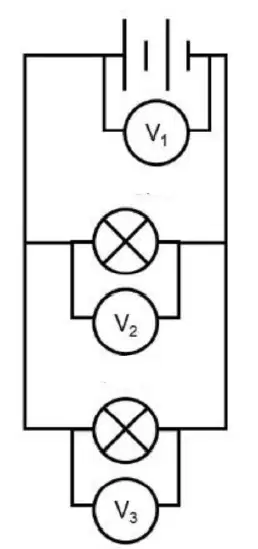
In this parallel circuit:
V1 = V2 = V3
V1 = V2 + V3
V2 = V1 + V3
V2 = V1 / V3
Which of the following is an advantage of connecting household appliances in parallel?
Increased resistance
Reduced voltage
Individual control
Increased current
What happens to the effective resistance when more resistors are added in series?
It decreases
It increases
It remains the same
It becomes zero
What is the symbol for power?
J
W
A
V
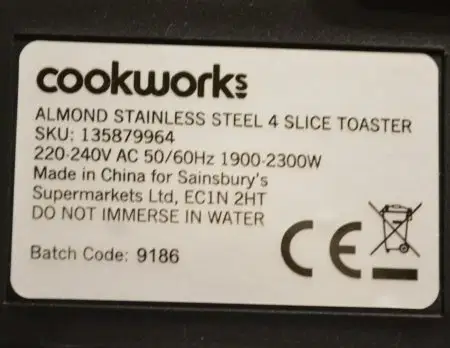
Based on the image, what is the power rating?
220 - 240 V
50/60 Hz
1900 - 2300 W
9186 V
The voltage rating tells us the voltage that the appliance is designed to be used with. What happens if the voltage used is higher than the voltage rating?
Current passing through is too low and appliance cannot work
Current passing through is too low and the appliance may be damaged
Current passing through is too high and the appliance cannot work
Current passing through is too high and the appliance may be damaged
Which equation shows the relationship between power, current, and voltage?
P = I + V
P = I - V
P = I x V
P = I / V
Which equation(s) can be used to calculate the power of an electrical circuit?
power = current x voltage
power = current/voltage
power = energy x time
power = energy/time
How is electrical energy typically measured in households?
Joules
Kilowatt-hours
Watts
Amperes
What is the formula to calculate the cost of using an electrical appliance?
Cost = Power - Time
Cost = Power + Time
Cost = Power / Time
Cost = Power x Time
What is the main purpose of a fuse in a circuit?
To provide resistance
To measure voltage
To break the circuit when current is too high
To increase current
Which of the following does NOT help to reduce electrical energy wastage?
Switching off the fans and lights when leaving a room.
Using energy-efficient appliances.
Switch on the fan and air-conditioner in a room.
Switching off the water heater after bathing.

