
 Worksheets
Review: World History TEST Topic 9 (24-25)
Total questions: 29
Worksheet time: 58mins
Which policy helped the Tang dynasty strengthen the central government?
Increasing civil service exam requirements
Breaking up large estates and redistributing land
Imposing higher taxes on merchants
Building the Great Wall
Why did merchants in Tang and Song China have a lower social status than peasants?
Most merchants were not Chinese citizens.
Their wealth came from the labor of others.
Merchants did not contribute to agricultural production.
Confucian ideals promoted wealth over labor.
Which of the following is true about women during the Tang and early Song periods?
Women had no influence in politics.
Women had higher status than in later dynasties.
Women were not allowed to receive education.
Women often worked as merchants and traders.
What was the purpose of the Grand Canal during the Tang and Song dynasties?
To connect China with foreign territories for trade
To allow for faster transportation of food and goods within China
To prevent invasions from northern tribes
To drain floodwaters from agricultural areas
What innovation during the Song dynasty greatly improved printing efficiency?
Block printing
Movable type
Woodblock carving
Paper manufacturing
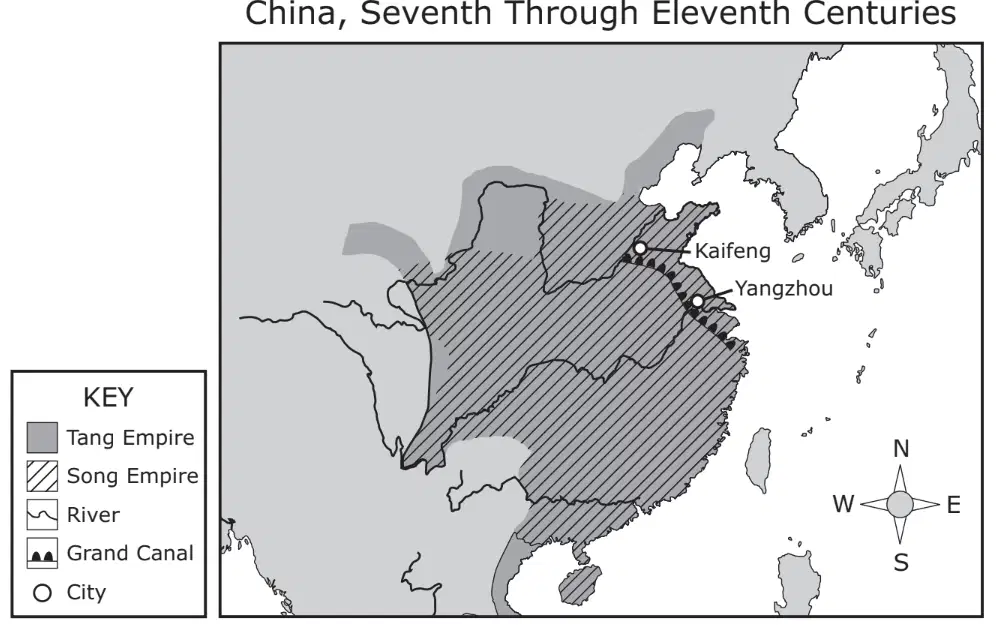
The canal shown on the map was important during the Tang and Song dynasties primarily because it provided —
flood control during monsoon season
water to urban centers in arid regions
a transportation route for military forces
a means of shipping rice from farms to urban centers
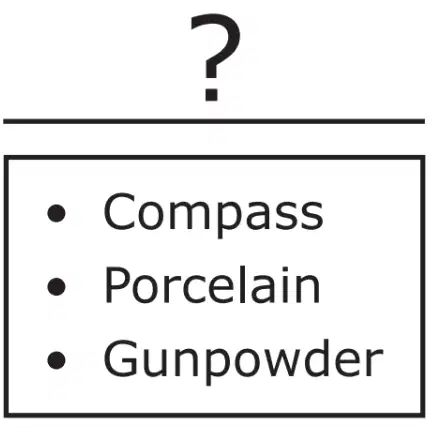
What is the best title for this list?
Muslim Discoveries
Chinese Inventions
Ancient Greek Tools
Renaissance Innovations
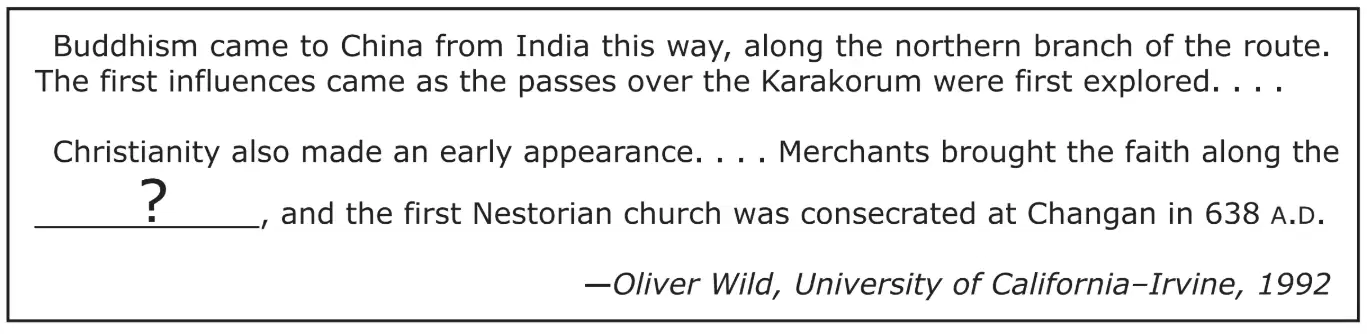
Which trade route correctly completes the excerpt?
Royal Road
Amber Road
Silk Road
Burma Road
During the Pax Mongolica, what was a significant effect of Mongol rule?
Increased restrictions on trade and cultural exchange
The spread of technologies and ideas along the Silk Road
A complete ban on foreign merchants within the empire
Political instability throughout Asia and Europe
How did the Mongols overcome the challenge of walled cities during their conquests?
They used cannons and other new weapons learned from Chinese and Turkish experts.
They built massive siege towers to scale city walls.
They bribed city leaders to surrender without resistance.
They starved cities into submission by cutting off trade routes.
Why did the Ming emperor halt the voyages like those of Zheng He in 1435?
The Ming emperor decided to focus on domestic policies and isolationism.
Zheng He failed to establish trade agreements with Southeast Asia.
Portuguese merchants arrived to replace Chinese trade missions.
The voyages were deemed too successful and competitive with European powers.
Which event led to the overthrow of the Mongol-led Yuan dynasty?
The death of Genghis Khan during a campaign
A series of costly wars and natural disasters under Kublai Khan’s rule
Zhu Yuanzhang leading a rebel army to establish the Ming dynasty
The reestablishment of the Song dynasty in southern China
What was one cultural achievement of the Ming dynasty?
The widespread use of steel in military technology
The creation of Ming porcelain, valued in global trade
The invention of the abacus for agricultural use
The writing of The Travels of Marco Polo to document the dynasty’s success
Which of the following is considered one of Genghis Khan’s greatest achievements?
He enabled Muslim rulers to gain control of valuable trans-Saharan caravan routes.
He encouraged the expansion of Buddhism across Asia and introduced it to Europe.
He united the nomadic tribes of northeast Asia to eventually form a vast empire.
He popularized the warrior culture originally developed by the Japanese samurai.
How did Korea’s geography influence its development?
Korea’s location near Japan led to heavy Japanese cultural and political influence.
Korea’s mountainous terrain limited farming but encouraged trade along its coastline.
Korea’s landlocked position led to little interaction with surrounding civilizations.
Korea’s access to the Mediterranean Sea helped it become a major trade empire.
What was one major effect of Chinese influence on Korea?
Korea adopted Buddhism, Confucianism, and elements of Chinese writing.
Korea became a colony of China for nearly 500 years.
Korea was forced to abandon its own language and adopt Mandarin.
Korea rejected all foreign influences and remained isolated.
Which of the Three Kingdoms of Korea was most influenced by Chinese civilization?
Koguryo, because of its cultural exchanges with Japan
Paekche, because it was the most distant from China
Silla, because it had the strongest ties with the Tang Dynasty
None of the kingdoms, because Korea remained isolated from China
What was a major impact of Hangul on Korean society?
It made literacy more accessible to the common people.
It made the Korean language more similar to Chinese.
It discouraged the use of Confucian principles in government.
It restricted education to the wealthy elite.
Which statement best describes Korea’s relationship with China during the Silla and Koryo dynasties?
Korea was more powerful than China, leading to frequent conflicts.
Korea strongly influenced Chinese culture and technology.
China’s influence helped Korea develop its own unique traditions.
Korea remained isolated from Chinese influence.
Why did Japan adopt Chinese ideas such as Buddhism and writing?
They believed Chinese practices were superior and needed to be incorporated into their culture.
Japanese society was in decline, and they needed to model their government after China's.
Chinese merchants and officials influenced Japan through trade.
Japan selectively borrowed elements of Chinese culture, adapting them to fit their own needs.
Which of the following best describes Japan's feudal system?
The emperor held all the real power, with the shogun serving as a figurehead.
The samurai were the highest class and held political and military control over Japan.
The shogun held the most power, while the emperor was a symbolic figurehead.
Japan was divided into independent kingdoms, each ruled by a separate monarch.
What was the main reason that Tokugawa Ieyasu was able to unify Japan?
He defeated the samurai in battle and became the supreme ruler.
He established a centralized government that brought stability and control.
He established diplomatic relations with Korea and China, increasing Japan’s power.
He implemented a policy of isolation, preventing foreign influence from disrupting Japanese society.
How did Zen Buddhism influence Japanese culture during the feudal period?
It promoted the practice of elaborate ceremonies and rituals.
It encouraged a life of luxury and indulgence, especially among the samurai.
It emphasized self-reliance, meditation, and mental discipline, impacting samurai behavior.
It replaced Shinto as the dominant religion in Japan.
Why did new artistic traditions, such as kabuki theater and haiku poetry, develop in Japan following the end of the feudal period?
These traditions emerged from the military culture of the samurai.
The lack of warfare allowed people to invest more time and resources into the arts.
They were used as a means of controlling the population through entertainment.
They reflected the aggressive nature of Japan’s society at the time.
Which fact suggests that women in Southeast Asia had greater social status than women in other parts of Asia?
They could become rulers and merchants.
They were expected to remain in the home.
They were required to marry at a young age.
They followed a strict Confucian code of behavior.
What was the primary way Hinduism, Buddhism, and Islam were introduced to Southeast Asia?
Through conquest by foreign armies
Through trade and missionary activities
Through agricultural advancements
Through the spread of written language
Which statement best describes the cultures of the different kingdoms and empires in Southeast Asia?
A blend of Indian influences with local cultures
A blend of Cambodian and Thai cultures
A blend of Pagan and Khmer cultures
Why did Vietnam experience stronger Chinese influence compared to other parts of Southeast Asia?
Chinese military forces conquered and ruled Vietnam for over 1,000 years.
Vietnam voluntarily adopted Chinese customs and traditions.
Vietnam had no trade connections with India or other neighboring regions.
The Vietnamese rulers sent ambassadors to China to request their guidance.
How did the Trung sisters contribute to Vietnam's history?
They fought against Mongol invaders to protect their kingdom.
They led a rebellion against Chinese rule and briefly won independence.
They established a powerful trade empire in Southeast Asia.
They introduced Hinduism to Vietnam.

