wayground logo

Free Printable Worksheets

Font size

S
M
L
XL
Worksheets

MATH 10

Total questions: 44

Worksheet time: 1hrs 23mins

Name
Class
Date
1.

What is the degree of the polynomial equation x2 −2x + x4 + 4 = 0?

a)

1

b)

2

c)

3

d)

4

2.
What is the standard form of the polynomial,
7x - 125 - 6x4 + 14x2
a)
125 + 7x - 14x2 +6x4
b)
6x4  -14x2 - 7x +125
c)
125 + 14x2 + 7x  - 6x4
d)

-6x4+0x3 +14x2+7x -125

3.

Which of the following is a polynomial equation?

a)

x−3−4x2=7x+8

b)

x5+x2−x+4=0

c)

6x1.4+3x2.3−5.3x=0

d)

x−x-2+3=0

4.

Which of the following is not a root of the polynomial function?

f(x)=(x+1)(x5)(x6)f\left(x\right)=\left(x+1\right)\left(x-5\right)\left(x-6\right)  

a)

-1

b)

5

c)

-6

d)

6

5.

How many roots does the polynomial function have?

f(x)=x43x2+10f\left(x\right)=x^4-3x^2+10  

a)

1

b)

2

c)

3

d)

4

6.

What are the zeros/roots of the polynomial
y = (x + 4)(x + 1)(x - 3)?

a)
-4, -1, 3
b)
3, -3, 4, 1
c)
4, 1, -3
d)
3, -4, -1, 3
7.

Which of the following are the roots of the polynomial function?


f(x)=x32x25x+6f\left(x\right)=x^3-2x^2-5x+6  

a)

-2

b)

3

c)

1

d)

-1

8.

To determine how many x-intercepts the polynomial has, look at the …

a)

Degree of the function

b)

End behavior

c)

Coeffients

d)

Y-intercept

9.

Find the y intercept of the polynomial equation y=(x1)(x+2)(x5)y=\left(x-1\right)\left(x+2\right)\left(x-5\right)

a)

5

b)

-5

c)

10

d)

-10

10.

Which of the following allows you to describe the end behavior of a polynomial?

a)

the degree and the constant

b)

the leading coefficient and the constant

c)

degree and the variable

d)

the degree and the leading coefficent

11.
Describe the end behavior of
f(x) = -5x4 - 2x2 + 8
a)
Left side: Rises  
 Right side: Rises
b)
Left Side:  Rises
Right side: Falls
c)
Left side: Falls
Right side: Rises
d)
Left side: Falls
Right side: Falls
12.

State the end behavior:


f(x) = -2x3 + 5x -2

a)

Left-Up, Right- Up

b)

Left- Up, Right- Down

c)

Left- Down, Right -Down

d)

Left- Down, Right Up

13.

State the end behavior:


y = x4 - 2x2 + 3x + 5

a)

Left- Up, Right Up

b)

Left- Up, Right- Down

c)

Left- Down, Right-Down

d)

Left- Down, Right Up

14.

Which functions have a negative leading coefficient?

a)

A

b)

B ONLY

c)

A and C

d)

B and D

15.

Select all the even degree functions. (you can select more than one answer)

a)

A

b)

B

c)

C

d)

D

16.
Describe the type of polynomial shown.
a)
Even degree, negative leading coefficient
b)
Even Function
c)
Odd degree, negative leading coefficient
d)
Even degree, positive leading coefficient
17.
Which equation MOST LIKELY matches the graph?
a)
y = x- x3 + 3x2 + 2
b)
y = -x4 + x3 + 5x + 2
c)
y = x3 - 2x2 + 1x + 3
d)
y = -x3 - 2x2 + 1x + 3
18.
Is the leading coefficient positive or negative
a)
positive
b)
negative
19.

Based on the end behavior which option best describes the leading term?

a)

negative coefficient, even degree

b)

negative coefficient, odd degree

c)

negative degree, odd coefficient

d)

negative degree, even coefficient

20.

The degree of the polynomial determines the number of roots.

a)

True

b)

False

21.
What is the leading coefficient?
a)
Positive 
b)
Negative
22.

It is where a function crosses the x-axis"?

a)
x-intercept
b)
zero
c)
root
d)
all of these.
23.
Describe the type of polynomial shown.
a)
Even degree, negative leading coefficient
b)
Even Function
c)
Odd degree, negative leading coefficient
d)
Even degree, positive leading coefficient
24.
Answer the question.
a)
Diameter
b)
Center
c)
Radius
d)
Chord
25.
Name a diameter.
a)
PR
b)
QS
c)
RS
d)
PQ
26.
Name the center.
a)
K
b)
KL
c)
KN
d)
N
27.
An angle in a circle with vertex on the center of the circle
a)
Central angle
b)
Angle
c)
Inscribed angle
d)
Circle
28.
A circle is named after its what?
a)
Center
b)
Arc
c)
Circumference
d)
Secant
29.

An arc greater than 180o

a)

semicircle

b)

major arc

c)

minor arc

d)

central arc

30.

An arc less than 180o

a)

semicircle

b)

major arc

c)

minor arc

d)

central arc

31.

An arc equal to 180o

a)

semicircle

b)

major arc

c)

minor arc

d)

central arc

32.

When naming a minor arc, we use _____ letters.

a)

1

b)

2

c)

3

d)

4

33.

When naming a major arc, we use _____ letters.

a)

1

b)

2

c)

3

d)

4

34.

This is formed when 2 radii meet in the center of a circle.

a)

Central angle

b)

Triangle

c)

Semicircle

d)

Arc measure

35.
If a circle has a radius of 16 ft. then which statement is true?
a)
The radius is 8 ft. 
b)
 The diameter is 8 ft
c)
The radius is 32 ft.
d)
The diameter is 32 ft.
36.

Which is a central angle?

a)

JKL\angle JKL  

b)

JIH\angle JIH  

c)

JGI\angle JGI  

d)

JLK\angle JLK  

37.

What is the relationship between a central angle and its arc?

a)

The angle is half of the arc.

b)

The arc is half of the angle.

c)

The arc is smaller than the angle.

d)

They are congruent.

38.
What is the measure of arc AD?
a)
38
b)
142
c)
180
d)
153
39.
What is the measure of arc AB?
a)
140
b)
142
c)
180
d)
153
40.
What is the measure of ∠PTQ?
a)
100°
b)
140°
c)
180°
d)
120°
41.
If the measure of arc ABC = 210°, what is the measure of arc AC?
a)
150°
b)
100°
c)
210°
d)
105°
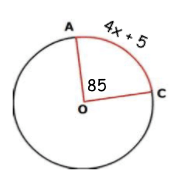
42.
Solve for x. 
a)
5
b)
20
c)
40
d)
85
43.
Find the measure of arc JH
a)
93
b)
130
c)
120
d)
95
44.
What is the measure of ∠PTQ?
a)
100°
b)
140°
c)
180°
d)
120°