
NEW
Font size
 Worksheets
Central heating Boilers Part 3
Total questions: 37
Worksheet time: 19mins
Which of the following is not a type of boiler?
Back boiler
System boiler
Solar boiler
Electric boiler
Fill in the blank: A _______ boiler is designed to be mounted on a wall.
A) Floor standing
B) Wall mounted
C) Combination
D) System
Which part of the Building Regulations covers heat producing appliances like boilers?
Part A
Part J
Part M
Part P
Only _______ Persons within their areas can install boilers.
Incompetent
Competent
Untrained
Unauthorized
What is the legal requirement for an engineer installing any type of boiler?
Must be a registered Competent Person
Must have a degree in engineering
Must be over 25 years old
Must have 5 years of experience.
Fill in the blank: For information on gas boilers, you should visit ______.
www.oftec.org
www.gassaferegister.co.uk
www.hetas.co.uk
www.niceic.com
Central heating systems can be heated by Gas, Oil, Solid fuel, and ______.
Water
Electricity
Wind
What are the two types of gas that gas boilers can burn?
LPG and natural gas
Coal and wood
Electricity and solar
Oil and diesel
Under Building Regulations part L, only _______ rated A condensing boilers can now be fitted.
SEDBUK
Energy Star
Eco-friendly
High-efficiency
Which type of boiler uses two heat exchangers to heat up the latent heat within the system?
Traditional boilers
Condensing boilers
Electric boilers
Solar boilers
Condensing boilers are required by Building Regulations part L because they are more ______.
Expensive
Efficient
Compact
Complex
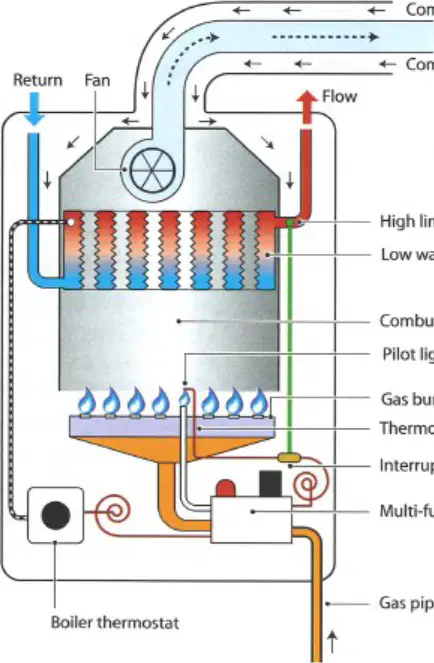
What is the primary function of a traditional (non-condensing) gas boiler?
To use multiple heat exchangers
To heat up the primary water using a single heat exchanger
To condense flue gases
To emit no gases to the atmosphere.
In a traditional gas boiler, the _______ is used to heat up the primary water.
Combustion chamber
Single heat exchanger
Multi-function control
Gas pipe
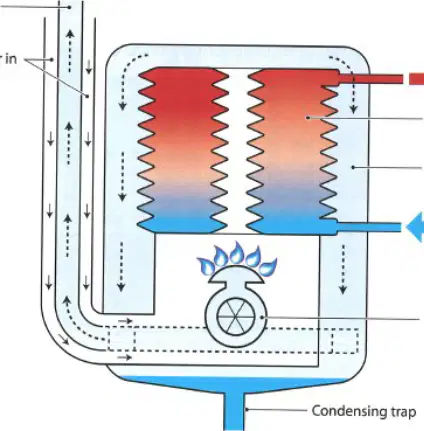
What is the main reason for the increased efficiency in condensing boilers?
Use of a single heat exchanger
Flue gases passing over a second heat exchanger
Higher combustion temperature
Larger boiler size
In a condensing boiler, the flue gases are cooled to ___ before condensation occurs.
100°C
75°C
55°C
35°C
Which of the following is an advantage of condensing boilers?
High maintenance
High efficiency
Use more gas if not in condensate mode
Disposal of acid condensate
Condensing boilers are ______ in operation.
Noisy
Quiet
Inefficient
Corrosive
Which of the following is not a type of gas boiler?
Conventional boiler
System boiler
Combination boiler
Electric boiler
Fill in the blank: The three main designs of gas boilers are Conventional boiler, System boiler, and ________.
A) Electric boiler
B) Combination boiler
C) Solar boiler
What is the efficiency range for a SEDBUK Band A boiler?
90% and above
86% - 90%
82% - 86%
78% - 82%
Fill in the blank: A SEDBUK Band C boiler has an efficiency range of ______.
90% and above
86% - 90%
82% - 86%
78% - 82%
What is a characteristic of a conventional boiler?
It is part of a combined system
It requires purchasing all system components
It does not need an expansion vessel
It is only used for small spaces.
A conventional boiler is required if an open _______ system is installed.
closed
vented
looped
sealed
What components are included in a system boiler?
Circulator, automatic bypass, and expansion vessel
Heat exchanger, pump, and thermostat
Burner, flue, and control panel
Radiator, valve, and filter.
System boilers are more commonly installed nowadays because they save ______ and space on the installation.
money
time
energy
water
What is a key feature of a combination boiler?
Requires a DHW cylinder
Provides instant hot water under mains pressure
Needs a separate water tank
Uses solar energy
Combination boilers eliminate the need for a ______.
DHW cylinder
Solar panel
Gas line
Electric heater
Which of the following is a limitation of a combination boiler?
Can supply DHW to multiple draw-off points simultaneously
•Only supply DHW to one draw-off point at any one time
Provides instant DHW at all times
Has a DHW back-up if mains is cut.
A combination boiler can only supply DHW to one draw-off point at any one time.
True
False
Which type of boiler needs to be installed to comply with Building Regulations part L?
Conventional boiler
Condensing oil boiler
Oil boilers tend to be installed in more ______ areas.
Urban
Suburban
Rural
Industrial
Which of the following is not a fuel source for boilers?
Natural gas
LPG
Solar power
Oil
Boilers can use various fuel sources such as Natural gas, LPG, and ______.
Wind
Solid fuel
Solar
Geothermal
Why is it important to read a drawing correctly for any installation?
To ensure the correct components are used
To save time
To reduce costs
To avoid legal issues.
The symbols from BS 1192 are related to which system?
Electrical system
Central heating system
Plumbing system
Ventilation system
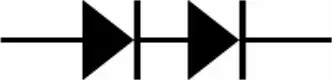
This symbol represents ___
Drain off Valve
Double Check Valve
Radiator Valve
Circulator or pump
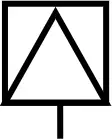
Identify this symbol
Drain off Valve
Double Check Valve
Automatic Air Vent (A.A.V)
Circulator or pump

