
 Worksheets
Aviation Communication and Marking Questions
Total questions: 20
Worksheet time: 10mins
(Refer to Figure 26, area 4.) The CTAF/UNICOM frequency at Jamestown Airport is
122.0 MHz.
123.0 MHz.
123.6 MHz.
Upon request by the FAA, the remote pilot-in-command must provide
a logbook documenting small UA landing currency.
a remote pilot certificate with a small UAS rating.
any employer issued photo identification.
A public unmanned aircraft system (UAS)
is the only type approved for operations in public locations.
is a UAS owned or operated by a federal, state, or local government agency.
is never subject to 14 CFR Part 107.
Exhaust plumes are most dangerous when
the surrounding air is calm and cold.
they are visible.
they come from larger towers.
What could be a consequence of operating a small unmanned aircraft above its maximum allowable weight?
Shorter endurance.
Faster speed.
Increased maneuverability.
Which of the following types of operations are excluded from the requirements in part 107?
Model aircraft for hobby use.
UAS used for motion picture filming.
Quadcopter capturing aerial imagery for crop monitoring.
Unmanned aircraft means an aircraft operated:
During search and rescue operations other than public.
Without the possibility of direct human intervention from within or on the aircraft.
By a remote pilot in command.
(Refer to Figure 26, area 2.) What is the recommended communication procedure when inbound to land at Cooperstown Airport?
Broadcast intentions when 10 miles out on the CTAF/MULTICOM frequency, 122.9 MHz.
Contact UNICOM when 10 miles out on 122.8 MHz.
Circle the airport in a left turn prior to entering traffic.
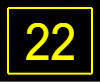
This sign confirms your position on A. runway 22. B. routing to runway 22. C. taxiway 22.
runway 22
routing to runway 22
taxiway 22
When may a remote pilot reduce the intensity of an aircraft's lights during a night flight?
At no time may the lights of an sUAS be reduced in intensity at night.
When a manned aircraft is in the vicinity of the sUAS.
When it is in the interest of safety to dim the aircraft's lights.
Which of the following operations would be regulated by 14 CFR 107?
Operating your sUAS for an imagery company.
Flying for enjoyment with family and friends.
Conducting public operations during a search mission.
The "taxiway ending" marker
A. indicates taxiway does not continue.
B. identifies area where aircraft are prohibited.
C. provides general taxiing direction to named taxiway.
While operating your small UA, it accidentally strikes your crewmember in the head, causing him to lose consciousness. When should this accident be reported?
No accidents need to be reported.
When requested by the UA owner.
Within 10 days of the accident.
An ATC radar facility issues the following advisory to a pilot during a local flight: "TRAFFIC 2 O'CLOCK, 5 MILES, NORTHBOUND..." Where should the pilot look for this traffic?
Between directly ahead and 90° to the left.
Between directly behind and 90° to the right.
Between directly ahead and 90° to the right.
25. Operating outside of the weight and balance limits of an unmanned aircraft
A. can result in loss of control of the aircraft.
B. increases performance.
C. is not possible per aircraft design.
The FAA may approve your application for a waiver of provisions in part 107 only when it has been determined that the proposed operation:
Will be conducted outside of the United States.
Involves public aircraft or air carrier operations.
Can be safely conducted under the terms of that certificate of waiver.
The angle of attack at which an airplane wing stalls will
increase if the CG is moved forward.
change with an increase in gross weight.
remain the same regardless of gross weight.
According to 14 CFR part 48, when must a person register a small UA with the Federal Aviation Administration?
All civilian small UAs weighing greater than .55 pounds must be registered regardless of its intended use.
When the small UA is used for any purpose other than as a model aircraft.
Only when the operator will be paid for commercial services.
The most comprehensive information on a given airport is provided by
the Chart Supplements U.S. (formerly Airport Facility Directory).
Notices to Airmen (NOTAMS).
Terminal Area Chart (TAC).
The most effective method of scanning for other aircraft for collision avoidance during daylight hours is to use
regularly spaced concentration on the 3-, 9-, and 12-o'clock positions.
a series of short, regularly spaced eye movements to search each 10-degree sector.
peripheral vision by scanning small sectors and utilizing off-center viewing.

