
NEW
Font size
 Worksheets
7.10.A & B Quiz
Total questions: 20
Worksheet time: 17mins
What is a trace fossil?
A complete organism
Evidence of an organism, like a footprint
A type of rock
A living plant
What processes expose fossils to Earth's surface?
Freezing and thawing
Erosion and uplifting
Melting and solidifying
Burning and cooling
The three types of tectonic plate boundaries do NOT include:
Convergent
Divergent
Transform
Mid-Ocean
What theory was Wegener's concept accepted as part of?
Theory of Evolution
Theory of Plate Tectonics
Theory of Relativity
Theory of Gravity
Which type of rock is most likely to contain fossils?
Sedimentary rock
Metamorphic rock
Volcanic rock
Igneous rock
What is the main cause of tectonic plate movement?
Wind currents
Solar radiation
Ocean tides
Convection currents in the mantle
How do fossils help in understanding the movement of tectonic plates?
They show that continents have always been in the same position.
They suggest that all continents were once underwater.
They provide evidence of similar species on different continents.
They indicate that tectonic plates do not move.

Scientist who studies rocks and the history of the Earth.
Paleontologist
Geologist
Meteorologist
Climatologist
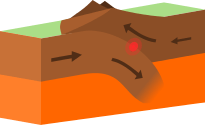
What type of plate boundary is shown in the image?
Plate
Divergent
Convergent
Transform

What is a scientist who studies fossils called?
Fossilologist
Rock Hound
Archaeologist
Paleontologist
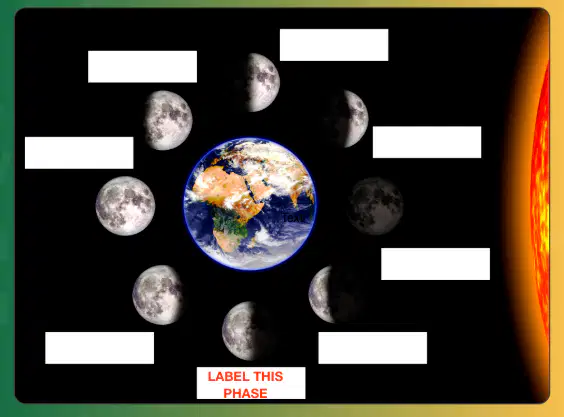
Label the lunar phase in RED on the photo.
Waning crescent
Last quarter
First quarter
Waxing gibbous
Why was Wegener's theory initially rejected by scientists?
His fossil evidence was incorrect.
His climate evidence was wrong.
He couldn't explain why the plates moved.
His timing was incorrect.
What is the lithosphere?
The inner and outer core combined
The crust and upper mantle
The lower mantle only
The asthenosphere
Even the fastest tectonic plates only move tens of ____ every year! That's a very short distance!
cubic centimeters
millimeters
centimeters
inches
What type of rock makes up the mantle?
Sedimentary
Metamorphic
Semi-solid molten
Solid crystalline
True or False:
Oceanic and Continental are the two types of Earth's crust.
True
False
The Earth's atmosphere is a mixture of which three gases?
Soil, Rocks, and Metal
Hydrogen, Helium, and Methane
Nitrogen, Oxygen, and Carbon Dioxide
Bacteria, Fungi, and Plants

4. What plate motion is happening at point B?
A convergent boundary where two plates collide.
A divergent boundary where two plates pull apart.
A transform boundary where two plates slide past each other.
Not enough information is given to be able to identify the plate motion.
Place the composition of these gases in order from greatest to least in the Earth's atmosphere:
Nitrogen > Argon = Carbon Dioxide
Oxygen > Methane > Nitrogen
Oxygen > Carbon Dioxide > Nitrogen
Carbon Dioxide > Oxygen > Hydrogen
The uppermost layer of the Earth is called
Mantle
Asthenosphere
Crust
Geosphere

