
 Worksheets
Final ESS A
Total questions: 60
Worksheet time: 30mins
Name
Class
Date
1.
What does the Big Bang Theory tell you?
a)
How stars are formed
b)
How the universe began
c)
How galaxies are formed
d)
How planets are formed
2.
Ultimately what will determine the path a star takes in its life cycle?
a)
Its mass
b)
Its temperature
c)
Its distance from Earth
d)
Its color
3.
What are some effects of solar flares on Earth?
a)
GPS Outages
b)
Auroras
c)
Radio outages
d)
All of the above
4.
This type of graph is used to show how some fixed quantity is broken into parts.
a)
Line graph
b)
Bar graph
c)
Pie chart
d)
Scatter plot
5.
The name of the law that explains the farther the galaxy is the faster it is moving away. This also provides supporting evidence for the Big Bang Theory.
a)
Newton's Law of Motion
b)
Einstein's Theory of Relativity
c)
Hubble's Law
d)
Kepler's Laws of Planetary Motion
6.
How does the sun get its energy?
a)
Nuclear fusion
b)
Nuclear fission
c)
Chemical reactions
d)
Gravity
7.
Compared to red shift, blue shift has ____________ wavelengths.
a)
Shorter
b)
Longer
c)
No change in
d)
Variable
8.
Approximately, how often does solar maximum happen?
a)
Every 1 year
b)
Every 11 years
c)
Every 100 years
d)
Every 1000 years
9.
This type of graph can show any relationship where the dependent variable changes due to a change in the independent variable (ex. change over time).
a)
Line graph
b)
Bar graph
c)
Pie chart
d)
Scatter plot
10.
This type of graph is useful for comparing information collected by counting.
a)
Line graph
b)
Bar graph
c)
Pie chart
d)
Scatter plot
11.
What is the difference between extrapolating and interpolating?
a)
Extrapolating is estimating values within the range of data, while interpolating is estimating values outside the range of data
b)
Extrapolating is estimating values outside the range of data, while interpolating is estimating values within the range of data
c)
Extrapolating is estimating values based on patterns, while interpolating is estimating values based on averages
d)
Extrapolating is estimating values based on averages, while interpolating is estimating values based on patterns
12.
What are sunspots?
a)
Dark spots on the surface of the sun with lower temperatures and stronger magnetic fields
b)
Bright spots on the surface of the sun with higher temperatures and lower magnetic fields
c)
Planets orbiting the sun emitting more light
d)
Comets passing by the sun emitting light
13.
Where are the independent and dependent variables located?
a)
Independent variable is on the x-axis, dependent variable is on the y-axis
b)
Independent variable is on the y-axis, dependent variable is on the x-axis
c)
Independent variable is on the z-axis, dependent variable is on the x-axis
d)
Independent variable is on the x-axis, dependent variable is on the z-axis
14.
What were the 2 atoms to form first?
a)
Hydrogen and helium
b)
Oxygen and carbon
c)
Nitrogen and hydrogen
d)
Helium and lithium
15.
How is a wavelength measured?
a)
The distance between two consecutive peaks (crests) of a wave
b)
The distance between two consecutive nodes of a wave
c)
The distance between the first and last observed wave
d)
The distance from a trough to a peak
16.
What is a dependent variable? What is an independent variable?
a)
The variable that is manipulated in an experiment; the variable that is measured or observed in an experiment
b)
The variable that is measured or observed in an experiment; the variable that is manipulated or tested in an experiment
c)
The variable that is controlled in an experiment; the variable that is measured or observed in an experiment
d)
The variable that is measured or observed in an experiment; the variable that is controlled in an experiment
17.
What are supporting pieces of evidence for the Big Bang Theory?
a)
Formation of elements
b)
Expansion
c)
Cosmic background radiation
d)
All of the Above
18.
Which of the following is an approximate age of when the Sun and Earth formed, along with the rest of the solar system?
a)
4.6 billion years ago
b)
4.6 million years ago
c)
13.7 billion years ago
d)
1 million years ago
19.
What method of radiometric dating should be used on once living samples?
a)
Potassium-40 and Argon-40
b)
Uranium-238 and Lead-206
c)
Carbon-14
d)
Rubidium-87 and Strontium-87
20.
The chemical composition of the atmosphere is similar to what it is today compared to when it formed _______ years go.
a)
1.5 billion
b)
3.5 million
c)
1.5 million
d)
3.5 billion
21.
According to Kepler’s 1st Law, the shape of a planetary orbit is called ___________.
a)
a circle
b)
an ellipse
c)
an epicycle
d)
a gravitational constant
22.
Read each clue and identify the correct law the clue is referring to:
Each planet revolves around the sun with equal area in equal time.
a)
Kepler's 1st Law
b)
Kepler's 2nd Law
c)
Kepler's 3rd Law
d)
Law of Universal Gravitation
23.
Read each clue and identify the correct law the clue is referring to:
The greater the eccentricity, the more elongated an ellipse is.
a)
Kepler's 1st Law
b)
Kepler's 2nd Law
c)
Kepler's 3rd Law
d)
Law of Universal Gravitation
24.
The first atmosphere of early Earth had a high percentage of these elements.
a)
Hydrogen and Oxygen
b)
Helium and Hydrogen
c)
Carbon Dioxide and Oxygen
d)
Nitrogen and Iron
25.
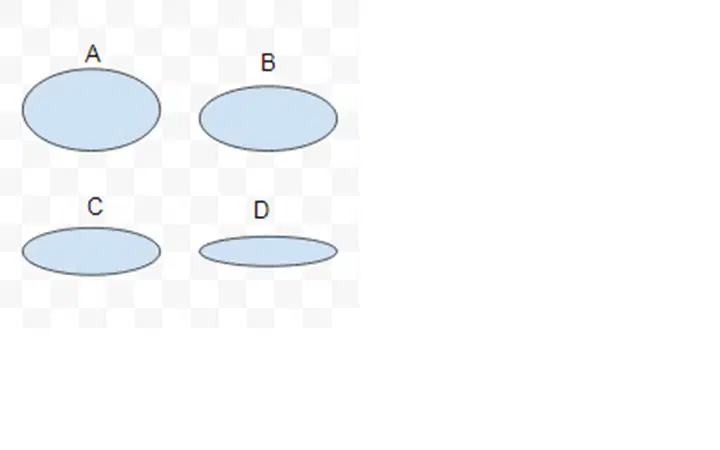
Identify which ellipse is most eccentric?
a)
A
b)
B
c)
C
d)
D
26.

Determine the force of gravitational attraction between the earth with a mass of 5.98 x 10^24 kg and the moon with a mass of 7.35x10^22 kg. The distance is 3.84 x 10^8 m from earth's center. How would you set up this problem to solve it?
a)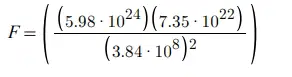
Option 1
b)
Option 2
c)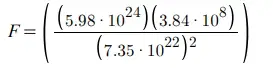
Option 3
d)
Option 4
27.
Which law from Kepler would you use if you wanted to determine the period of revolution for a planet that had an average distance of 1.76 AU’s from the Sun?
a)
Kepler’s 1st Law
b)
Kepler’s 2nd Law
c)
Kepler’s 3rd Law
d)
Kepler's 4th Law
28.
If we start with 400 atoms of a radioactive substance, how many would remain after four half-lives?
a)
50
b)
25
c)
12.5
d)
6.25
29.
Which layer of the Earth is the hottest?
a)
Crust
b)
Mantle
c)
Outer Core
d)
Inner Core
30.
Where does thermal convection primarily occur?
a)
In the atmosphere
b)
In the oceans
c)
In the Earth's mantle
d)
In the crust
31.
What is the equation for density?
a)
D = M + V
b)
D = M - V
c)
D = M / V
d)
D = V / M
32.
If oil floats on water, what does this indicate about the density of oil compared to water?
a)
Oil is denser than water
b)
Oil is less dense than water
c)
Oil has the same density as water
d)
Oil's density is variable
33.
Which processes do scientists use to learn about the Earth's layers?
a)
Seismic wave analysis
b)
Magnetic field studies
c)
Both above
d)
None of the above
34.
What do seismic waves measure?
a)
Temperature changes
b)
Earth's magnetic field
c)
Earthquake activity
d)
Earth's layers
35.
Which seismic wave can ONLY travel through solid rock?
a)
P Wave
b)
S Wave
c)
Surface Wave
d)
Rayleigh Wave
36.
If an object sinks in water, what does that tell you about its density?
a)
It is less dense than water
b)
It is more dense than water
c)
It has the same density as water
d)
It is variable
37.
Can scientists make direct observations within the Earth’s layers? Why?
a)
Yes, using drilling
b)
No, it's impossible to observe
c)
Yes, using seismic waves
d)
No, only through indirect methods
38.
What can result from convection currents in the Earth's interior?
a)
Trenches
b)
Ridge Crests/Volcanoes
c)
All of the above
d)
None of the Above
39.
What makes up the lithosphere?
a)
Crust and upper mantle
b)
Crust and outer core
c)
Mantle and inner core
d)
Outer core and inner core
40.
What is seafloor spreading?
a)
Movement of tectonic plates
b)
Formation of mountains
c)
Creation of ocean trenches
d)
Expansion of oceanic crust
41.
What is subduction?
a)
When two plates collide
b)
When one plate moves under another
c)
When plates slide past each other
d)
When plates separate
42.
Which type of crust is more dense?
a)
Oceanic crust
b)
Continental crust
c)
Both are equally dense
d)
Neither is dense
43.
What is an earthquake?
a)
A sudden release of energy in the Earth's crust from plate tectonics sliding past each other
b)
A volcanic eruption
c)
A shift in tectonic plates moving away
d)
A weather phenomenon
44.
Which material helps create Earth’s magnetic field?
a)
Quartz
b)
Iron
c)
Calcite
d)
Feldspar
45.
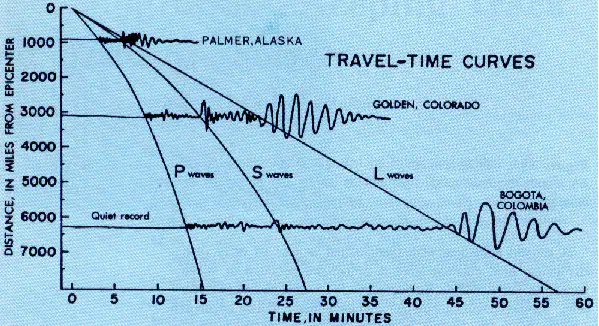
According to seismic wave data, which wave is slower?
a)
P Wave
b)
S Wave
c)
Both travel at the same speed
d)
Surface Wave
46.
What theory supports continental drift?
a)
Plate Tectonics
b)
Seafloor Spreading
c)
Magnetic Reversal
d)
Volcanic Activity
47.
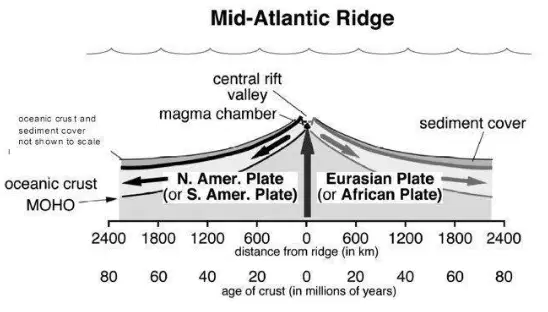
How old should the age of the crust be when the seafloor has spread 3,000 kilometers from the ridge?
a)
40 Million
b)
60 Million
c)
80 Million
d)
100 Million
48.
If we use the units of grams (g) for mass and cubic centimeters (cm3) for volume, then the units for density will be…...Remember, D=M/V
a)
g * cm^3
b)
cm^3/g
c)
g/cm^3
d)
g/mL
49.
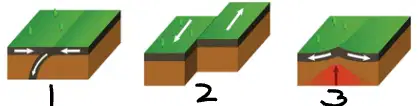
Name each plate boundary:
a)
(1)Convergent (2)Divergent (3) Transform
b)
(3)Convergent (2)Divergent (1) Transform
c)
(1)Convergent (3)Divergent (2) Transform
d)
(2)Convergent (1)Divergent (3) Transform
50.
What event happens at divergent plate boundaries of 2 oceanic plates?
a)
volcanoes
b)
earthquakes
c)
seafloor spreading
d)
mountains
51.
What is the primary difference between mechanical and chemical weathering?
a)
Mechanical weathering changes the rock's composition, while chemical weathering does not.
b)
Mechanical weathering involves physical processes, while chemical weathering involves chemical reactions.
c)
Mechanical weathering occurs only in cold climates, while chemical weathering occurs only in warm climates.
d)
Mechanical weathering is faster than chemical weathering.
52.
Which of the following is an example of erosion?
a)
A rock breaking apart due to freeze-thaw cycles.
b)
Soil being washed away by rainwater.
c)
A tree root growing into a rock.
d)
Iron rusting due to moisture.
53.
Which of the following best describes a constructive force?
a)
A force that breaks down landforms.
b)
A force that builds up landforms.
c)
A force that has no impact on landforms.
d)
A force that only occurs during earthquakes.
54.
What is frost wedging?
a)
The process of ice melting and causing erosion.
b)
The expansion of water when it freezes, which cracks rocks.
c)
The formation of glaciers.
d)
The movement of ice sheets over land.
55.
What role does abrasion play in weathering?
a)
It causes rocks to chemically change.
b)
It smooths and polishes rocks through friction.
c)
It adds minerals to the soil.
d)
It prevents further weathering.
56.
Biological weathering is primarily caused by:
a)
Chemical reactions in the soil.
b)
The physical actions of living organisms.
c)
The effects of temperature changes.
d)
Wind and water movement.
57.
What is oxidation in the context of weathering?
a)
The process of rocks breaking apart due to temperature changes.
b)
The reaction of minerals with oxygen, leading to rusting.
c)
The movement of soil by wind.
d)
The freezing and thawing of water in rocks.
58.
How does acid rain contribute to weathering?
a)
It increases the temperature of the rocks.
b)
It chemically reacts with minerals, breaking them down.
c)
It physically erodes rocks through heavy rainfall.
d)
It has no effect on weathering.
59.
Carbon dioxide erosion primarily occurs through:
a)
The physical movement of rocks by wind.
b)
The chemical reaction of carbon dioxide with water, forming carbonic acid.
c)
The freezing of water in cracks.
d)
The growth of plant roots.
60.
Which of the following processes is considered a destructive force?
a)
Volcanic eruptions that create new land.
b)
Erosion that wears down mountains.
c)
Deposition that builds up riverbanks.
d)
Earthquakes that create new landforms.
100 %

