
 Worksheets
PFL-Economics Mid-Term Review
Total questions: 25
Worksheet time: 14mins
Which statement best explains the impact of fiscal policies on the unemployment rate?
When the government reduces taxes, it prompts consumers to increase spending, leading businesses to boost production, ultimately resulting in a decrease in unemployment.
When the government reduces taxes, it prompts consumers to decrease spending, leading businesses to reduce production, ultimately resulting in a decrease in unemployment.
When the government increases spending, it prompts businesses to reduce production, ultimately resulting in a increase in unemployment.
When the government reduces spending, it contracts companies to manufacture goods that the government needs, leading to a rise in unemployment.
Which type of financial aid involves programs offering career-related work experience?
Grants
Scholarships
Work-Study
Student Loans
What type of financial aid is typically awarded based on a student's achievements and/or accomplishments?
Grants
Work-Study
Scholarships
Student Loans
Which financial aid option involves borrowed funds that must be repaid?
Grants
Work-Study
Scholarships
Student Loans
Which statement is TRUE about the value of a college degree? Select TWO correct answers.
A high school graduate can expect to earn about the same as a college graduate.
A college degree generally leads to higher lifetime earnings compared to a high school diploma.
A college graduate can expect to earn, on average, more than a high school graduate over a career.
A college graduate typically earns less than someone with a high school diploma for the first 10 years.
Every college graduate can expect to have a starting salary over $60,000 right after college.
Grants and _______ are better than student loans for financing college because they do not require repayment.
scholarships
loans
debts
interests
Based on this excerpt, how do economic concepts like choice and opportunity cost relate to everyday decision-making?
Choice and opportunity cost involve deciding between different activities and understanding that choosing one option means forgoing others.
Choice and opportunity cost primarily affect financial decisions and are less relevant to balancing academic and personal responsibilities.
Choice and opportunity cost are only relevant in a professional context, not in managing a college workload or extracurricular activities.
Choice and opportunity cost only impact the decision-making of individuals with a flexible work-life balance.
Which statements describe some of the benefits of a free enterprise economy? Select TWO correct answers.
A. Individuals and businesses are allowed to own private property.
B. Customs and tradition determine what goods are produced.
C. All major economic decisions are made by government planners.
D. Property and resources are all nationally-owned.
E. Profits and wages motivate individuals and firms to engage in the economy.
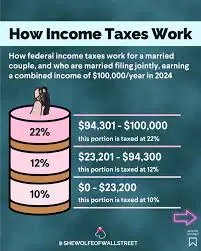
Which taxation underlies the levels of taxation shown for the three individuals in the infographic above.
Regressive
Ability to Pay
Progressive
Benefits recieved

What is the purpose of providing parents' information when completing FAFSA application?
Verify mailing address
Confirm dependency status
Confirm high school graduation date
Calculate your family's contribution to education
For a consumer, which is part of making an economic choice?
The consumer makes goods and services to sell to others.
The consumer moves to a place that has very few businesses.
The consumer purchases everything he or she needs or wants.
The consumer weighs his or her needs and wants before spending money.
What health insurance plan is sponsored by a large company who forms a contract with certain health agencies to provide certain types of health care at reduced rates?
HMO
PPO
Indemnity Plans
Out of Pocket
John must pay $10 for each visit to his physician. What term describes the $10 payment?
Deductible
Co-Insurance
Premium
Co-Payment
What do the initials PPO stand for?
Preferred Provider Option
People's Preferred Option
Preferred Provider Organization
Partial Practice Organization
What is the disadvantage of belonging to an HMO?
monthly fee, no additional charge for care
required to see only HMO affiliated providers
care is directed toward prevention of disease
private insurance option
The amount that must be paid by the patient for medical services before the policy begins to pay is the:
(a)
Short term disability is coverage for someone who is out of work for a short period of time
True
False
When do you need disability insurance?
When you lose your job
When you first obtain a job
When you drop out of school
When you become disabled and are unable to earn an income
What is the waiting period for short term disability insurance?
0-4 weeks
0-14 days
6 months or less
0-14 weeks
What percent of your income does disability insurance cost?
They are all the same 1-3%
Short term 3-5% Long Term 1-3%
Short Term 1-3% Long Term 3-5%
None of these answers are correct
Long term disability insurance can take up to several months to obtain
True
False
What is not covered by Long-term Care Insurance?
Medical care costs
Nursing homes
Short-term hospice care for individuals who are terminally ill
At-home care
Long-term care insurance is coverage that provides nursing-home care, and personal adult daycare for seniors with a chronic or disabling condition that needs constant supervision.
True
False
The older the senior is , the cheaper their premium will be.
True
False
When looking at options for LTC insurance, you should consider:
Rates
Benefits and discounts
What is and isn't covered, and out-of-pocket money
All of the above

