
 Worksheets
cladograms and phylogeny
Total questions: 21
Worksheet time: 2hrs 32mins
The bullfrog, Rana catesbeiana, is most closely related to the
spotted chorus frog, Pseudacris clarki
asian flying frog, Polypedates leucomystax
northern leopard frog, Rana pipiens
african bullfrog, Pyxicephalus adspersus
At what point in time did the species become carnivorous?
Why is it important to assign each organism a scientific name?
Each scientific name applies to only one species, making it universally identifiable to scientists.
Each scientific name allows scientists to better study the behavior of an organism.
The scientific name allows scientists to develop common names for organisms.
The scientific name describes how an individual looks relative to others of the same genus.
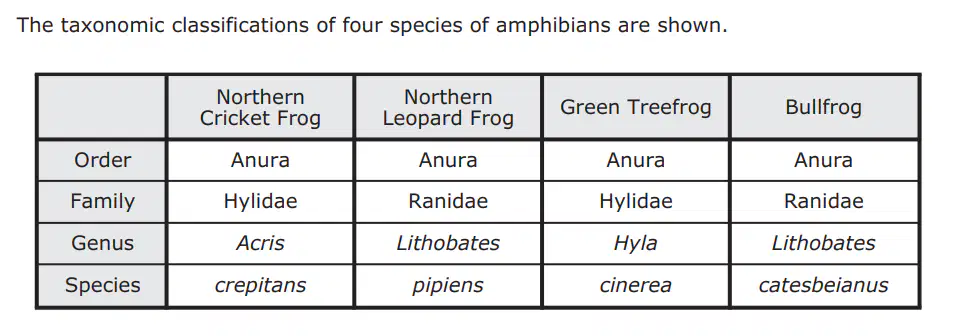
Based on the information provided, which two species are most closely related?
Northern leopard frog and bullfrog
Northern cricket frog and green treefrog
Northern leopard frog and green treefrog
Northern cricket frog and bullfrog
Place the labels where they go according to taxonomic classification.
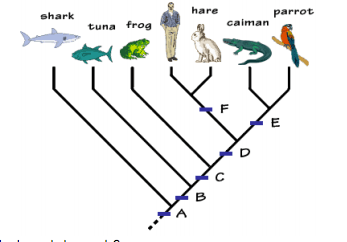
On the cladogram, which organism is the closest relative of the parrot?
Frog
Hare
Caiman
Parrot

According to this tree, which of these animal phyla are most closely related?
Arthropoda & Mollusca
Arthropoda & Chordata
Chordata & Mollusca
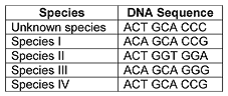
When comparing the DNA of two different organisms, the more differences in the DNA base pairs the more-
Closely related they are.
Distantly related they are.
It doesn't prove anything.
They look alike.

Which letter represents the most recent common ancestor of sponges and mushrooms?
A
B
C
D
E

In a phylogenetic tree, the branching points represent common ancestors.
Yes
NO

What is the common ancestor of Letters C and E?
1
2
3
4

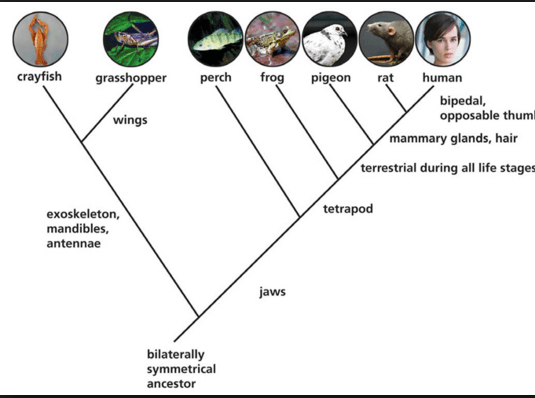
Each node on a cladogram represents...
the last point at which two groups shared a common ancestor.
the point at which one or more species became extinct.
the most recent point at which a trait was lost in a certain clade.
the point at which two clades joined and became monophyletic.

According to this image, which two domains of life are most related?
Bacteria & Archaea
Archaea & Eukarya
Eukarya & Bacteria

Which cladogram best fits the data table?


Which of the following best describes a cladogram?
A) A diagram that shows the geographic distribution of species
B) A chart that lists species in alphabetical order
C) A branching diagram that illustrates evolutionary relationships
D) A timeline of species' extinction events

Which species is most closely related to E?
A
B
C
D
F
How has technology helped us in understanding evolutionary relationships?
We can travel back in time to observe different organisms in their habitats.
We clone different organisms using DNA from fossils so we can bring them back and observe.
We can now compare the DNA of different organisms to help determine the relationships between them.
We can follow different organisms on Twitter to look for similar traits and characteristics.
What is phylongeny?
the study of all phyla in the classification system
the evolutionary history of a species or taxonomic group
the study of plants
the study of animals

