
 Worksheets
Unit 3 3/4 Complete Review
Total questions: 45
Worksheet time: 45mins
The Earth completes one of these every 365.25 days
rotation
revolution

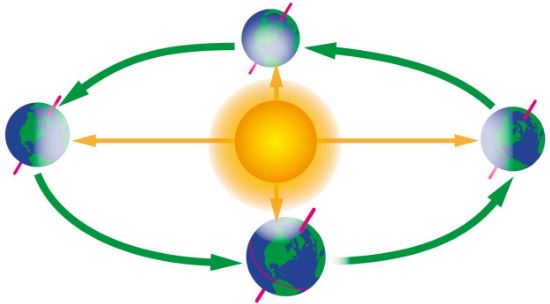


Days on Earth are shortest during which season?
Summer
Winter
Spring
Fall
Half of a sphere is also called a ____________.
celestial sphere
hemisphere
globe
cluster
A group of stars that form a pattern in the sky when viewed from earth is called a _____________.
galaxy
solar system
planet
constellation
Huge glowing balls of gases made up of mostly hydrogen and helium are called ____________.
hemisphere
stars
planets
comets
How many named constellations are there?
80
84
88
92
Who were the first ancient group of people to first describe constellations?
French
Greek
British
Chinese
Which is NOT an example of how constellations were helpful to people throughout history?
Helped keep track of the calendar
Helped provide heat during the winter months
Helped with navigation
Helped farmers know when to plant and harvest crops
The Big Dipper is located in which constellation?
Ursa Major
Ursa Minor
Orion
Andromeda

Stars like the sun appear to move across the sky due to Earth _________________ on it's axis
Revolving
Wobbling
Rotating
Jumping


Asteroids are found in a region called the
Kuiper Belt
Asteroid Belt
Oort Cloud
Earth's surface

A comet forms a tail when
It is deep in outer space and begins to melt
It gets close to the sun and begins to melt
They revolve around the Sun.
Inner Planets
Outer Planets
Both
They are terrestrial and have rocky surfaces.
Inner Planets
Outer Planets
Both
They are relatively close to each other.
Inner Planets
Outer Planets
Both
They are larger in size.
Inner Planets
Outer Planets
Both
They have many moons.
Inner Planets
Outer Planets
Both
They have gravity.
Inner Planets
Outer Planets
Both
They have a gaseous surface.
Inner Planets
Outer Planets
Both
They are all very cold.
Inner Planets
Outer Planets
Both
They have few or no moons.
Inner Planets
Outer Planets
Both
They are in our Solar System.
Inner Planets
Outer Planets
Both

The table below shows some of the characteristics of a planet. Which two characteristics would be most helpful for determining whether the planet is a gas giant or a rocky planet?
Length of day and color
Diameter and length of day
Color and number of moons
Number of moons and diameter
Until 2006, Pluto was considered the solar system’s ninth planet. Pluto is now classified as a dwarf planet. Which of these properties of Pluto explains why it is classified as a dwarf planet?
It does not orbit the sun.
It is too far from Earth.
It is too small to be a planet.
It has other bodies in its orbit.
Ganymede is a moon of Jupiter. It is larger than Mercury and has a metallic core similar to Earth’s core. Which of these statements best explains why Ganymede is classified as a moon rather than a planet?
It is too large to be called a planet.
It orbits Jupiter instead of the sun.
Its properties are different from Jupiter.
It is farther from the sun than Mercury.
All the planets in the solar system orbit the sun. What is the main difference between the orbits of the inner and outer planets?
The inner planets travel a greater distance than the outer planets do.
The inner planets have almost round orbits, and the outer planets do not.
The outer planets rotate as they orbit the sun, and the inner planets do not.
The outer planets’ orbits are longer than the inner planets’ orbits.

Josleen divided some of the planets into two main groups. The table below shows how she grouped them. Which of the following two categories did Josleen most likely use to group the planets?
Planets and dwarf planets
With moons and without moons
Orbit the sun and orbit other bodies
Small diameters and large diameters
The Kuiper Belt is a region of the solar system that contains thousands of objects, including dwarf planets. Where is the Kuiper Belt located?
Just after Neptune
Just before Mercury
Between Mars and Jupiter
Between Uranus and Neptune

