
 Worksheets
Waves Introduction Quiz
Total questions: 124
Worksheet time: 2hrs 6mins

The picture shows 4 sound waves on an oscilloscope. Which has the highest pitch?
A
B
C
D
The picture shows 4 sound waves on an oscilloscope. What can you say about A?
It is a very low pitched sound
It is a very high pitched sound
It is a very quiet sound
It is a very loud sound
The picture shows 4 sound waves on an oscilloscope. Which 2 have the smallest amplitude?
A
B
C
D
The picture shows 4 sound waves on an oscilloscope. What is the wavelength of B?
4 boxes
2 boxes
6 boxes
8 boxes
The picture shows 4 sound waves on an oscilloscope. What is the amplitude of B?
4 boxes
2 boxes
6 boxes
8 boxes

What type of wave is shown by the diagram?
Transverse
Longitudinal
Which is true about transverse waves?
Sound waves are transverse
They have areas of rarefaction and compression
Vibrations are across the direction of travel
Which statement is true of sound waves. Select 2 answers.
They are made by objects vibrating
They are detected because they make our ear drum vibrate
They are transverse waves
They travel faster in air than in water.

The distance between 2 crests or troughs
wavelength
amplitude
frequency
wave speed
The picture shows 4 sound waves on an oscilloscope. Which has the highest pitch?
A
B
C
D
The picture shows 4 sound waves on an oscilloscope. What can you say about A?
It is a very low pitched sound
It is a very high pitched sound
It is a very quiet sound
It is a very loud sound
Which statement is true of sound waves. Select 2 answers.
They are made by objects vibrating
They are detected because they make our ear drum vibrate
They are transverse waves
They travel faster in air than in water.
What is the height of a wave called?
Peak
Wavelength
Amplitude
Frequency
Sound waves are caused by the (a) of particles

A
B

A
B
Human can hear Ultrasound?
YES
NO
Select the correct answer: Ultrasound are...
sounds that only dolphins can produce
sounds that have a frequency above 20 000Hz
sounds that only superheroes can hear
sounds that are below 20 000Hz
From the words below, which one is linked with the Pitch of the sound
Amplitude
Loudness
Frequency
speed
Frequency is measured in
m/s
m
Hz
Decibel
The picture shows 4 sound waves on an oscilloscope. Which 2 have the smallest amplitude?
A
B
C
D

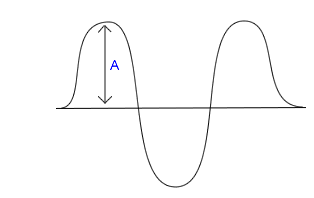
Wave height
frequency
wavelength
amplitude
wave speed
The distance between 2 crests or troughs
wavelength
amplitude
frequency
wave speed
The number of waves that pass in a given amount of time.
wavelength
wave speed
amplitude
frequency
Which of the following are measured in metres
amplitude
wavelength
frequency
Which of the following are measured in Hertz (Hz)
amplitude
wavelength
frequency

What type of wave is this?
longitudinal
transverse
Which of these is NOT an example of a transverse wave
Seismic waves
Sound
Light
Ripples on water

The highest point on a wave is:
the crest
the trough
the top
the coast
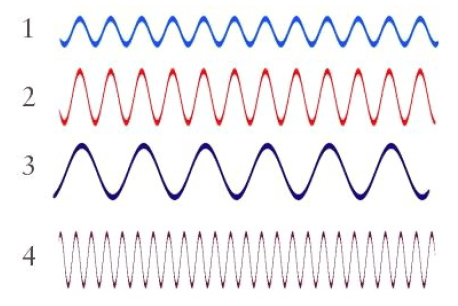
Which wave in the diagram has the greatest frequency?
1
2
3
4
Light travels... (select 2 answers)
Around corners
In straight lines
Faster in glass than in air
Faster than sound
Light and water waves are examples of what?
Transverse waves
Longitudinal waves
The speed of light in a vacuum is:
3 x 10⁹ m/s
3 x 10⁸ m/s
3 x 10⁸ km/s
3 x 108 cm/s

What word describes the distance between the middle line and the highest part of the wave?
Wavelength
Superposition
Amplitude
Frequency
What type of wave does sound travel as?
Transverse
Longitudinal
A high pitched sound has a:
high frequency
low frequency
What units is frequency measured in?
Meters
Newton
Hertz
Seconds
Frequency measures:
the number of vibrations per hour
the number of vibrations per minute
the number of vibrations per second
the number of vibrations per millisecond


The angle of incidence is _________ the angle of reflection


Which type of wave does light travel in?
Ocean wave
Compression wave
Transverse waves
Radio wave

In the diagram, which letter represents the angle of incidence?
A
B
C
D


Which type of wave does light travel in?
Ocean wave
Compression wave
Transverse waves
Radio wave
Light travels... (select 2 answers)
Around corners
In straight lines
Faster in glass than in air
Faster than sound

When drawing ray diagrams, you need to...
Use a ruler
Use a pencil
Have no gaps in the light rays
Put an arrow to show the direction the light ray is travelling
The picture shows 4 sound waves on an oscilloscope. Which has the highest pitch?
A
B
C
D
The picture shows 4 sound waves on an oscilloscope. What can you say about A?
It is a very low pitched sound
It is a very high pitched sound
It is a very quiet sound
It is a very loud sound
The picture shows 4 sound waves on an oscilloscope. Which 2 have the smallest amplitude?
A
B
C
D
The picture shows 4 sound waves on an oscilloscope. What is the wavelength of B?
4 boxes
2 boxes
6 boxes
8 boxes
Which statement is true of sound waves. Select 2 answers.
They are made by objects vibrating
They are detected because they make our ear drum vibrate
They are transverse waves
They travel faster in air than in water.

Which statement is true for refraction of light? Choose 2 answers.
When it enters a denser medium (e.g. from air to glass), it changes direction towards the normal.
When it enters a denser medium (e.g. from air to glass), it changes direction away from the normal.
When it enters a less dense medium (e.g. from glass to air), it changes direction towards the normal.
When it enters a less dense medium (e.g. from glass to air), it changes direction away from the normal.
The picture shows 4 sound waves on an oscilloscope. What is the amplitude of B?
4 boxes
2 boxes
6 boxes
8 boxes
What type of wave is shown by the diagram?
Transverse
Longitudinal
The picture shows 4 sound waves on an oscilloscope. Which 2 have the smallest amplitude?
A
B
C
D
Which statement is true of sound waves. Select 2 answers.
They are made by objects vibrating
They are detected because they make our ear drum vibrate
They are transverse waves
They travel faster in air than in water.
What is the height of a wave called?
Peak
Wavelength
Amplitude
Frequency
The distance between 2 crests or troughs
wavelength
amplitude
frequency
wave speed
All waves can be reflected
true
false
The speed of sound is about...
34 m/s
340 m/s
34,000 m/s
340,000 m/s
From the words below, which one is linked with the Pitch of the sound
Amplitude
Loudness
Frequency
speed
Frequency is measured in
m/s
m
Hz
Decibel
What does the Auditory canal do?
Makes ear wax
Pulls sound waves into the ear
End the journey of the sound waves
What happens in the eardrum?
Sound waves vibrate the skin and delivers vibrations
Sound waves make the tiny hairs in your ear move
Carries the message to the brain
What does the fluid inside your ears do?
Vibrates the skin in your ear
Sends sound waves to the brain
Vibrates the cilia (tiny hairs).
What does the Auditory nerve do?
Carries the message to the brain
Carries the message to the Semi-Circular canal
Send the message to the Eustachian tube
What is in the Semi-Circular canals?
Cilia (Tiny Hairs)
Liquid filled tubes
Thin Skin
Name the 3 bones in your ear
Hammer, Anvil, Shoe
Hammer, Anvil, Stirrup
Rods, Cones, Anvil
Where is the Cochlea located
The Inner Ear
The Middle Ear
The Outer Ear
Where is the Eardrum located?
The Outer ear
The Inner Ear
The Middle Ear
Where is the Eustachian Tube connected to?
The back of the head
The back of the nose
The back of the Ear

Light travels... (select 2 answers)
Around corners
In straight lines
Faster in glass than in air
Faster than sound

What are the mistakes in the image? Select 2 answers.
The arrow on the light ray is going towards the person's eye
The arrow on the light ray is going away from the person's eye
The arrow on the light ray is going towards the light source
The arrow on the light ray is going away from the light source

Which is true about reflection?
The angle of incidence is bigger than the angle of reflection.
The angle of incidence is smaller than the angle of reflection
The angle of incidence = the angle of reflection
When drawing ray diagrams, you need to...
Use a ruler
Use a pencil
Have no gaps in the light rays
Put an arrow to show the direction the light ray is travelling

What is happening to the light ray at the surface of the water to mean the fish appears higher up than it is?
The light ray is reflecting
The light ray is refracting
The light ray is scattering
The light ray is absorbed
The picture shows 4 sound waves on an oscilloscope. Which has the highest pitch?
A
B
C
D
The picture shows 4 sound waves on an oscilloscope. What can you say about A?
It is a very low pitched sound
It is a very high pitched sound
It is a very quiet sound
It is a very loud sound
The picture shows 4 sound waves on an oscilloscope. Which 2 have the smallest amplitude?
A
B
C
D
The picture shows 4 sound waves on an oscilloscope. What is the wavelength of B?
4 boxes
2 boxes
6 boxes
8 boxes
Which statement is true of sound waves. Select 2 answers.
They are made by objects vibrating
They are detected because they make our ear drum vibrate
They are transverse waves
They travel faster in air than in water.

What can you see here? Select 2 answers.
LIght is being refracted through a prism
Light is being reflected by the prism
A spectrum is formed
A rainbow is formed
Which statement is true for refraction of light? Choose 2 answers.
When it enters a denser medium (e.g. from air to glass), it changes direction towards the normal.
When it enters a denser medium (e.g. from air to glass), it changes direction away from the normal.
When it enters a less dense medium (e.g. from glass to air), it changes direction towards the normal.
When it enters a less dense medium (e.g. from glass to air), it changes direction away from the normal.

A ship sends out a pulse of ultrasound and hears its echo 0.3 seconds later. The speed of sound in water is 1500m/s. Calculate the depth of the sea below the ship.
450m
900m
225m
500m
The picture shows 4 sound waves on an oscilloscope. What is the amplitude of B?
4 boxes
2 boxes
6 boxes
8 boxes
Why can you not hear symbols clashed together a mile away? Select 2 answers.
The sound waves' energy travel too slowly
The sound waves' energy gets too spread out
The sound waves' energy is reflected away from you.
The sound waves' energy gets absorbed by objects and the air
If I shine white light at a red filter, what will I see the other side of the filter?
White light
No light
Red light
Yellow light
If I shine red light on a blue bowling ball, what colour will the bowling bowl appear to be?
Magenta
Black
Red
Blue
If I shine magenta light on a blue bowling ball, what colour will the bowling bowl appear to be?
Magenta
Black
Red
Blue
What type of wave is shown by the diagram?
Transverse
Longitudinal
Which is true about transverse waves?
Sound waves are transverse
They have areas of rarefaction and compression
Vibrations are across the direction of travel

