
Font size
 Worksheets
Evolutions Quiz
Total questions: 20
Worksheet time: 30mins
Which scientist came up with the idea of natural selection?
Lamarck
Lyell
Darwin
Malthus
Which best describes non-random mating?
Organism from different populations mate and have a new offspring
Organism from the same population that have similar characteristics have an offspring
Organisms from one population have an offspring and move to a different population
Which best describes convergent evolution?
It forms homologous structures
It forms structures in different species that are similar
Convergent evolution creates analogous structures that have similar form or function but were not present in the last common ancestor of those groups.

According to the diagram, what is the common ancestor of ALL organisms on the phylogenetic tree?
B
C
D
E

Which group on the cladogram arose FIRST?
Theropods
Allosaurus
Robin
Velociraptor

What is the common ancestor of Letters C and E?
1
2
3
4

Who is most closely related to Taxidea taxus?
Lutra lutra
Panthera pardus
Canis latrans
Canis lupus
Who is most closely related to Taxidea taxus?
Lutra lutra
Panthera pardus
Canis latrans
Canis lupus

What happens when a forest has too many deer?
Deer share the limited resources
Deer eat less so that all can survive
Only those that are least fit can survive
Only those that are best fit can survive
In the context of genetics, ___ are mistakes in the DNA that cause variation within a species.
mutations
adaptations
speciations
isolations
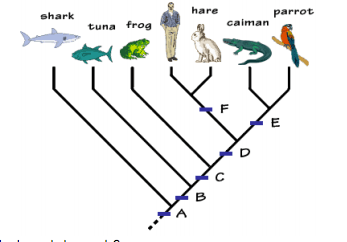
On the cladogram, which organism is the closest relative of the parrot?
Frog
Hare
Caiman
Parrot

Each node on a cladogram represents...
the last point at which two groups shared a common ancestor.
the point at which one or more species became extinct.
the most recent point at which a trait was lost in a certain clade.
the point at which two clades joined and became monophyletic.
What adaptation makes the most sense for living in a cold snowy area?
gills
colorful wings
white fur
striped skin
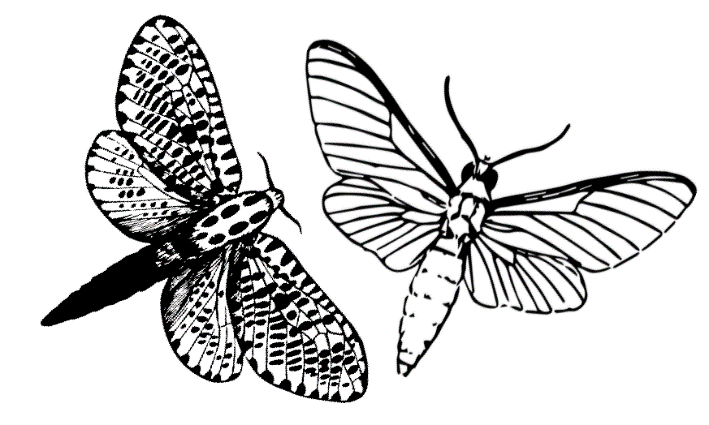
A physical trait favored by an environmental change can be called an (a)

Charles Darwin said all that species share:
a common ancestor
the same DNA
the same species
a home
What is evolution?
The change in organisms over time.
A group of the same species in a given area
Differences in inherited traits
Overproduction of offspring

