
 Worksheets
Chinese Geo Quiz
Total questions: 39
Worksheet time: 20mins
Name
Class
Date
1.

1
a)
Northwestern Plain
b)
North China Plain
c)
Northeastern Plain
d)
Northeastern China Plain
2.

2
a)
Northwestern Plain
b)
North China Plain
c)
Northeastern Plain
d)
Northeastern China Plain
3.

3
a)
Taklimakan Desert
b)
Ghandi Desert
c)
Gobi Desert
d)
Tiramisu Dessert
4.

4
a)
Taklimakan Desert
b)
Ghandi Desert
c)
Gobi Desert
d)
Tiramisu Dessert
5.

5
a)
Himalaya Plateau
b)
Gobi Plateau
c)
Yellow Plateau
d)
Tibetan Plateau
6.

6
a)
Himalaya Moutains
b)
Gobi Mountains
c)
Yellow Mountains
d)
Tibetan Mountains
7.

7
a)
Yellow River
b)
Huang He River
c)
Himalaya River
d)
Gobi River
e)
Yangtze River
8.

8
a)
Yangtze River
b)
Chang Jiang River
c)
Himalaya River
d)
Gobi River
e)
Yellow River
9.

9
a)
East China Sea
b)
Yellow Sea
c)
South China Sea
d)
Sea of Japan
e)
Bay of Bengal
10.

10
a)
East China Sea
b)
Yellow Sea
c)
South China Sea
d)
Sea of Japan
e)
Bay of Bengal
11.

11
a)
East China Sea
b)
Yellow Sea
c)
South China Sea
d)
Sea of Japan
e)
Bay of Bengal
12.

12
a)
East China Sea
b)
Yellow Sea
c)
South China Sea
d)
Sea of Japan
e)
Bay of Bengal
13.

13
a)
East China Sea
b)
Yellow Sea
c)
South China Sea
d)
Sea of Japan
e)
Bay of Bengal
14.

14
a)
Hawaii
b)
South China Island
c)
Japan
d)
Taiwan
e)
Mr. Kane's private island
15.
Modern China is the _______ largest country in the world, by land size.
a)
1st
b)
2nd
c)
3rd
d)
4th
16.
Modern China is the _______ largest country in the world, by population size.
a)
1st
b)
2nd
c)
3rd
d)
4th
17.
To understand Chinese history, it's helpful to divide China into two main areas: ________ China and _______ China
a)
Old and New
b)
North and South
c)
East and West
d)
Inner and Outer
18.
In southwest China you will find the ____________ Mountains.
a)
Kush
b)
Andes
c)
Himalayas
d)
Rocky
19.
The rivers often enrich the soil by _________ .
a)
flooding and depositing silt
b)
Running and flowing water into farms
c)
raining down from mountains and valleys
d)
telling jokes, which makes the soil laugh
20.
A place where water can be found in a desert is called a/an __________ .
a)
Silt
b)
Oasis
c)
tributary
d)
maize
21.
Fine particles of rock is called ___________.
a)
Silt
b)
Oasis
c)
tributary
d)
maize
22.
A stream that feeds into a larger river is called a
a)
Silt
b)
Oasis
c)
tributary
d)
maize
23.
A type of corn:
a)
Silt
b)
Oasis
c)
tributary
d)
maize
24.
What does the name Taklimakan mean?
a)
"The worlds smallest violin playing the worlds saddest song"
b)
"What goes up must come down"
c)
"Only one way in one way out"
d)
"Once you go in, you will not come out"
25.
Legend says what _______ is buried buried 600 feet beneath the sand dunes of the Taklimakan Desert.
a)
300 cities
b)
250 birds
c)
300 rivers
d)
1,0000 books
26.
Stretching over 500,000 square miles, the ________ Desert is one of the world's largest deserts.
a)
Gobi Desert
b)
Taklimakan Desert
c)
The Great Desert
d)
The Yellow Desert
27.
The Tibetan Plateau is how tall (on average)?
a)
13,500 feet
b)
4,500 feet
c)
29,000 feet
d)
800 feet
28.
Also known as the Tibetan Plateau, this area is often called the "_________ of the ________."
a)
"Roof of the World."
b)
"Roof of the Asia."
c)
"Inner and outer china"
d)
"Top of the World"
29.

This picture from page 188 shows what part of Ancient China?
a)
The Gobi Desert
b)
The Northeastern Plain
c)
The Tibetan Plateau
d)
Mr. Sundstrom's backyard
30.
Archeologists believe that the first inhabitants of China lived in _______ more than 500,000 years ago.
a)
Boats
b)
Mud Brick houses
c)
Walled towns
d)
Caves
31.
When people in China began farming, they settled mostly on the North China Plain in ______China.
a)
Inner
b)
Outer
c)
Lower
d)
Upper
32.
When people in China began farming, they settled mostly in villages near the what physical feature?
a)
Huang He River
b)
Tibet-Qinghai Plateau
c)
Taklimakan Desert
d)
Yellow Bay
33.
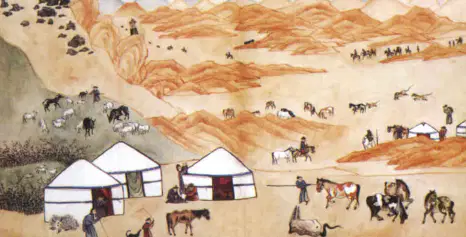
This is a picture of life from
a)
Inner China
b)
Outer China
34.

This picture shows the physical features of
a)
Outer China
b)
Inner china
35.
Nomads Outer China raised sheep, goats, cattle, and horses. Their main food was meat. They were constantly moving to find grass for their animals, so they lived in tents. The nomads often invaded the North China Plain to get needed supplies. What did the people of Inner China do to keep out the invaders?
a)
They became nomads and moved out of Inner China
b)
They built the Great Wall to keep the invaders out
c)
They built city-states with walls and moats for protection
d)
They invented the first siege machines for protection
36.
True or false: Outer China had a mild, wet climate. Temperatures ranged from 68 degrees Fahrenheit in summer to 39 degrees in winter.
a)
True
b)
False
37.
River + flooding + silt =
a)
42
b)
Deserts
c)
a good place to grow cops
d)
a good place to read books
38.
Having a stable food supply allows people to do what?
a)
build permanent shelters
b)
be nomads
c)
go hunting for wolves
d)
spend more time with their Yaks
39.
Ancient Chinese people built ___________ houses so they could stay in one place and tend their animals and crops
a)
long, steel-framed
b)
tent-like
c)
tiny
d)
permanent
100 %

