wayground logo

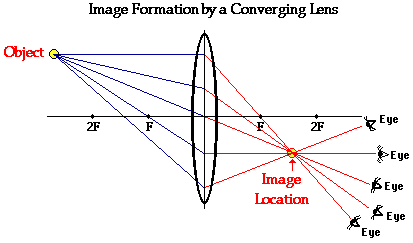
Free Printable Worksheets

NEW

Font size

S
M
L
XL
Worksheets

AP 2 Unit 13 Review

Total questions: 36

Worksheet time: 51mins
Name
Class
Date
1.
Compared to the object in front the lens, its image is.....
a)
inverted and smaller
b)
inverted and larger
c)
not inverted and smaller
d)
not inverted and larger
2.
What type of image is formed when rays of light actually intersect?
a)
real
b)
virtual
c)
projected
d)
curved
3.
An image that you can see , but does not really exist is called which of the following?
a)
Real Image
b)
Fake Image
c)
Virtual Image
d)
Digital Image
4.
A real image...
a)
is produced by virtual rays and can be projected on a screen
b)
is produced by real rays and cannot be projected on a screen
c)
is produced by virtual images and cannot be projected on a screen
d)
is produced by real rays and can be projected on a screen
5.
Which one is a convex lens?
a)
A
b)
B
6.
What type of image is formed in a plane mirror?
a)
Real
b)
Virtual
c)
Enlarged
d)
Small
7.
If an image formed by a convex lens is inverted, it is most likely what type of image?
a)
Real
b)
Virtual
c)
None of the above
8.
As you move an object further away from a convex lens, its image would become which of the following?
a)
Larger and virtual
b)
Larger, only
c)
Smaller, only
d)
Smaller and virtual
9.
Which of the following does not refract light?
a)
prism
b)
convex lens
c)
concave lens
d)
mirror
10.
What kind of image will you get if you put an object right at F, the focal point of this lens?
a)
Virtual, larger
b)
Real, smaller
c)
Real, larger
d)
No image
11.

The process of light bouncing off a surface

a)

refraction

b)

reflection

c)

diffraction

d)

diffusion

12.
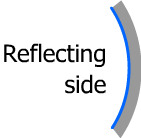
The following is a picture of what type of mirror? 
a)
Convex Mirror
b)
Concave Mirror
c)
Plane Mirror
d)
Flat Mirror
13.
The following is a picture of what type of mirror? 
a)
Convex Mirror
b)
Concave Mirror
c)
Plane Mirror
d)
Flat Mirror
14.
Which type of mirror magnifies a close up image, like a make-up mirror.
a)
Concave
b)
Convex
c)
Specular
d)
Plane
15.
Which type of mirror is shown.
a)
Concave
b)
Convex
c)
Specular
d)
Plane
16.
Individuals that are farsighted need to have prescription lenses that are _________. 
a)
convex
b)
concave
c)
plane
d)
flat
17.
Individuals that are nearsighted need to have prescription lenses that are ___________. 
a)
convex
b)
concave
c)
plane 
d)
flat
18.
Concave lenses, like the ones found in the peepholes of a door, always produce images that are .....
a)
Virtual, upright, smaller
b)
Real, inverted, larger
c)
Real, inverted, smaller
d)
Virtual, upright, larger
19.
Convex mirrors, like those found on the side of a car, produce images that are always _________________. 
a)
Real, larger and inverted
b)
Virtual, larger, and inverted
c)
Virtual, smaller and upright
d)
Of equal size and position as the original object
20.
The point where the rays meet is known as....
a)
Fire
b)
the focal point
c)
refraction
d)
Plane of the lens
21.
This image is...
a)
Inverted and smaller
b)
Inverted and larger
c)
not inverted and smaller
d)
not inverted and larger
22.
What is Nearsightedness? 
a)
condition that has difficulty seeing things that are close 
b)
condition that has difficulty seeing things that are far away
23.
What is an Astigmatism?
a)
a very contagious condition caused by a bacterial infection 
b)
a substance that hardens your teeth 
c)
 a hard substance that gives nails their strength 
d)
persons vision is distorted due to a irregular shaped eye 
24.
A real image having a size of 10 cm is formed by a concave mirror. The size of the object is 5 cm.The magnification of the object is
a)
-5
b)
5
c)
2
d)
-2
25.
An object is placed 10 cm from a convex mirror. Its image is formed 5 cm behind the mirror.The focal length of the given convex mirror is
a)
-5 cm
b)
5 cm
c)
10 cm
d)
-10cm
26.

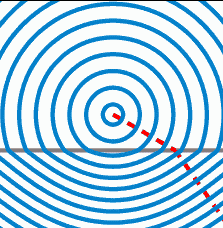
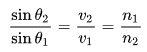
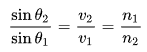
Snell's Law describes the relationship between the ________ angle and the _______ angle of waves passing through two different media

a)

incident - reflected

b)

incident - refracted

c)

incident - bounced

d)

answer is not here

27.

If light travels from a higher to a lower index of refraction medium the light will

a)

bend away from the vertical axis or may not refract

b)

bend closer to the vertical axis

c)

not bend

d)

answer is not here

28.

Light travels from air (n = 1.000) into an optical fiber. If the angles of incidence and refraction are 22oand 15º respectively. what is the index of refraction inside the fiber? Round off your values to 3 sig. figs.

a)

1.45

b)

1.44

c)

0.69

d)

0.70

29.

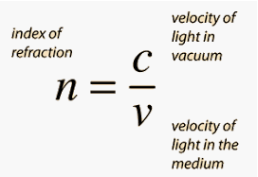
The index of refraction, is defined as the ratio of the speed of light in a vacuum (c = 3x10^8 m/s) to the speed of light in a medium. What is the index of refraction of a medium where the speed of light is 0.7c ? Round off your values to 3 sig. figs.

a)

1.42

b)

1.43

c)

1.28

d)

1.29

30.

For light passing across the boundary from higher to lower index of refraction medium, the angle of refraction is always _________________________

a)

greater than the angle of incidence

b)

less than the angle of incidence

c)

equal to the angle of incidence

31.

There are certain angles of incidence for which the angle of refraction is close to 90°. What is this angle called?

a)

Total internal angle

b)

Critical angle

c)

Reflection angle

d)

Refracted angle

32.

What is the speed of light in a material that has an index of refraction of 1.88?

a)

3.0 x 10⁸ m/s

b)

1.88 x 10⁸ m/s

c)

1.6 x 10⁸ m/s

d)

5.64 x 10⁸ m/s

33.

If a material has an index of refraction of 2.3, how fast will light travel through that material?

a)

2.3 x 10⁸ m/s

b)

6.9 x 10⁸ m/s

c)

3.0 x 10⁸ m/s

d)

1.3 x 10⁸ m/s

34.

If light travels through a piece of glass at 2.1 x 10⁸ m/s, what is the index of refraction of the glass?

a)

1.14

b)

1.43

c)

2.10

d)

6.3

35.

Light travels from air (n = 1.00) into a "mystery" material. The incident ray of light hits the surface at angle of 43o and the refracted ray enters the mystery material at an angle of 27o. What is the index of refraction of the mystery material? n1sin(Θ1) = n2sin(Θ2)

a)

1.5

b)

1.0

c)

0.67

d)

2.1

36.

1. A ray of light traveling from air into crown glass strikes the surface at an angle of 30 degrees. What will the angle of refraction be?

1 step: (n1sin(angle of incidence)) / n2

2nd step: inverse (sin) the answer from step one

a)

19.2

b)

23,4

c)

54.1

d)

17.8