
 Worksheets
Chemical Bonding
Total questions: 25
Worksheet time: 14mins
Name
Class
Date
1.
Luke was in the lab when her reacted hydrogen and oxygen together to form H2O (water). The chemical bond formed when the two atoms share electrons is called a(n)
a)
covalent bond
b)
ionic bond
c)
metallic bond
d)
electron bond
2.
Which atoms are likely to form covalent bonds?
a)
metal atoms that share electrons
b)
nonmetal atoms that share electrons
c)
metal atoms that share protons
d)
nonmetal atoms that share protons
3.
Sodium and chlorine react to form sodium chloride which is also known as table salt. Which of the following is the reason why atoms of sodium and chlorine attract each other in a salt crystal?
a)
sodium has a positive charge and chlorine has a negative charge
b)
sodium has a negative charge and chlorine has a positive charge
c)
both have a positive charge
d)
both have a negative charge
4.
Cations are ions with a __________ charge that are formed when an atom ___________ electrons
a)
positive/gains
b)
negative/loses
c)
negative/gains
d)
positive/loses
5.
Anions are ions with a __________ charge that are formed when an atom ___________ electrons
a)
positive/gains
b)
negative/loses
c)
negative/gains
d)
positive/loses
6.
Ionic compounds are made of __________ and ________
a)
metals and metals
b)
metals and nonmetals
c)
nonmetals and nonmetals
d)
metalloids and metals
7.
Covalent compounds are made of __________ and ___________
a)
metals and metals
b)
metals and nonmetals
c)
nonmetals and nonmetals
d)
metalloids and metals
8.
What is the chemical formula for magnesium bromide (a)
9.
Which of the following is the correct name for a compound between Magnesium and Sulfur?
a)
magnesium sulfur
b)
magnesium (II) sulfide
c)
magnesium sulfide
d)
dimagnesium disulfide
10.
Which combination of elements would most likely form an ionic compound?
a)
hydrogen and oxygen
b)
carbon and chlorine
c)
sodium and fluorine
d)
silicon and sulfur
11.
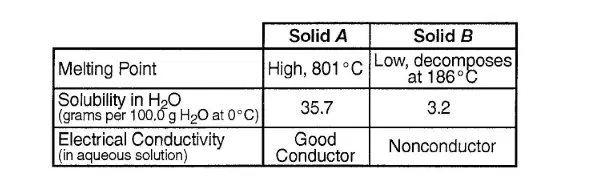
A chemist performs the same tests on two homogenous crystalline solids, A and B. The results are shown in the table below. The results of these tests suggest that
a)
solid A only contains covalent bonds and solid B only contains ionic bonds
b)
solid A only contains ionic bonds and solid B only contains covalent bonds
c)
both solids contain only covalent bonds
d)
both solids contain only ionic bonds
12.
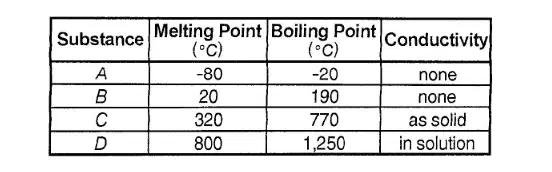
Jace was performing a lab analyzing substances A, B, C and D. He needed a substance that was ionic to perform a chemical reaction. Which of the four substances is an ionic compound?
a)
A
b)
B
c)
C
d)
D
13.
When aluminum and sulfur react, which compound is produced? (a)
14.
What is the strongest type of bond?
a)
hydrogen bond
b)
ionic bond
c)
covalent bond
d)
dipole bond
15.
Name this ionic compound: NaOH
a)
Sodium hydride
b)
Monosodium hydride
c)
Sodium hydroxide
d)
Monosodium monohydroxide
16.
Chlorofluorocarbons (CFCs) are chemical compounds that contain carbon, chlorine, and fluorine, and are sometimes bonded with hydrogen. They were once used as refrigerants in refrigerators and freezers manufactured before 2003 A bond between C, Cl and F would be classified as
a)
covalent
b)
ionic
c)
metallic
d)
hydrogen
17.
Bronze is an alloy composed of approximately 88% copper and 12% tin that is commonly used in the production of architecture and musical instruments. What type of bond is responsible for the formation of this substance?
a)
covalent
b)
ionic
c)
metallic
d)
hydrogen
18.
A bond between W and O is
a)
covalent
b)
ionic
c)
metallic
d)
hydrogen
19.
Carbon dioxide is formed from volcanoes, breathing animals and decaying vegetation. A bond between C and O is
a)
covalent
b)
ionic
c)
metallic
d)
hydrogen
20.
Rusting of iron (Fe), also known as corrosion, is a chemical reaction that occurs when iron is exposed to oxygen in the presence of water, forming a reddish-brown iron oxide called rust. A bond between Fe and O is
a)
covalent
b)
ionic
c)
metallic
d)
hydrogen
21.

This is the lewis structure of which compound?
a)
Monoboron trifluoride
b)
Boron fluoride
c)
Boron (I) fluoride
d)
Boron trifluoride
22.
Name this ionic compound: Mg3P2
a)
Trimagnesium Disulphide
b)
Dimagnesium Disulphide
c)
Magnesium Phosphide
d)
Magnesium (II) Phosphate
23.
What is the name for N2O
a)
Nitrogen oxide
b)
Nitrogen (II) oxide
c)
Dinitrogen oxide
d)
Dinitrogen monoxide
24.
Name this covalent compound: CS2 (a)
25.
Lithium and phosphate form a compound that is used widely in the production of batteries. What is the formula for the following ionic compound: Lithium Phosphate
a)
LiPO4
b)
Li2PO4
c)
Li3PO4
d)
Li3(PO4)2
100 %

