
 Worksheets
Atoms & Electricity Study Guide
Total questions: 20
Worksheet time: 15mins
An atom is:
a large molecule
the smallest building block of matter
a type of chemical reaction
a form of energy
Atomic number is the number of __________ OR __________ in an element’s atoms.
Protons and Neutrons
Protons and Electrons
Neutrons and Electrons
Protons only
Electricity is created by the movement of what kind of particles?
Protons
Neutrons
Electrons
Photons
What are the 3 variables involved in Ohm’s Law and what unit goes with each variable?
Voltage (Volts), Current (Amperes), Resistance (Ohms)
Power (Watts), Energy (Joules), Time (Seconds)
Force (Newtons), Mass (Kilograms), Acceleration (m/s²)
Pressure (Pascals), Volume (Liters), Temperature (Kelvin)
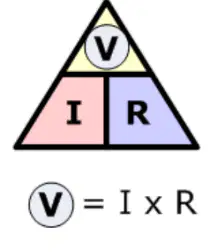
A small motor in a toy car pulls 2 A of current when running. If the motor has a resistance of 3 Ω, what is the voltage being supplied by the battery?
2 V
3 V
5 V
6 V
What does it mean when two charges attract?
It means they will come together because they have the same type of charge.
It means they will come together because they have opposite types of charge.
It means they are neutral.
It means they will go away from each other because they are both positive.
What does it mean when two charges repel?
It means the charges are of the same type, either both positive or both negative. They will not come together.
It means the charges are of opposite types, one positive and one negative. They will come together.
It means the charges are neutral.
It means the charges are in motion.
Coulomb’s law states that as charge increases, then force will _________________
decrease
Coulomb’s law states that as charge decreases, then force will _________________.
increase
Coulomb’s law states that as distance increases (they get further apart), then force will _________________.
increase
Coulomb’s law states that as distance decreases (they get closer together), then force will _________________
decrease
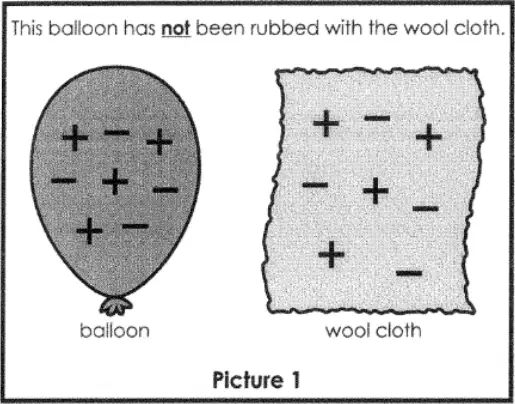
In Picture 1, does the cloth have a positive charge, negative charge, or no charge?
positive
negative
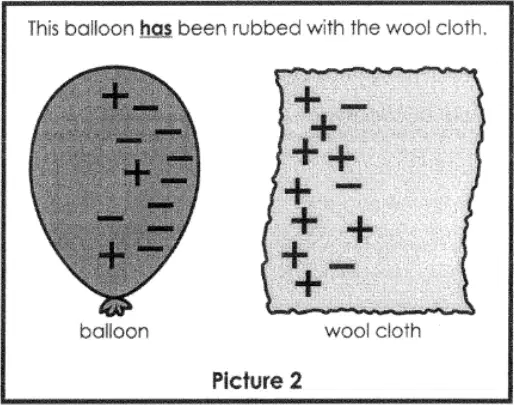
In Picture 2, does the balloon have a positive charge, negative charge, or no charge?
positive charge
neutral
fill in the blanks

fill in the blanks

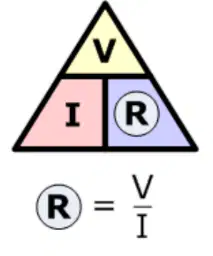
A flashlight runs on a 10 V battery and has a resistor inside. If the current
flowing through the circuit is 2 A, what is the resistance of the flashlight’s circuit?
5 Ohm's
0.2 Ohm's
20 Ohm's
8 Ohm's
Electrons have a __________ charge and are found in the ___________ of the atom
positive; electron cloud
negative; electron cloud
negative; nucleus
positive; nucleus
Protons have a __________ charge and are found in the ___________ of the atom
positive; electron cloud
negative; electron cloud
negative; nucleus
positive; nucleus
Neutrons have __________ charge and are found in the ___________ of the atom
positive; electron cloud
no charge; electron cloud
no charge; nucleus
positive; nucleus
How is static electricity different from current electricity?
Static electricity is a sudden change in charge (shock), while current electricity is a flow of charge.

