
 Worksheets
Unit B: The Solar System
Total questions: 22
Worksheet time: 22mins
Which of the following solar system objects contains the most mass?
Jupiter
Sun
Mars
All of the asteroids together
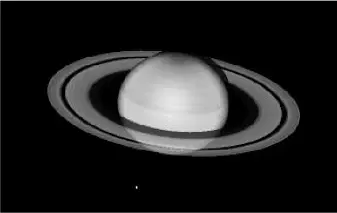
What is the name of this planet?
Neptune
Uranus
Jupiter
Saturn
Planets shine by their own light.
True
False
The planets, comets and asteroids all formed at about the same time as the Sun.
True
False
The planets of the solar system orbit the Sun:
In one direction
In two directions
In random orbits
Faster or slower depending on the season
The letters AU are a short form for:
Astronomical Universe
After Uranus
Asteroid Ursa
Astronomical Unit
The diameter of Earth is roughly how many times larger than the diameter of the Moon?
Two times larger
Ten times larger
Fifty times larger
Four times larger
Which of the following is not a member of the solar system?
The planet Venus
The Sun
The star Rigel
The asteroid Vesta
Which object lies furthest from the plane of the solar system?
Mercury
Earth
Jupiter
Pluto
The main asteroid belt is located between which planets?
Mars and Jupiter
Mercury and Mars
Jupiter and Neptune
Venus and Earth
Compared to the Earth, the Moon:
Rotates more slowly
Has shorter days
Rotates at the same speed
Has more mass
What is an Astronomical Unit?
Any star or planet
The approximate size of the Earth
The average distance from the Earth to the Sun
The distance to the nearest star
Which planet takes longer to orbit the Sun than Saturn?
Venus
Mercury
Jupiter
Neptune
The size of the planets is ________________ compared to the distances between them.
small
large
equal
unknown
The planets all orbit the Sun in the same (a) , so the solar system is .
(b)
Connect the items in column A with the matching item in column B by writing their number in column B.
Planet
Mars
Unit of measure in the solar system
Astronomical Unit
Star
Sun
Moon
Phobos
Why don’t astronomers use kilometers or miles to describe distances between objects in the solar system?
Because kilometers and miles are too small for astronomical distances.
Because kilometers and miles are not scientifically accurate.
Because kilometers and miles are not used in space.
Because kilometers and miles are not recognized internationally.
Complete the graphic organizer.
The largest planets in the solar system:
Are found closest to the Sun
Have solid surfaces
Have no atmospheres
Tend to be surrounded by rings
If light can travel from Earth to the Sun in 8 minutes, how long does it take light to travel one astronomical unit?
8 minutes
8 hours
1 minute
1 light year
Which planet has about the same diameter as Earth?
Mercury
Venus
Mars
Pluto
The Sun-centered or (a) model of the solar system was introduced in 1543 by (b) .

