
 Worksheets
IG Chapter 6 Chemical analysis
Total questions: 25
Worksheet time: 13mins

A student carries out an investigation on different plant extracts using paper chromatography. The experimental set-up he uses is shown below. Where should he place the samples of plant extract?
On the pencil line
Below the pencil line in the solvent
Exactly 1 cm above the pencil line
Exactly 1 cm below the pencil line
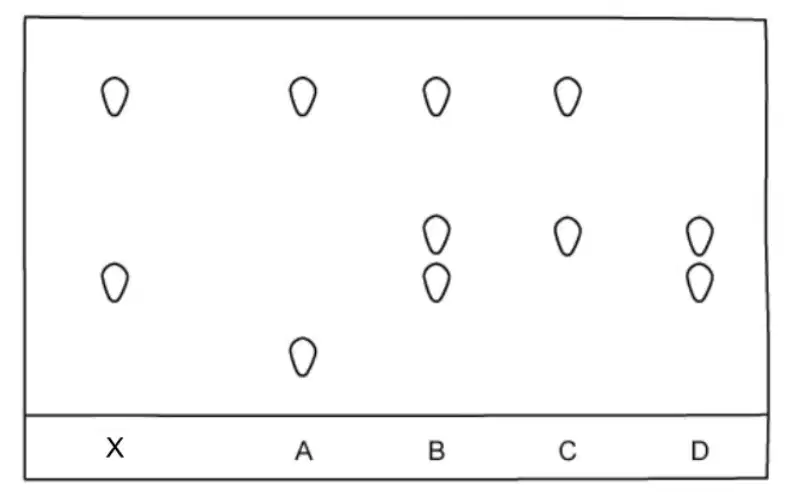
Paper chromatography was used to determine if a banned preservative, X, is present in four samples obtained from four different packaged foods labelled A, B, C and D. The results of the analysis of the foodstuffs are shown in the diagram below. Which foodstuff contains X?
A
B
C
D

The diagram below illustrates the experimental set-up to carry out distillation. What are the correct labels for points A and B on the condenser?
A: water in, B: water in
A: water in, B: water out
A: water out, B: water in
A: water out, B: water out
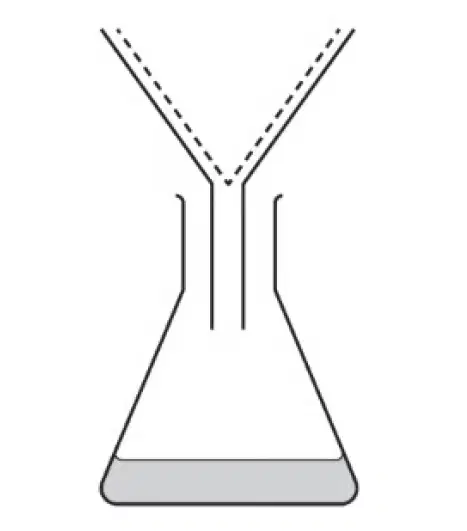
A student performs a technique using the apparatus shown. Which separation technique has the student performed?
Crystallisation
Evaporation
Distillation
Filtration
Rocksalt is the mineral form of sodium chloride. It is known to commonly contain sodium chloride and sand along with other trace impurities. A combination of physical changes and separation techniques can be used to produce higher purity sodium chloride and sand. What is the correct order of physical changes and separation techniques to separate sodium chloride and sand?
Melting, filtering, crystallising
Melting, filtering
Dissolving, filtering, crystallising
Dissolving, crystallising
A substance was analysed and was found to have a boiling point of 450 °C. At room temperature it is a soft grey solid. Which temperature could be the melting point of a pure sample of the substance?
-12 °C
56 °C to 72 °C
250 °C to 275 °C
142 °C

Solid P melts at exactly 60oC and boils at exactly 310oC. Solid Q dissolves in ethanol and shows a green colour and a yellow colour when analysed using paper chromatography. Which row is correct?
A
B
C
D
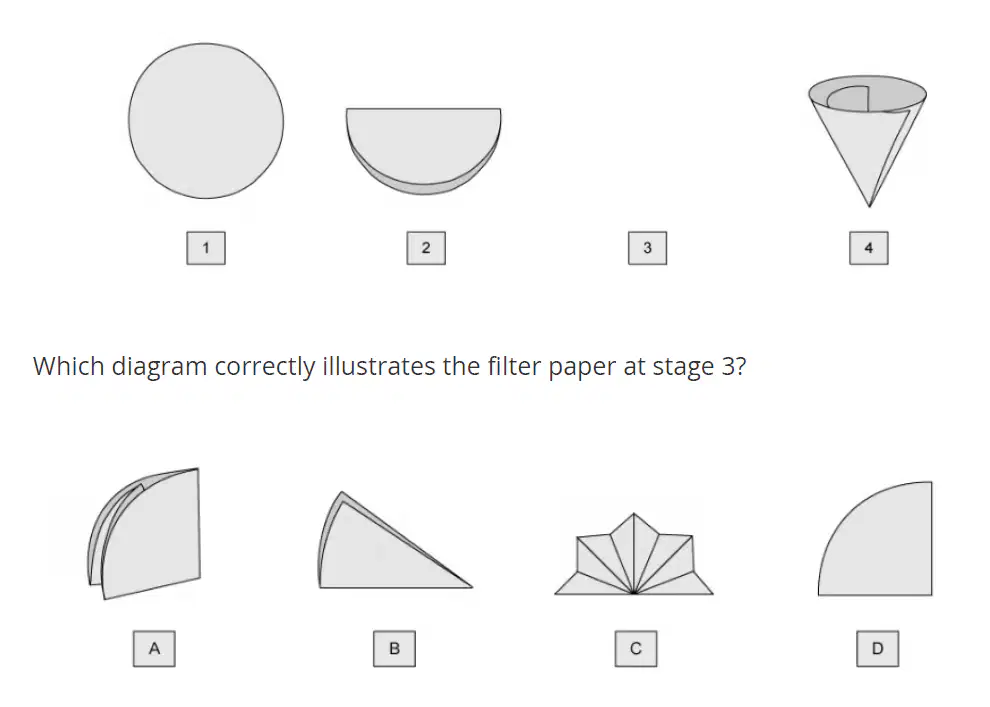
A student has performed an experiment which produced a precipitate. She correctly chooses to separate the precipitate using the process of filtration. She prepares the filter paper to be placed into the funnel by folding it as shown below. Which diagram correctly illustrates the filter paper at stage 3?
A
B
C
D
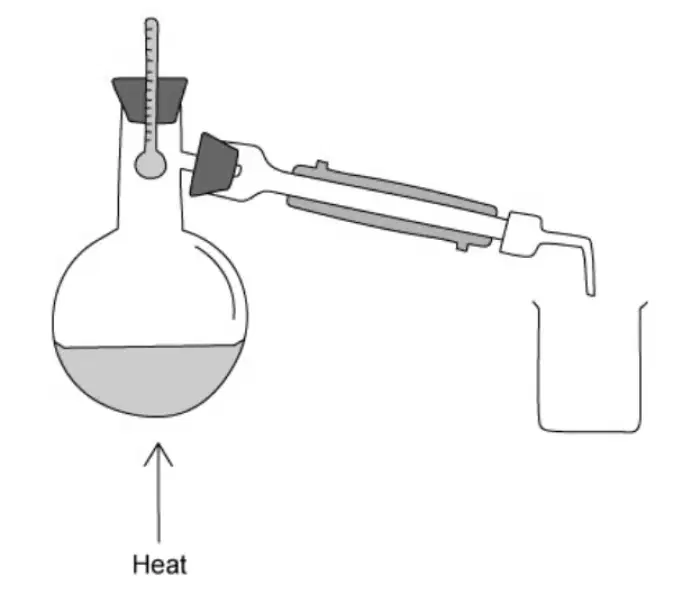
The diagram below shows the apparatus a student used to separate a product from a reaction mixture. What did the mixture contain?
Aqueous sodium chloride and unreacted solid catalyst
Water and ethanol
Water and oil
Aqueous sodium chloride and oil
A yellow solid, W is soluble in water. Which method of separation is most commonly used to obtain the solid W from an aqueous solution?
Neutralisation
Chromatography
Distillation
Crystallisation
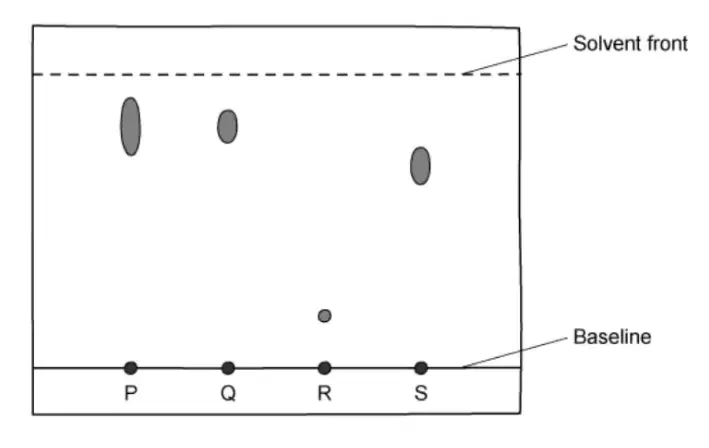
Four different dyes labelled P, Q, R and S produced the chromatograms as shown below. Which dye has an R value of 0.2?
S only
R only
Both P and Q
P only

The impure sample of paracetamol was contaminated with one of the raw chemicals used during its synthesis. What is the Rf value of the chemical?
0.70
0.75
0.65
0.85
A mixture of sugars can be separated out by paper chromatography. The student sprays the dried chromatogram with a locating agent. Why is this used?
To help the sugars dissolve in the solvent
To stop the sugars reacting with each other
To form coloured spots with the sugars
To aid the separation of the mixture

Which row correctly describes the test for each gas?
A.
B.
C.
D.

Halide ions in solution are detected using silver nitrate solution. Dilute nitric acid is used to acidify the solution first and then a few drops of silver nitrate solution are added. Each halide produces a different coloured silver halide precipitate.
Which row correctly describes the colour of the precipitate for each halide?
A
B
C
D
A solution containing an unknown substance was analysed. On the addition of acidified silver nitrate solution a yellow precipitate formed. A flame test produced a lilac coloured flame.
What is the identity of the unknown solid?
Lithium iodide
Lithium bromide
Potassium iodide
Potassium bromide
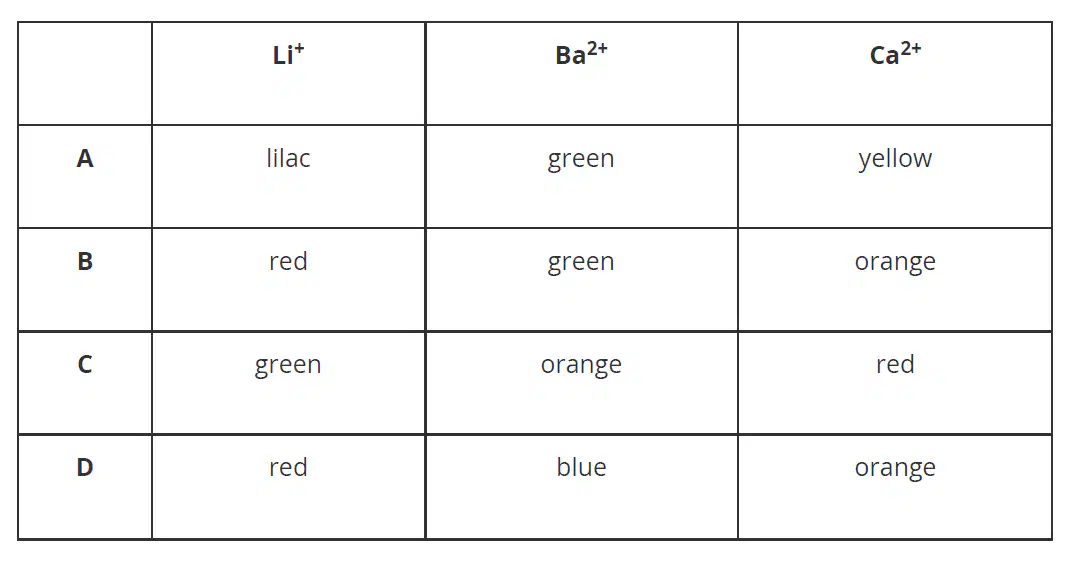
Metal cations can be detected using flame tests.
Which row correctly describes the colour of the flame for each metal cation?
A
B
C
D

The results of two tests on a solid are shown below.
What is the solid?
Iron(II) bromide
Iron(III) bromide
Iron(II) chloride
Iron(III) chloride
Which reaction would result in the production of a gas that would produce a squeaky pop with a lit splint?
Iron(II) oxide + sulfuric acid
Methane + oxygen during complete combustion
Magnesium + hydrochloric acid
Carbon dioxide and water in the presence of light and chlorophyll
Which statement about aqueous sodium hydroxide is correct?
When added to a solution containing nitrate ions and aluminium foil then warmed, the gas given off will bleach moist red litmus paper
When added to a solution containing iodide ions, a yellow precipitate is formed
When added to a solution of iron(II) ions, a green precipitate is formed which dissolves in excess sodium hydroxide to form a green solution
When added to a solution containing aluminium ions, a white precipitate forms which dissolves in excess sodium hydroxide to form a colourless solution

The results of different chemical tests on a solution of compound Y are shown.
What is compound Y?
Aluminium sulfate
Aluminium chloride
Zinc sulfate
Zinc chloride
Which statement about aqueous NaOH is correct?
A white precipitate is formed when added to a solution containing sulfate ions
A green precipitate is formed upon addition to a solution of iron(II) ions which does not dissolve in excess
A green precipitate is formed upon addition to a solution of iron(II) ions which dissolves in excess
An acidic gas is produced when added to ammonium chloride

Scientists test a solution of compound X. The table shows their results.
Fe3+ and Cl-
Fe3+ and SO42-
Fe2+ and Cl-
Fe2+ and SO42-
A student adds a few drops of dilute nitric acid followed by a few drops of silver nitrate solution to a test tube containing an unknown colourless solution. A white precipitate is seen. What ions could be present in the solution?
Ammonium ions
Chloride ions
Sulfate ions
Magnesium ions
A solution containing carbonate ions can be reacted with hydrochloric acid, HCl, and a gaseous product collected and tested.
Which is a correct positive test result for a product of this reaction?
A gas is produced which causes cloudiness in limewater
A gas is produced which makes a squeaky pop sound when a lit splint is introduced
A gas is produced which bleaches damp litmus paper
A gas is produced which re-ignites a glowing splint

