
 Worksheets
Water on Earth Test
Total questions: 20
Worksheet time: 10mins
James was observing the weather outside and noticed that when water falls to the ground in the form of rain, snow, or hail, it is called___________________.
infiltration
transpiration
precipitation
True or False- When Charlotte heats a pot of water on the stove, the water will evaporate faster.
True
False
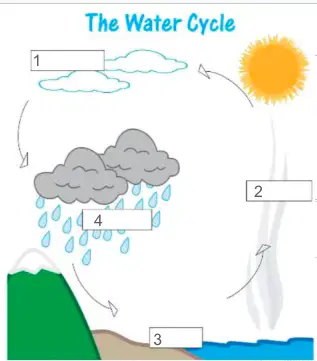
Abigail and Mason are learning about the water cycle in class. What is the process shown as number 1 in their diagram?
Condensation
Evaporation
Precipitation
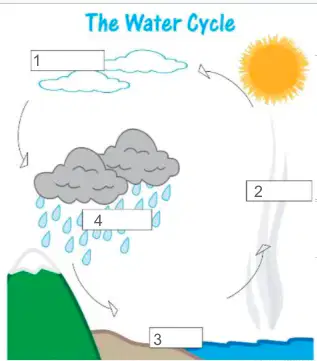
Mia and Lily are observing the water cycle diagram. What is the process shown as number 2?
Condensation
Evaporation
Precipitation
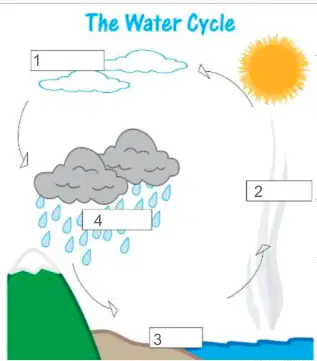
Olivia and Grace are learning about the water cycle in class. They see a diagram showing different processes. What is the process shown as number 4?
Condensation
Evaporation
Precipitation
True or False- Mia learned in her geography class that oceans only account for 3% of all the water on Earth.
True
False
During a science class, Isla asked her teacher what scientists call all the water on, in, and around the Earth. The teacher replied that it is known as the __________________.
hydrosphere
biosphere
geosphere
water cycle
During a geography class, Arjun asked, "Which body of water makes up 96.5% of all the water on Earth?"
lakes
oceans
reservoir
glacier
Oliver and Charlotte are discussing the types of water they encounter during their trip. What is the difference between water in the ocean and water in a river?
The water in the river is saltwater and the water in the ocean is freshwater.
The water in the river is freshwater and the water in the ocean is saltwater.
The water in the river moves and the water in the oceans doesn't move.
Isla and William are studying about water resources in their geography class. They learned about a type of water that is crucial but not easily accessible for human use. What is this type of water called?
Freshwater that human cannot easily get to and clean for consumption.
Saltwater that is filtered
Freshwater that is in reservoirs
Anika and Kai are studying the Earth's water distribution in their geography class. They learned that most of the freshwater is located in a specific place on Earth. Where is most of the freshwater located?
Oceans
Lakes
Glaciers
Atmosphere
True or False- During a school trip to the mountains, Kai observed that glaciers are permanent and do not move.
True
False
During a geography class, Arjun asked, "Which of the following is the most abundant form of FRESHWATER on Earth?"
Rivers
Groundwater
Ice
Rohan and Benjamin are studying different water sources for their geography project. They learn that one particular water source is made up of saltwater and constitutes 96.5% of all the water on Earth. What is this water source?
glaciers
ocean
rivers
Luna is conducting an experiment to understand the water cycle. She wants to know which process moves water from the ocean to the atmosphere. What should she observe?
condensation
precipitation
evaporation
Grace and Sophia are studying different sources of water for their science project. They need to identify a natural or artificial body of freshwater that can be used as a source of water for living things. What should they choose?
Lake
Reservoir
Ocean
Glacier

