
 Worksheets
ray optics
Total questions: 10
Worksheet time: 5mins
Consider an extended object immersed in water contained in a plane trough. When seen from close to the edge of the trough the object looks distorted. Which of the following is not correct.
The apparent depth of the points close to the edge are nearer the surface of the water compared to the points away from the edge.
The angle subtended by the image of the object at the eye is smaller than the actual angle subtended by the object in air.
Some of the points of the object far away from the edge may not be visible because of total internal reflection.
Water in a trough acts as a lens and magnifies the object.
Critical angle and refractive index are:
Directly related
Equal
Inversely related
None of these
A point source of light is placed in front of a plane mirror.
All the reflected rays meet at a point when produced backward.
Only the reflected rays close to the normal meet at a point when produced backward
Only the reflected rays making a small angle with the mirror, meet at a point when produced backward
Light of different colours make different images
Mark the correct options:
If the incident rays are converging, we have a real object.
If the final rays are converging, we have a real image.
The image of a virtual object is called a virtual image.
If the image is virtual, the corresponding object is called a virtual object.
Mirage is a phenomenon due to:
Refraction of light
Reflection of light
Total internal reflection of light
Diffraction of light

Which figure represents the path light takes through a converging lens?
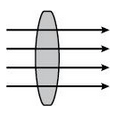
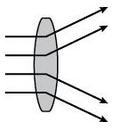
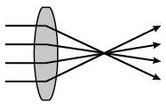
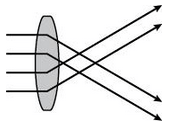
A hollow convex lens of glass will behave like
convex lens
concave lens
glass plate
mirror
A real image is formed by a a convex lens, then it is put in contact with a concave lens and again a real image is formed. This image is : ______________
shift towards the lens system
shift away from the lens system
remain in its original position
shift to infinity
The speed of light in an isotropic medium depends on,
its intensity
its wavelength
the nature of propagation
the motion of the source w.r.t medium

