
NEW
Font size
 Worksheets
CA8S6e3abcd
Total questions: 29
Worksheet time: 16mins
Freshwater is water that contains little or no salt. Which of the following is least likely to be a source of freshwater?
glaciers
lakes
oceans
rivers
Where is most of the Earth's freshwater located?
in the ocean
in icecaps and glaciers
in rivers and streams
in aquifers
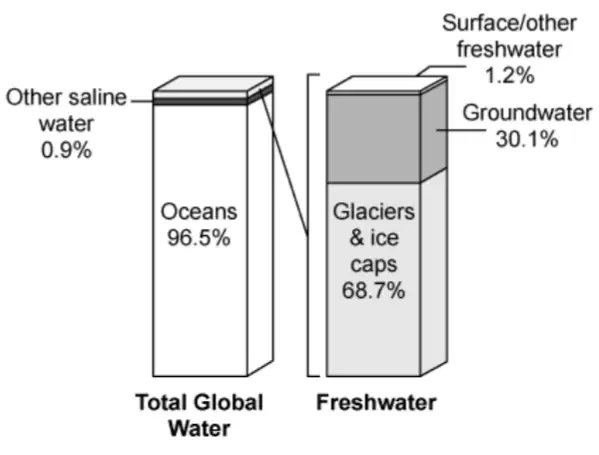
The graph shows the distribution of water on Earth's surface. What can be concluded from the image?
A. Most of the freshwater on Earth is found in oceans.
B. Most of the water available on Earth is not drinkable.
C. Most of the water available on Earth is drinkable.
Why are oceans a major part of the water cycle?
because they are large bodies of salt water that easily evaporate salt into the air
because they are large bodies of salt water that fresh water can be evaporated from
because the salt water condenses easily to become a gas in the air
because the salt water runs off onto land to fill lakes and streams
Where is most of Earth's water found?
glaciers
lakes
oceans
rivers
What is the primary cause of water evaporation from Earth's oceans and lakes?
energy from the Sun
heat from the surrounding land
warm air masses from the tropics
circulation of warm water currents
Which of the following experiments would BEST help illustrate the Sun's role in the water cycle?
Leave a dish of water out on a picnic table on a cold day. Measure the temperature and the volume of the water throughout the day.
Leave a dish of water out on a picnic table on a cold day. Measure the amount of time it takes the dish of water to completely freeze.
Leave a dish of water out on a picnic table on a cool day and on a warm day. Measure the air temperature and water loss throughout each day.
Leave a dish of water out on a picnic table on a cool day and on a warm day. Measure the air temperature and the water temperature throughout the day.
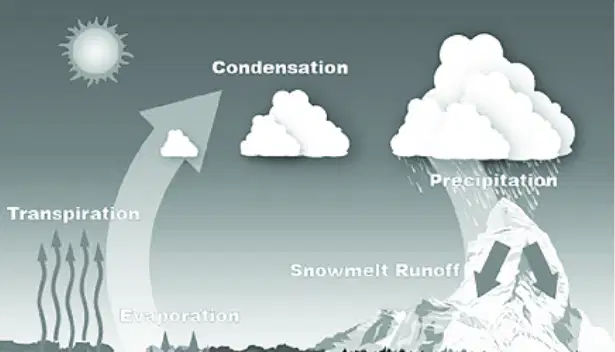
What is the purpose of this model?
to illustrate how water travels from Earth's surface into the atmosphere and back to Earth's surface again
to illustrate how some water is lost on Earth as some of it never returns to Earth's surface once it evaporates
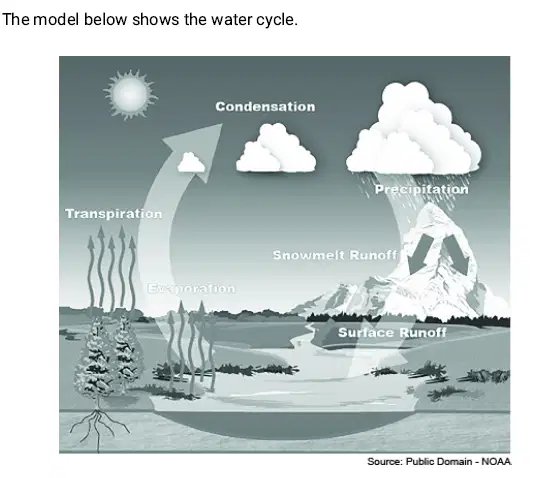
What is the purpose of the diagram?
to show how water moves through the water cycle
to show how water is used by plants and animals
to show how severe weather forms in the water cycle
to show how Earth's water formed billions of years ago
Evaporation in the water cycle is most affected by
the Sun's energy.
Earth's rotation.
human activities.
Earth's landforms.
What is the term for water that moves across the surface of the land and enters streams and rivers?
runoff
groundwater
unconfined aquifer
water table
If Maria draws a topography map of the ocean, which of these features would be closest to the coast?
continental slope
continental shelf
ocean trench
continental rise

The graphic shows ocean floor topography. Which is most likely represented by letter X?
continental slope
oceanic trench
volcanic island
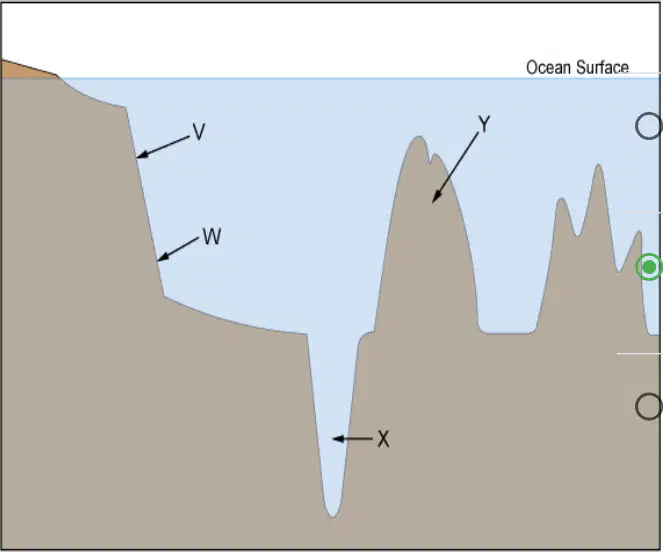
The diagram shows a cross section of the topography of the ocean floor. A seamount is an underwater mountain that peaks at least 1,000 meters above the ocean floor and does not reach the ocean's surface. Which letter on the diagram most likely labels a seamount?
W
X
Y
The main driving force of ocean surface currents is
centripetal force
the Coriolis effect
winds
gyres
Which statement best describes a spring tide?
the periodic rise and fall of the water level in oceans
a tide of maximum range that takes place two times a month
the difference in levels of ocean water at high tide and at low tide
a tide of minimum range that takes place two times per month
Which of these things is caused by the force of gravity between the Moon and Earth?
the ocean tides
the phases of the moon
an airplane's flight plans
the growth of plant roots
Which type of tide occurs when the Sun, the Moon, and Earth align?
low tide
high tide
neap tide
spring tide
What causes tides?
the pull of Earth's gravity
the pull of the ocean's gravity
the pull of the Moon's gravity
the pull of waves caused by storms
Which of the following best describes the primary cause of wave formation?
tidal fluctuations
tsunamis
gravitational pull of the moon
wind
What is the primary cause of tides on Earth?
the gravitational force of the Moon and Sun
the Sun's electromagnetic energy
Earth's magnetic field
Earth's rotation
What affects the density of water?
A. Salt
B. Temperature
C. The seasons of the year
Both A and B
Why is upwelling important?
Upwelling regulates ocean temperature
Upwelling provides nutrient rich water that sustains life
Upwelling controls the tides
Upwelling helps sailors to navigate the seas
What are a circular system of currents in the Earth's major oceans?
ocean current
gyre
upwelling
conveyor belt


