
 Worksheets
World History Bench mark 2
Total questions: 14
Worksheet time: 7mins
What do the concepts of militarism, alliances, imperialism, and nationalism (MAIN) represent as causes of World War I? How might each factor have contributed to the outbreak of the war?
Militarism led to countries preparing for war, alliances pulled nations into the conflict, imperialism caused competition for resources, and nationalism made people believe their country was superior.
Militarism made peace treaties stronger, alliances created unity without conflicts, imperialism spread peace, and nationalism promoted cooperation.
Militarism made countries afraid to fight, alliances prevented nations from engaging in war, imperialism reduced international tensions, and nationalism caused countries to ignore their interests.
Militarism and alliances kept countries weak, imperialism made nations less competitive, and nationalism focused on diplomatic negotiations.

Why would a poster depicting a gorilla carrying various items be seen as propaganda? What does this symbolism suggest about public opinion during World War I? How might it have shaped people's ideas of enemy nations?
The gorilla represents strength and courage in the enemy; this image likely depicted the enemy as violent and barbaric, shaping public opinion against them.
The gorilla represents the power of the military, and the image was used to encourage public support for the war.
The gorilla is used to show how the enemy is just as peaceful as everyone else, reducing fear.
The gorilla symbolizes the wisdom of enemy leaders, and the poster was designed to show respect toward them.

3. What does the creation of the Women’s Army Auxiliary Corps (WAAC) suggest about the changing roles of women during World War I? What does this tell us about societal attitudes toward gender roles during that time?
It suggests that women were increasingly seen as capable of contributing to the war effort, indicating a shift in societal attitudes towards more progressive gender roles.
It suggests that women were still confined to traditional roles, indicating no change in societal attitudes towards gender roles.
It suggests that women were only temporarily allowed to take on new roles, indicating a temporary shift in societal attitudes.
It suggests that women were not involved in the war effort, indicating a lack of change in societal attitudes.
The Great War by James Joll, British Historian
“War was not seen as something to be avoided: rather, it fitted into the national mood of 1914.”
In James Joll’s quote, how does the national mood of 1914 reflect the public's attitude toward war? How did this influence the decision to engage in World War I?
The national mood of 1914 saw war as an inevitable and necessary part of national pride, influencing countries to join the conflict.
The national mood of 1914 was against war, leading countries to try to avoid conflict.
The public’s attitude was neutral, and they wanted to stay out of any international disputes.
The national mood was one of peace, which prevented any countries from joining the war.
What were some of the key terms in the Treaty of Versailles that led to tensions among nations, particularly with Germany? Why did these terms contribute to future conflicts?
The Treaty of Versailles blamed Germany for the war, imposed reparations, and reduced their military power, leading to resentment and future instability.
The Treaty offered Germany complete independence and freedom from war debts, leading to peaceful relations.
The treaty guaranteed all nations equal military strength and economic power, preventing further conflicts.
The Treaty increased trade between Germany and the Allied nations, leading to economic growth.
Excerpt from the Treaty of Versailles (1919)
"The Allied and Associated Governments affirm and Germany accepts the responsibility of Germany and her allies for causing all the
loss and damage to which the Allied and Associated Governments and their nationals have been subjected as a consequence of the
war imposed upon them by the aggression of Germany and her allies."
How could the article from the Treaty of Versailles, which blames Germany for causing the war, affect Germany and its political climate post-World War I? What consequences did this have for both Germany and Europe?
It led to widespread anger and humiliation in Germany, contributing to the rise of extremism and paving the way for World War II.
It promoted peace and cooperation between Germany and other nations.
Germany's political climate became calm and peaceful, leading to rapid recovery.
The article encouraged Germany to form alliances with the Allied nations to avoid future wars.
Quotation by Ernest Hemingway
“World War I was the most colossal, murderous, mismanaged butchery that has ever taken place on earth. Any writer who said otherwise lied, So the writers either wrote propaganda, shut up, or fought.”
In Ernest Hemingway's quote, how does he describe the nature of World War I, and what does this suggest about the challenges writers faced during the war? How might this attitude reflect broader societal views on the war?
Hemingway suggests that World War I was a chaotic and destructive event, and writers faced pressure to conform to official war narratives or remain silent.
Hemingway describes the war as an orderly and well-managed event, with little impact on the public’s perspective.
Hemingway praises the war as a necessary and heroic struggle, with no challenges for writers.
Hemingway highlights the war’s minimal destruction and the straightforward role of writers.
What political changes resulted from the Russian Revolution of 1917? How did this shift from a monarchy to a socialist state reshape Russia’s political landscape?
The monarchy was replaced by a socialist government, leading to radical reforms and the rise of communism.
The revolution restored the monarchy, maintaining traditional Russian leadership.
The revolution led to the establishment of a democratic system with elections and political freedom.
How did Stalin's policies, particularly the Great Purge, impact human rights and political dissent in the Soviet Union? What was the broader effect on Soviet society during this time?
Stalin’s policies led to widespread political repression, human rights abuses, and the suppression of dissent, creating a climate of fear.
Stalin’s policies encouraged free expression and political discussion, leading to a flourishing of individual rights.
The Great Purge improved human rights by eliminating all threats to the government.
The policies strengthened political dissent and led to greater freedom of speech.
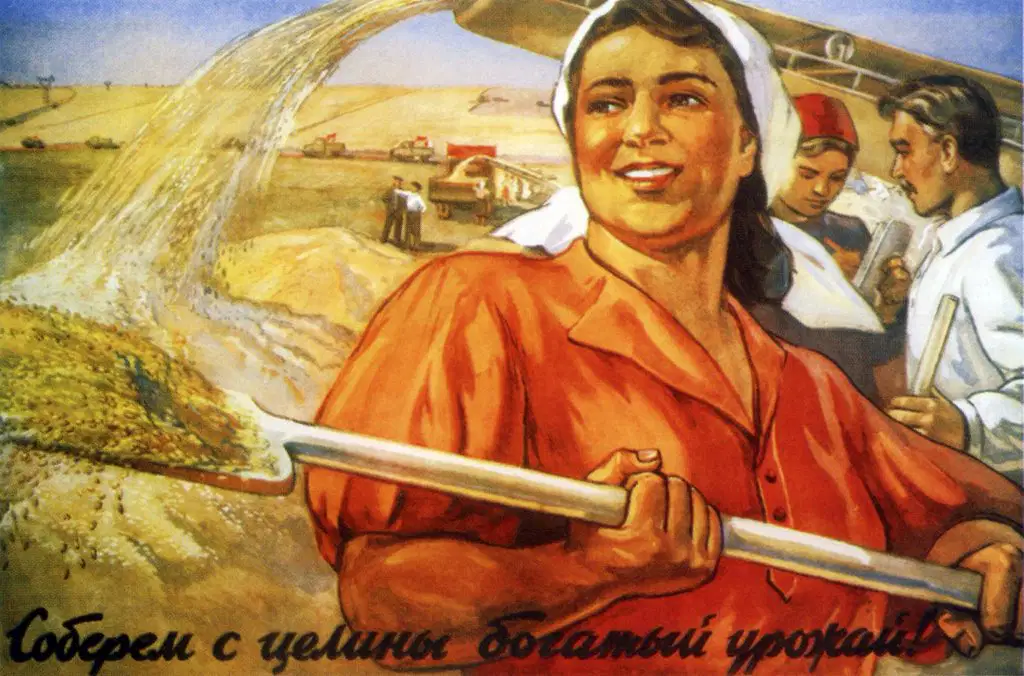
What role did propaganda posters, such as those depicting farmers, play in promoting Soviet government values? How were these images used to support the regime's goals?
Propaganda posters were used to depict the ideal Soviet citizen and promote support for government policies, particularly agricultural collectivization.
The posters aimed to discourage agricultural work, promoting urbanization instead.
Propaganda posters were not effective and had no significant role in Soviet society.
These images were used to focus on individual rights and freedom, rather than supporting government values.

How does the use of fear-inducing images, like sledgehammers crushing "lazy workers," function in Soviet propaganda? What message was the government trying to convey to the people?
The government used fear to create an image of harsh punishment for those who did not contribute to the state's goals, promoting productivity and obedience.
The government used these images to show the rewards for lazy workers who could become obedient.

During Stalin’s purges, photographs were often altered to remove individuals considered "enemies." How does this practice reflect Stalin's control over history and public perception? How did it influence Soviet values during his reign?
This practice shows how Stalin controlled public perception and historical records to eliminate any traces of opposition, fostering loyalty and fear.
Altering photos was an attempt to glorify enemies and increase their influence in Soviet society.
The practice helped the Soviet Union embrace diversity and promote open political discussion.
It had no real effect on public perception or values, as the people were unaware of the changes.
"Report on an Investigation of the Peasant Movement in Hunan " (March 1927), Selected Works, Vol. I, p. 28. by Mao Zedong
“A revolution is not a dinner party, or writing an essay, or painting a picture, or doing embroidery; it cannot be so refined, so leisurely
and gentle, so temperate, kind, courteous, restrained and magnanimous. A revolution is an insurrection, an act of violence by which
one class overthrows another.”
How does Mao Zedong’s view of revolution as an act of violence contrast with more peaceful methods of change? Why is this approach significant in the context of Chinese history?
Mao’s approach emphasizes the necessity of forceful action to overthrow the ruling class, highlighting the revolutionary nature of Chinese society at the time.
Mao believes that revolutions can be peaceful, as long as they involve slow reforms.
Mao’s view suggests that revolutions should avoid violence and rely on peaceful negotiations.
His approach indicates a preference for democratic elections over any form of rebellion.
"Report on an Investigation of the Peasant Movement in Hunan " (March 1927), Selected Works, Vol. I, p. 28. by Mao Zedong
“A revolution is not a dinner party, or writing an essay, or painting a picture, or doing embroidery; it cannot be so refined, so leisurely
and gentle, so temperate, kind, courteous, restrained and magnanimous. A revolution is an insurrection, an act of violence by which
one class overthrows another.”
What does Mao’s statement about revolution reveal about his beliefs on class struggle and political change? How does his description of revolution shape our understanding of the Chinese Communist movement?
Mao’s statement reveals his belief in violent revolution as necessary to overthrow the ruling classes, which was central to the Chinese Communist movement.
Mao’s belief was focused on peaceful dialogue between social classes.
His views were influenced by Western democratic principles, favoring elections over revolutions.
Mao’s statement shows that he was interested in maintaining the status quo in Chinese society.

