
 Worksheets
Engineering Electromagnetics 01
Total questions: 25
Worksheet time: 25mins
Vector is a quantity with:
magnitude and direction
magnitude
direction
none of the above

Vectors are equivalent if they have the same magnitude and direction. Which are equivalent vectors?
u and -u
u and a
u and v
u and b
What are electromagnetic waves?
Electromagnetic waves are a type of sound waves
Electromagnetic waves are a form of energy that is all around us and takes many forms, such as radio waves, microwaves, infrared, visible light, ultraviolet, X-rays, and gamma rays.
Electromagnetic waves are a form of solid matter
Electromagnetic waves are only visible light
What is the speed of electromagnetic waves in a vacuum?
The speed of electromagnetic waves in a vacuum is approximately 299,792,458 meters per second.
The speed of electromagnetic waves in a vacuum is 1,000,000 meters per second.
The speed of electromagnetic waves in a vacuum is 500,000 meters per second.
The speed of electromagnetic waves in a vacuum is 100 meters per second.
List the different types of electromagnetic waves in order of increasing frequency.
Radio waves, microwaves, infrared, visible light, ultraviolet, X-rays, gamma rays
Visible light, infrared, radio waves, X-rays, ultraviolet, gamma rays, microwaves
Infrared, visible light, radio waves, microwaves, ultraviolet, X-rays, gamma rays
X-rays, ultraviolet, visible light, infrared, microwaves, radio waves, gamma rays
What is the relationship between the frequency and wavelength of electromagnetic waves?
Inverse relationship
Direct relationship
Random relationship
No relationship
What is the electromagnetic spectrum and how is it organized?
The electromagnetic spectrum is the range of all types of electromagnetic radiation. It is organized by wavelength or frequency, from longest to shortest wavelength or from lowest to highest frequency, including radio waves, microwaves, infrared, visible light, ultraviolet, X-rays, and gamma rays.
The electromagnetic spectrum is the range of all types of gravitational waves. It is organized by energy, from lowest to highest energy, including radio waves, microwaves, infrared, visible light, ultraviolet, X-rays, and gamma rays.
The electromagnetic spectrum is the range of all types of sound waves. It is organized by amplitude, from lowest to highest amplitude, including radio waves, microwaves, infrared, visible light, ultraviolet, X-rays, and gamma rays.
The electromagnetic spectrum is the range of all types of mechanical radiation. It is organized by color, from red to violet, including radio waves, microwaves, infrared, visible light, ultraviolet, X-rays, and gamma rays.
What is the role of electromagnetic waves in communication technology?
Electromagnetic waves are used for cooking food
Electromagnetic waves are used to carry information in the form of radio, TV, and mobile phone signals, as well as in wireless internet and satellite communication.
Electromagnetic waves have no role in communication technology
Electromagnetic waves are only used for medical imaging
Discuss the impact of electromagnetic waves on human health and the environment.
Exposure to electromagnetic waves is completely safe for humans and wildlife
There is no need for further research on the impact of electromagnetic waves
The impact of electromagnetic waves on human health and the environment is a complex and ongoing area of research. While some studies suggest potential health risks from prolonged exposure to certain electromagnetic waves, such as those from mobile phones and power lines, the overall consensus is that more research is needed to fully understand the effects. In terms of the environment, electromagnetic waves can also have impacts on wildlife and ecosystems, but the extent of these effects is still being studied.
Electromagnetic waves have no impact on human health or the environment
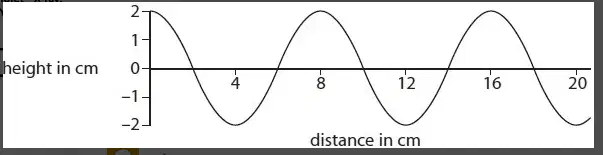
The diagram shows a water wave. The amplitude of a wave is
1 cm
2 cm
4 cm
8 cm
To find the magnitude of a vector you use which formula
inverse sine
graphical analysis
pythagorean theorem
slope
Temperature is an example of ______
Scalar Fileld
Vector Field
Scalar & Vector Field
Velocity is an example of ______
Scalar Fileld
Vector Field
Scalar & Vector Field
In vector AB
point B is the ______________
initial point, also known as the tip
initial point, also known as the tail
terminal point, also known as the tip
terminal point, also known as the tail
When using the head-to-tail method to draw a vector addition diagram, the resultant is drawn from the _____ .
head of the first vector to the tail of the last vector
tail of the first vector to the head of the last vector
head of the last vector to the tail of the first vector
tail of the last vector to the head of the last vector
Bob walks 2 miles north and turns west and walks 2 miles. What is Bob's general displacement?
4 miles northeast
4 miles northeast
3 miles northwest
3 miles southeast

What is the magnitude of the resultant vector, r?
3
4
5
7

Describe the direction of the vector above.
30 degrees
30 degrees North East
30 degrees North of East
30 degrees East of North

What is the resultant of the two vectors shown above?
+5
-5
+15
-15
Two like parallel forces of 4N and 8N are 15m apart. Find the distance in meters of the line of action of their resultant from 4N force.
The position vectors of A and B are (2i+j) and (−i+4j) respectively. Find |AB|.
5
4 2
2 2
3 2
Given that AB=5i+3j and AC=2i+5j, find BC.
−7i−8j
−3i+2j
3i−2j
3i+8j
Which of the following is not a vector field?
Gravitational Field
Magnetic intensity
Electric potential
Electric field
A theorem which converts surface integral into a line integral and vice versa is
Stoke's theorem
Green's theorem
Gauss's theorem
Newton's theorem

