
NEW
Font size
 Worksheets
Food Webs and Changes in Populations Quiz 24-25
Total questions: 20
Worksheet time: 20mins
A farmer had an accident and spilled a chemical into his pond. Several days later, he noticed many dead frogs around the pond. That summer, the number of flies around the pond was higher than ever. This is because
the chemical doesn’t affect the populations of the pond
the frogs are limiting factors for the flies
the flies are a limiting factor for the frogs
the chemical is a limiting factor for the flies
A scientist was studying a population of fish in a pond over a period of 10 years. He observed that the population increased each year for 3 years and then leveled off and stabilized for the rest of the study. The best explanation for this observation is that the population had
No predators
Limiting factors
Abundant resources
Natural hazards
These restrict populations from growing exponentially larger in ecosystems.
carrying capacity
limiting factor
population density
niche
The maximum number of organisms that an ecosystem can support is known as ________.
changes in population
population density
energy pyramid
carrying capacity
What happens to the population of an ecosystem if no limiting factors exist?
population remains the same
population decreases
population increases
population fluctuates

In the graph below where was the population growing the most?
days 1-7
days 9-17
days 21-27
days 29-35

What is the carrying capacity in the graph to the right?
500
1000
400
800
The growth rate of a population that has a limited food supply will MOST LIKELY be __.
exponential
natural
logistic
random
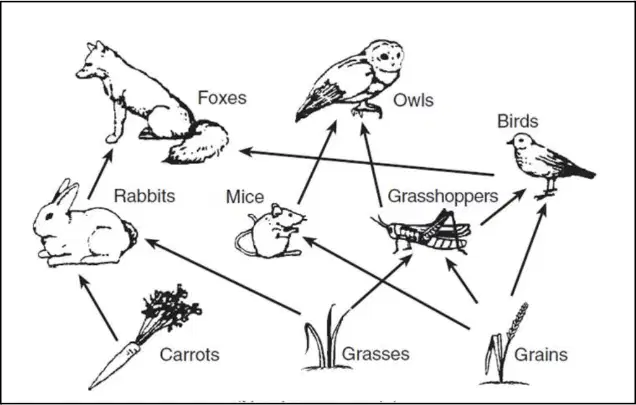
How many producers are in the food web?
3
2
1
0
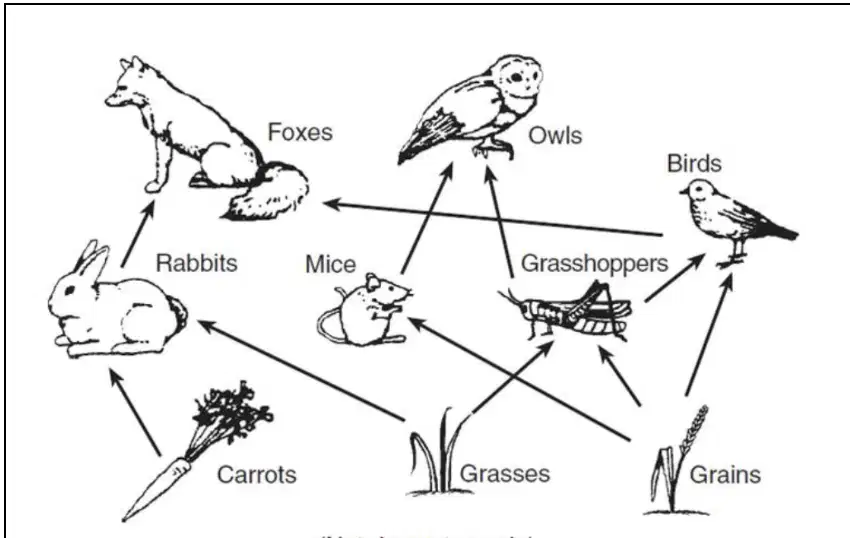
How many carnivores in the food web?
0
1
2
3

How many omnivores in the food web?
0
1
2
3
The arrow in the food web shows ________.
the flow of heat
the flow of toxins
the flow of energy
what an organism is eating
One biotic factor that limits the carrying capacity of any habitat is the ___________?
availability of water
level of atmospheric oxygen
activity of decomposers
amount of soil
We do not often see exponential population growth in an ecosystem because _____.
ecosystems have limited resources
ecosystems do not have a carrying capacity
species rarely compete with one another in an ecosystem
interactions between organisms are unchanging
If a scientist is counting how many individuals of a species are living in a given area then they are measuring the species ________________.
population growth
population density
limiting factors
carrying capacity
Which correctly describes the flow of energy in an ecosystem?
sun to producer to consumer to decomposer
producer to consumer to decomposer to sun
sun to consumer to decomposer to producer
decomposer to sun to consumer to producer


How much of the energy in each level of a ecological pyramid gets lost/transformed into heat or used by the organism so that it CANNOT be passed on to the next trophic level?
80%
90%
10%
20%
There are more producers than consumers.

Based on the diagram, which statement best describes this ecosystem?
Energy is gained by the organisms in the ecosystem, while the matter is lost.
Energy flows through the ecosystem, while the matter is recycled and conserved.
Energy cycles in the ecosystem, while the matter is used up by an organism.
Energy and matter are both lost as they move through the ecosystem.

