
 Worksheets
Chapter 7 (1) : Electrical Installation Systems
Total questions: 10
Worksheet time: 7mins
Which one is NOT a part of the basic concepts of electricity?
Conductors
Electric
Inculators
Lightning
Which one describes the best definition of CONDUCTORS?
Material which not allow an electric current to flow.
Material which allow an electric current to flow.
Material that not resist the flow of an electric current.
Material that resist the flow of an electric current.
CURRENT refers to the
Flow of the electric charge in a circuit.
Amount of stored electricity in a battery.
Voltage supplied by a power source.
Resistance to electricity in a circuit.
What happens to electricity when the circuit is broken?
It reverses direction.
It flows faster.
It stops flowing.
It increases in voltage.
Ohm's Law explains the concept of electricity through the relationship between:
Voltage
Current
Resistance
All of the above answers.
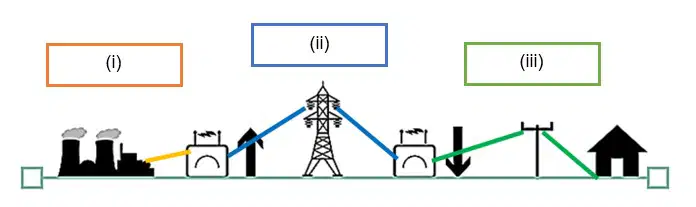
Based on the diagram provided, choose the appropriate system for each box.
(i) GENERATION
(ii) DISTRIBUTION
(iii) TRANSMISSION
(i) GENERATION
(ii) TRANSMISSION
(iii) DISTRIBUTION
(i) TRANSMISSION
(ii) DISTRIBUTION
(iii) GENERATION
Choose the correct example of a RENEWABLE SOURCE.
Coal
Natural Gas
Hydropower
Oil
Electric power can be transmitted or distributed either by overhead system or by underground cable. TRUE or FALSE?
True
False
What is the primary function of a distribution substation in an electric power system?
To generate electricity.
To transmit electricity over long distances.
To store electricity for future use.
To lower the transmission voltage to medium voltage for distribution.
What are the two types of power distribution phases?
Direct Phase and Indirect Phase.
Single Phase Power and Three Phase Power.
High Voltage Phase and Low Voltage Phase.
Static Phase and Dynamic Phase.

