
Font size
 Worksheets
10 Legal Practice Exam Prep
Total questions: 20
Worksheet time: 20mins
We need laws in our society to... (choose two options)
· To make laws are made in an open and transparent way by the people.
· To ensure the law is known and accessible.
· To ensure people can only be punished in accordance with the law.
· To ensure independent and impartial judiciary.
· Allows for Open Justice.
· Maintain order in society
· To ensure people are treated equally and respectfully
· To make clear the behaviours that are acceptable
· To reflect and protect the values and norms of society
· To ensure the safety and security of the community
· Protect people’s rights
· To restrain behaviours that might have a negative effect on other
· To uphold democracy and prevent anarchy
· To settle disputes fairly and equitably
· Provide consequences and punishment to address wrongdoing
· To Regulate Kangaroo Overpopulation in Urban Areas –
· Preventing Crocodile-Related Workplace Accidents
· Protecting Australia’s "Non-Intended" Time Zones –
· Mandatory Shrimp Sizing Regulations for BBQs –.
· Regulating Indigenous Australian Languages in Public Schools
What are the three arms of government according to the doctrine of the Seperation of Powers?
Parliament
Judiciary
Executive
Legislature
Which arm of government is responsible for making laws?
Legislature
Executive
Judiciary
Local Council
What is the primary function of the Executive arm of government?
To administer and enforce laws
To make laws
To interpret laws
To elect representatives
Which of these is a key responsibility of the Judiciary?
Interpreting laws and resolving disputes
Managing government departments
Setting government budgets
Interpreting laws and resolving disputes
The Australian legal system has steps in the law making process that are used to ensure the laws are effective and represent the needs of all Australians.
Choose three examples of steps taken to ensure Bills are scrutinised properly.
There is opportunity for public enquiry
There are three readings of a Bill in each house of Parliament
Bills have to passed by both Houses of Parliament, the House of Representatives and the Senate
Judges are able to use their discretion in creating laws.
How does multiple readings of a Bill in each House of Parliament ensure the Bill is properly scrutinised?
This allows the public, who will be affected by the laws, to have a say.
This allows for review by different elected officials which requires majority support
It ensures Parliamentarians understand the Bill in full form.
It provides opportunity for discussion and debate a number of times before a final decision is made and a Bill is passed into law.
A Bill is passed by both both Houses of Parliament, the House of Representatives and the Senate. Why does this ensure the Bill is properly scrutinised?
Once the House of Representatives passes a Bill, the Senate automatically approves it without any further review or changes.
Having a Bill pass through both Houses of Parliament ensures proper scrutiny because each House represents different interests and perspectives.
Passing a Bill through both Houses ensures a fast-track process, allowing minimal debate and scrutiny, which speeds up its implementation.
The House of Representatives and the Senate always share the same views, so the Bill doesn’t need any detailed discussion or amendments, ensuring smooth passage.
The public is involved in the law making process through public enquiry. How does public enquiry allow for scrutiny of the Bill?
During a public enquiry, citizens have the opportunity to ask questions of their elected officials and put forward their own opinions and experiences related to the Bill
During a public enquiry, citizens are given the chance to vote on whether the Bill should be passed, bypassing parliamentary debate altogether.
The public are able to take public enquiries as an opportunity to grill their local members about their behaviour.
During a public enquiry, citizens are encouraged to listen but not provide feedback. It is treated as more of a 'public information session' than a consultation.
How do multiple reading of Bills in Parliament ensure laws are effective at representing the interests of Australians?
As a result of the multiple readings, the public is assured their taxes are going to good use paying the salary of the Senators and members of Parliament
This ensures Bills are balancing the rights of individuals and the rights of the States.
As a result laws are then more effective or representative because they have been informed by more viewpoints, considered in greater depth and there have been multiple opportunities for flaws to be addressed.
This ensures laws are more effective and represent the interests of Australians, balancing the rights of individuals and the rights of the States.
True or False: Public inquiry as part of the law making process increases the effectiveness of the law by allowing citizens, experts, and organisations to share their views and experiences with Parliament. Through submissions and hearings, the public can highlight potential problems, suggest improvements, and explain how the law would affect different communities. This input helps create laws that work better in real life and reflect the diverse needs of all Australians.
True
False
Identify two elements of the Rule of Law that are potentially undermined by mandatory sentencing.
Judicial independence or discretion
No retrospective laws shall be made
Equality before the law
People can only be punished within the law
When we analyse in Legal Studies, we examine the nature and scope of an issue and different viewpoints.
What does nature involve?
The perspectives/arguments on the issue held by different stakeholder groups. When we consider viewpoints/arguments about the current law, we also consider consequences. (what is the viewpoint/argument? What is a consequence of this? How does the issue create/cause this consequence? Why is this a problem or of concern? (consider linking to criteria for effective laws in your viewpoint and consequence)
The extent of the components of the legal issue (Who is affected? What is the jurisdiction? What is the legislation at issue? Who are the stakeholders affected? What are the overarching social/economic/cultural/environmental impacts for stakeholders?)
The essence and elements of the of the legal issue being considered (what is the issue? Why does it exist? What is it’s significance?)
When we analyse in Legal Studies, we examine the nature and scope of an issue and different viewpoints.
What does scope involve?
The essence and elements of the of the legal issue being considered (what is the issue? Why does it exist? What is it’s significance?)
The perspectives/arguments on the issue held by different stakeholder groups. When we consider viewpoints/arguments about the current law, we also consider consequences. (what is the viewpoint/argument? What is a consequence of this? How does the issue create/cause this consequence? Why is this a problem or of concern? (consider linking to criteria for effective laws in your viewpoint and consequence)
The extent of the components of the legal issue (Who is affected? What is the jurisdiction? What is the legislation at issue? Who are the stakeholders affected? What are the overarching social/economic/cultural/environmental impacts for stakeholders?)
When we analyse in Legal Studies, we examine the nature and scope of an issue and different viewpoints.
What are viewpoints?
The essence and elements of the of the legal issue being considered (what is the issue? Why does it exist? What is it’s significance?)
The perspectives/arguments on the issue held by different stakeholder groups. When we consider viewpoints/arguments about the current law, we also consider consequences. (what is the viewpoint/argument? What is a consequence of this? How does the issue create/cause this consequence? Why is this a problem or of concern? (consider linking to criteria for effective laws in your viewpoint and consequence)
The extent of the components of the legal issue (Who is affected? What is the jurisdiction? What is the legislation at issue? Who are the stakeholders affected? What are the overarching social/economic/cultural/environmental impacts for stakeholders?)
Match the following

Rule by a king or queen
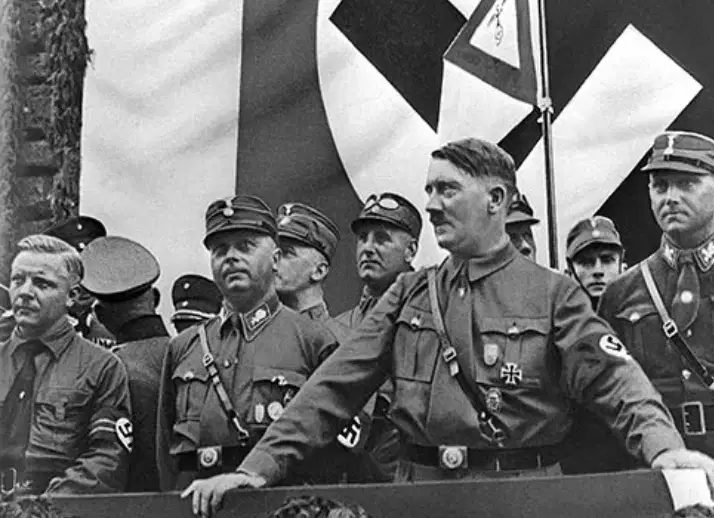
Rule by a single leader with absolute power
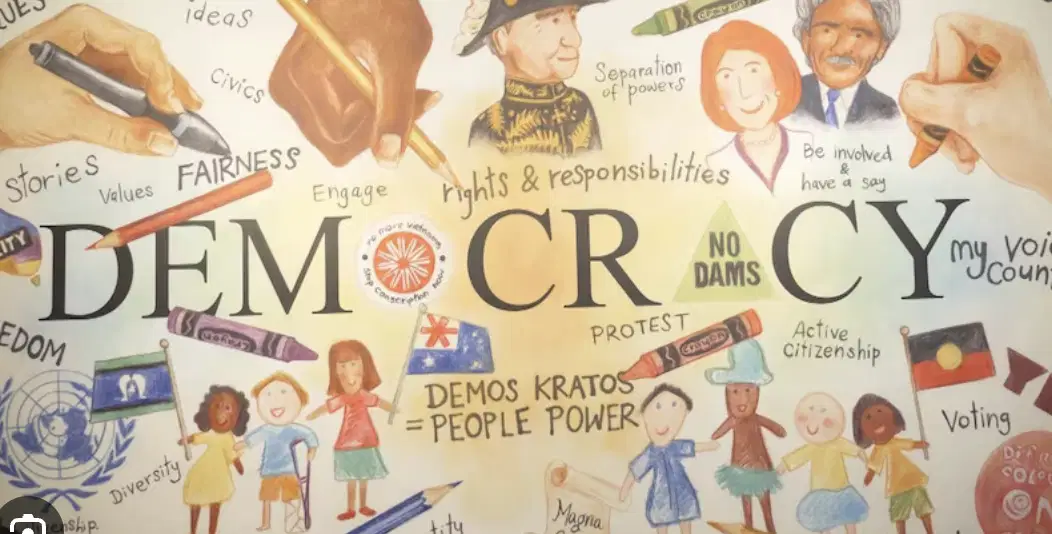
Rule by the people through elected representatives

Rule by a small group of people

Absence of government
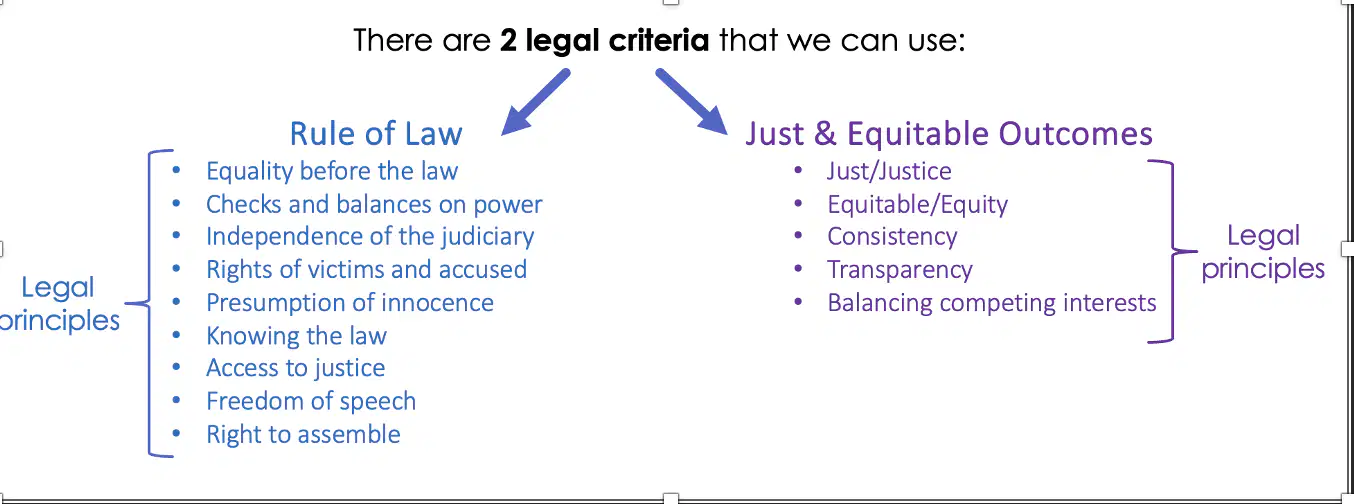
In Legal Studies we need to use legal criteria to justify recommendation. Identify 3 things we consider when we are analysing Just and Equitable Outcomes
Consistency
Balancing Competing Interest (Proportionality)
Right to assemble
Equitable/Equity
Rights of the Victim and Accused
How Mandatory Sentencing Potentially Undermines Rule of Law
Can disproportionately impact disadvantaged groups - May create inequality in practice
Reduces judicial discretion - Limits judges' ability to consider individual circumstances
May create disproportionate outcomes - Can lead to unjust sentences in unique cases
Shifts power from judiciary to legislature - Weakens separation of powers
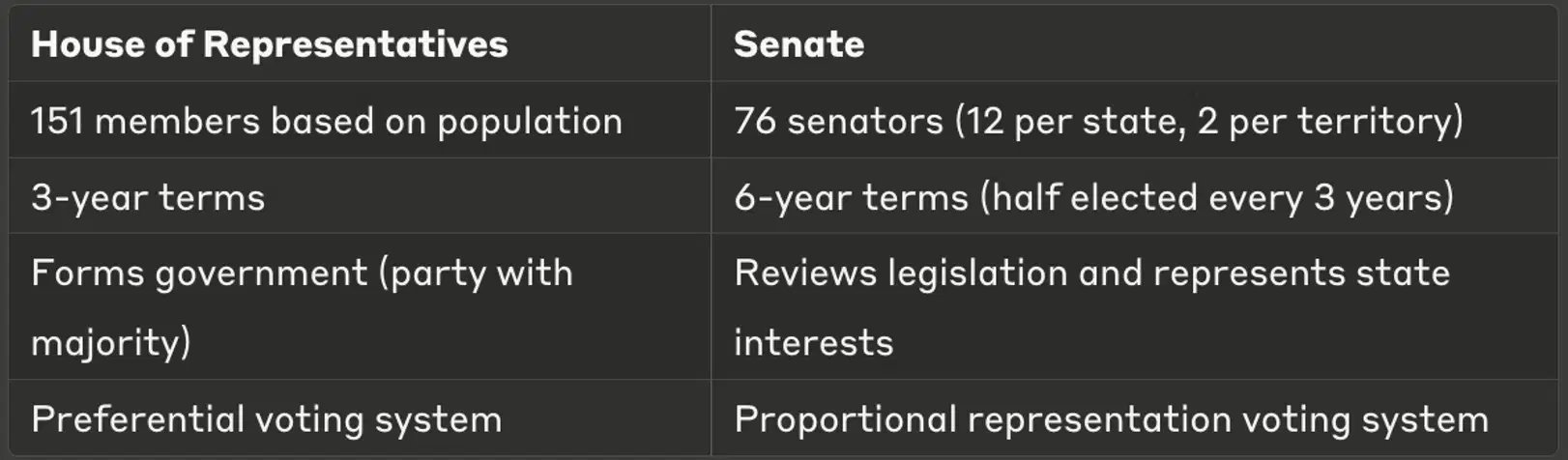
The table represents...
State representation
The key differences between the two houses (bicameral structure)
Examples of a unicameral house
Different electoral systems
(a) is in practice necessary to achieve a parliament truly representative of the people. Bicameralism helps to improve and enhance the representative quality of a parliament and to ensure that it is representative in a way in practice not achievable in a unicameral parliament. Modern societies are complex and diverse; no systems of representation are, of themselves, capable of providing a truly representative assembly. Adequate representation of a modern society, with its geographic, social and economic variety, can be realised only by a variety of modes of election. This is best achieved by a bicameral parliament in which each house is constituted by distinctive electoral process. A properly structured bicameral parliament ensures that representation goes beyond winning a simple majority of votes in one election, and encompasses the state of electoral opinion in different phases of development.

