
 Worksheets
Exploring Food Chains and Ecosystems
Total questions: 129
Worksheet time: 2hrs 17mins
What are producers in a food chain?
Producers are animals that consume other organisms.
Producers are organisms that decompose dead matter.
Producers are organisms that rely on external sources for food.
Producers are organisms that create their own food, such as plants and algae.
Name one example of a producer.
Carrot
Mushroom
Rabbit
Sunflower
What role do consumers play in a food chain?
Consumers do not interact with producers in a food chain.
Consumers are only herbivores in a food chain.
Consumers are organisms that obtain energy by eating producers or other consumers in a food chain.
Consumers produce energy for the food chain.
Can you list the three types of consumers?
Herbivores, Predators, Scavengers
Herbivores, Carnivores, Omnivores
Producers, Decomposers, Scavengers
Carnivores, Detritivores, Filter feeders
What is the role of decomposers in an ecosystem?
Decomposers produce energy for plants.
Decomposers recycle nutrients and break down dead matter in an ecosystem.
Decomposers are primary consumers in the food chain.
Decomposers compete with herbivores for food resources.
Give an example of a decomposer.
Bacteria
Plant
Animal
Fungus
How does energy flow in a food chain?
Energy is created and consumed in equal amounts in a food chain.
Energy flows in a circular pattern among all organisms in a food chain.
Energy flows from producers to consumers in a food chain.
Energy flows from consumers to producers in a food chain.
What happens to energy as it moves up the food chain?
Energy remains constant throughout the food chain.
Energy increases as it moves up the food chain.
Energy is completely transferred to the top predators.
Energy decreases as it moves up the food chain.
What is the difference between a food chain and a food web?
A food chain shows only herbivores, while a food web shows only carnivores.
A food chain is a linear sequence of energy flow, while a food web is a complex network of interconnected food chains.
A food chain includes multiple species, while a food web includes only one species.
A food chain is a complex network, while a food web is a simple sequence.
Why are food webs more complex than food chains?
Food webs are simpler because they focus on one species.
Food webs are more complex than food chains because they represent multiple interconnected feeding relationships among various organisms.
Food chains are more detailed than food webs.
Food chains include all possible feeding relationships.
How do plants contribute to the food chain?
Plants are only used for decoration in the food chain.
Plants contribute to the food chain by serving as primary producers that provide energy for herbivores, which are then consumed by carnivores.
Plants do not play any role in the food chain.
Plants are consumed directly by carnivores without any herbivores.
What would happen if there were no decomposers?
Ecosystems would collapse due to nutrient depletion and waste accumulation.
Decomposers would thrive and increase biodiversity.
Nutrient levels would remain stable and healthy.
Waste would be converted into energy efficiently.
Can you name a primary consumer?
Grass
Deer
Frog
Rabbit
What is a secondary consumer?
An organism that decomposes dead matter.
An organism that eats primary consumers.
An organism that eats plants directly.
An organism that produces its own food.
How do humans fit into food chains?
Humans only consume other humans in food chains.
Humans are at the top of the food chain and do not interact with other species.
Humans are omnivores in food chains, consuming plants and animals.
Humans are strictly herbivores in food chains.
Energy is
the ability to cool
what is needed to do work or cause change
What stops motion
energy produced by the movement of electrons is
mechanica
electrical
thermal
Energy produced by a machine or a moving part is
thermal
electrical
mechanical
Energy that causes a transfer of heat between materials is
thermal
electrical
mechanical
Radiant energy that our eyes can see is
light
thermal
electrical
What is a code word for the five forms of energy?
MENDS
STEMS
MELTS
Energy produced from air vibrations is
sound
light
heat
Anytime anything moves energy is involved
True
False
What type of energy powers a computer
electrical
sound
heat
A lamp uses electrical energy to produce what two other types of energy?
heat and light
light and sound
mechanical and light
What form of energy allows you to see yourself in a mirror?
light
heat
mechanical
Campfires us what type of energy to cook food
light
thermal
electrical
A girl riding a bike is an example of what type of energy?
thermal
mechanical
light
When a lamp is plugged in and turned on, it converts _______ energy to _________ energy.
mechanical to light
electrical to sound
electrical to light
light energy is produced by
computer monitors
air conditioners
stove tops
Pushing a lawn mower uses
mechanical energy
electrical energy
sound energy
A wind-up toy uses
mechanical energy
sound energy
thermal energy
a light bulb can show two types of energy
true
false
Turning gears are an example of
sound energy
mechanical energy
light energy
thermal energy is used to
signal traffic lights
cook food
sharpen pencils
BONUS: Energy can change from one form to another
true
false

The highes point of a wave above the line of origin.
Trough
Crest
Wavelength
Amplitude

The distance between two consecutive crests.
Wavelength
Medium
Frequency
LIne of Origin

the height of the wave.
Matter
Wavelength
Energy
Amplitude
A wave that moves matter and vibrates our eardrums so we can hear.
Seismic waves
Light waves
Sound waves
Water waves

What type of wave is shown in the picture? (up and down)
Transverse Wave
Longitudinal Wave

What type of wave is shown in the picture?
Transverse Wave
Longitudinal Wave
Transverse waves are made up of.......
Crests and Troughs
Compressions and Rarefactions

Which wave has the largest amplitude?
Green
Blue
Red
The total number of waves produced in one second is called the ________ of the wave.
Vibration
Echo
Frequency
Amplitude
What happens when you increase the amplitude of a sound?
It makes the sound travel faster
It makes the sound louder
It increases the wavelength of the sound
It increases the frequency of the sound
A measure of how high or low a sound is
vibration
sound
pitch
music

The lowest point of a wave below the line of origin
Crest
Frequency
Trough
Valley

The line running through the center of the wave.
Amplitude
Equator
Equilibrium
Middle Line
A disturbance in a medium that transfers energy from place to place.
Science
Solids
Matter
Wave
Waves transfer _________.
Energy
Matter
Candy
Boats

What is A supposed to be?
wavelength
crest
trough
amplitude

What is B supposed to be?
wavelength
crest
trough
amplitude

What is C supposed to be?
wavelength
crest
trough
amplitude

What is D supposed to be?
wavelength
crest
trough
amplitude

What is A supposed to be?
short wavelength
long wavelength
high frequency
low frequency

What is B supposed to be?
short wavelength
long wavelength
high frequency
low frequency

What is C supposed to be?
short wavelength
long wavelength
high frequency
low frequency

What is D supposed to be?
short wavelength
long wavelength
high frequency
low frequency

What is a wavelength?
How many waves pass a certain point
The distance from one wave crest to another
The entire length of a wave


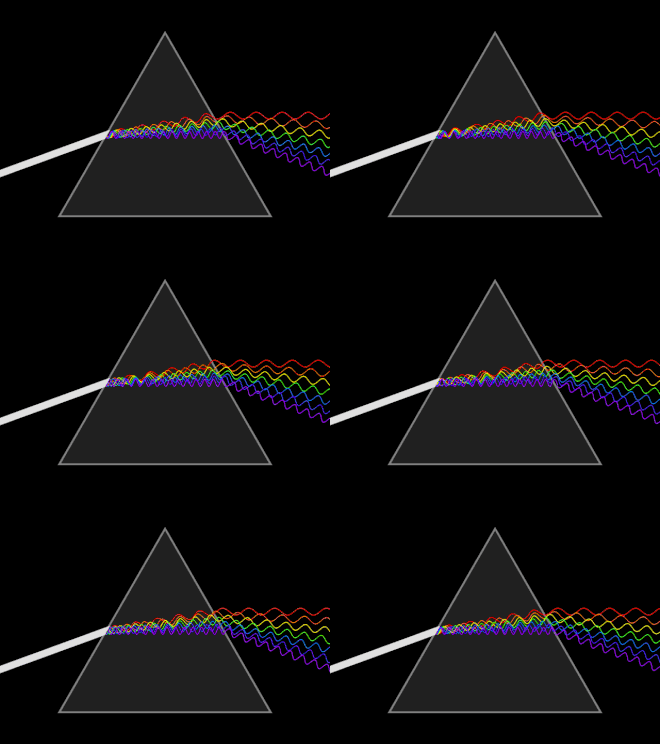


What happens to all of the light when it hits this object?
reflection
absorption
transmission
What is the process called for how rainbows are formed?
Reflection
Refraction (bending)
Transmission
Scattering
In order to make a rainbow, what is needed?
Light
Rain
Leprechauns
Surface
Which of the following colors have the longest wavelength?
Red
Yellow
Blue
Green
Which of the following has the correct order from shortest wave to longest?
Red, orange, green
Green, yellow, blue
Indigo, Green, Yellow
Violet, Green, Indigo
When light passes through a prism, why do you see different colors?
Each color has a different wavelength, so they all bend at different angles
Because Stone Cold said so
Because the prism is magical and allows you see the colors

Waves with a long wavelength have:
Low energy/low frequency
High energy/high frequency
Which type of waves allow you to listen to music in your cars?
Radio
Micro
X-Ray
Gamma
Which part of the EMS is the only portion we can see?
Gamma
Radio
Visible Light
What does EMS stand for?
Electromagnetic Spectrum
Energy Management System
Electron Microscope Silo
Which of the following is not a wave on the EMS?
Infrared
Ultraviolet
Biological
Gamma Ray
Why do colors of light separate when they are refracted?
The bend causes them to split up randomly
Their wavelengths causes them to bend at different angles
Skittles (taste the rainbow)
In order to see the other light on the EMS, we need:
Better eyes
Machines/Tools

This is an example of a tool being used to see what kind of light?
Ultraviolet
Infrared
Gamma

The moment the bat touches the ball, energy from the moving bat is transferred to what?
The baseball player
The ball
The bat
The field
An encounter between two objects. After the encounter, there is a change in energy.
Transformation
Energy
Collision
Friction
The ability to do work.
Energy
Force
Friction
Mass
A push or a pull on an object.
Friction
Mass
Energy
Force
A pushing force that occurs when two objects touch. This slows down things that are moving.
Energy
Force
Friction
Collision
The transfer of energy from a warm object to a cooler one.
Heat Energy
Sound Energy
Light Energy
Friction
The energy an object has when it is in motion.
Potential Energy
Sound Energy
Light Energy
Kinetic Energy
Energy cannot be created and it cannot be destroyed. It can only change from one form to another.
Laws of Energy Transfer
Law of Conservation of Energy
Newton's Law
Universal Laws of Energy
The amount of matter in an object; related to how heavy an object is.
Friction
Energy
Speed
Mass
The type of energy that travels in waves through matter.
Light Energy
Heat Energy
Sound Energy
Electrical Energy
In a collision, some kinetic energy that is transferred is converted to _________ and ________ energy.
light
heat
sound
electric
The amount of kinetic energy in an object depends on that object's ________ and ________.
speed
light
mass
force

A car traveling at a slow speed runs into a stopped car. A car moving at a fast speed runs into a stopped car. Which one would cause the most damage?
The damage would be the same
The fast-moving car would cause more damage
The slow moving car would cause more damage
Which has more kinetic energy, a fast horse or a stopped horse?
Neither has kinetic energy
They have the same kinetic energy
The fast horse
The stopped horse

If a 7 pound ball and a 1 pound ball are rolling along at the same speed, which ball has more kinetic energy?
The 7 pound ball
The 1 pound ball
They have the same amount of kinetic energy
There is not enough information to answer this question

If two basketballs are rolling at different speeds, does the faster one or the slower one have more kinetic energy?
Faster
Slower
They have the same kinetic energy
There is not enough information to answer
Which of the following is an example of a collision that does not cause damage?
A truck stopped in traffic
A ball resting on the grass
A pencil writing on a piece of paper
None--all collisions cause damage
If you rub your hands together, why do they get warm?
Some kinetic energy is converted to sound energy
Some of the kinetic energy is converted to heat energy
Some of the kinetic energy is converted to electrical energy
Some of the kinetic energy is converted to light energy
During a collision, the speed and motion of each object changes.
True
False
During a collision, energy is _________.
Lost by the system
Gained by the system
Conserved
Either a or b
What does it mean when we say energy is conserved during a collision?
Energy is created by the system
Energy is destroyed by the system
Energy is lost by the system
Energy of the system remains the same
A basketball and a bowling ball are moving at the same speed. What will happen when the two balls bump together?
The motion of the ball will change in the exact same ways
The motion of the bowling ball will change more than the motion of the basketball
The motion of the basketball will change more than the motion of the bowling ball
There will be no change to the motion of the balls
The conversion (change) of energy from one form of energy to another form of energy.
Energy Transfer
Energy Transformation
Creation of Energy
Energy being destroyed
The movement of energy from one place to another. The type of energy does not change.
Energy Transfer
Energy being created
Energy Transformation
Energy being destroyed


If a hawk eats a snake, the snake is the...
Predator
Alpha
Prey

A frog eats a fly. The frog and fly are demonstrating ________.
mutualism
competition
predator/prey
photosynthesis
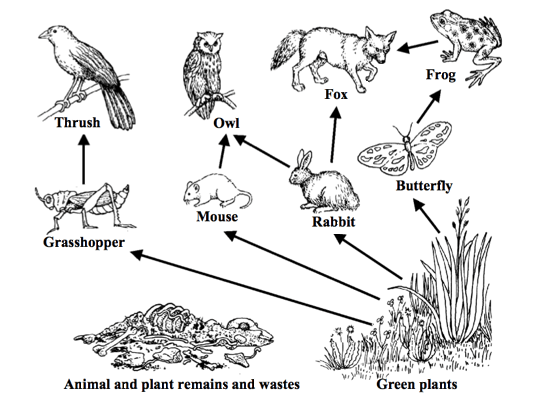


These don't eat meat
carnivores
omnivores
herbivores

These consumers are herbivores.
secondary consumers
primary consumers
producers

These eat herbivores.
secondary consumers
primary consumers
producers

They eat meat.
carnivores
herbivores
decomposers

These eat secondary consumers and primary producers.
omnivores
carnivores
herbivores

These turn dead animals and plants into soil.
carnivores
omnivores
decomposers

