
 Worksheets
Physical Behavior of Matter #2
Total questions: 20
Worksheet time: 10mins
Homogeneous Mixture
uniform distribution of particles
random distribution of particles
separation of components
visible layers of substances
Normal Boiling Point
Temperature at which the vapor pressure is equal to standard pressure
Temperature at which a liquid turns into a solid
Temperature at which a gas condenses into a liquid
Temperature at which a substance reaches absolute zero
Heating Curve
graphical representation of phase transitions when heat is added
a method to cool substances rapidly
a type of chemical reaction diagram
a chart showing temperature changes over time without phase transitions
q = mHf
Formula for calculating kinetic energy
Formula used for heat problems involving a solid-liquid phase change
Formula for calculating potential energy
Formula for determining the speed of light
Chromatography

Separation based on polarity
A technique for separating mixtures
A method for measuring temperature
A process for generating electricity
A type of chemical reaction
A liquid will boil...
when the vapor pressure is equal to the atmospheric pressure
when the temperature is below freezing point
when the liquid is stirred vigorously
when the atmospheric pressure is higher than the vapor pressure
q = mHv
Formula for calculating kinetic energy
Formula used for heat problems involving a liquid-gas phase change
Formula for calculating potential energy
Formula for determining the speed of an object
Heterogeneous Mixture
uniform distribution of particles
nonuniform distribution of particles
completely dissolved substances
a mixture of gases only
Heat of Vaporization
Amount of heat required to boil 1 g of a substance at its boiling point
Amount of heat required to freeze 1 g of a substance at its freezing point
Amount of heat required to raise the temperature of 1 g of a substance by 1°C
Amount of heat required to condense 1 g of a substance at its boiling point
Evaporation

Separation of a liquid and a dissolved solid
The process of a liquid turning into vapor
The process of a solid turning into liquid
The process of gas turning into liquid
The process of a liquid turning into solid
Specific Heat Capacity
The amount of heat required to raise the temperature of 1 g of a substance by 1°C/1K
The amount of heat required to raise the temperature of 1 kg of a substance by 1°C/1K
The amount of heat required to raise the temperature of 100 g of a substance by 1°C/1K
The amount of heat required to raise the temperature of 1 g of a substance by 10°C/10K
Distillation

Separation of 2 liquids based on the differences in boiling point
A method for separating mixtures based on differences in boiling points.
A technique for measuring temperature accurately.
A process for cooling substances rapidly.
A way to mix different liquids together.
Cooling Curve
graphical representation of phase transitions when heat is removed
a method to increase the temperature of a substance
a type of graph used for measuring pressure changes
a diagram showing the relationship between temperature and volume
Filtration
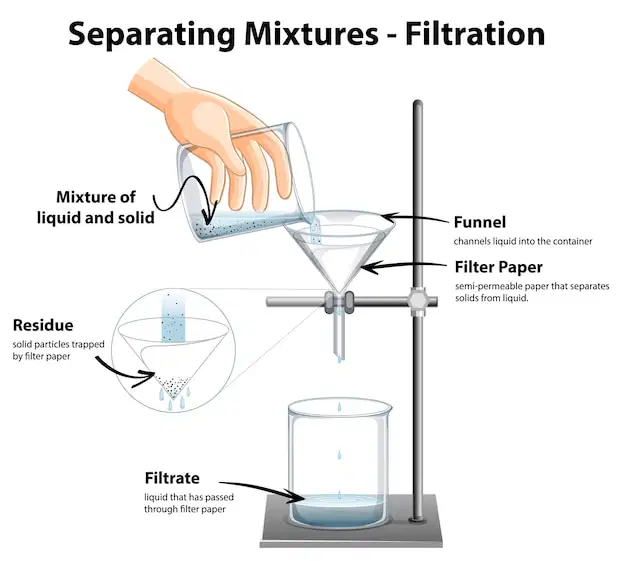
Separation of a liquid and an insoluble solid based on particle size
The process of separating solids from liquids or gases using a filter
A method of cooking food using water
A technique for measuring temperature
A way to purify air by removing pollutants
q = mCΔT
1. Specific Heat Capacity and Temperature Changes
2. Pressure and Volume Changes
3. Mass and Density Changes
4. Work and Energy Changes
During a phase change...
average kinetic energy (temperature!) remains the same
average potential energy remains constant
kinetic energy increases while potential energy decreases
temperature increases continuously
Vapor Pressure
Directly related to temperature
Inversely related to temperature
Unrelated to temperature
Constant regardless of temperature
Heat of Fusion
amount of heat required to melt 1 g of a substance at its melting point
the temperature at which a substance boils
the energy needed to raise the temperature of 1 g of a substance by 1°C
the heat released when a substance freezes
During a calorimetry problem...
the amount of heat lost = the amount of heat gained
the amount of heat lost > the amount of heat gained
the amount of heat lost < the amount of heat gained
the amount of heat lost is irrelevant
Standard Pressure
101.3 kPa
1 atm
100 kPa
102 kPa

