
 Worksheets
AP Biology Topic 6.7 Mutations
Total questions: 20
Worksheet time: 40mins
Explain the difference between point mutations and frameshift mutations.
Point mutations involve changes in multiple nucleotides, while frameshift mutations involve the substitution of nucleotides.
Point mutations involve changes in a single nucleotide, while frameshift mutations involve the insertion or deletion of nucleotides.
Point mutations result in the deletion of nucleotides, while frameshift mutations involve the duplication of nucleotides.
Point mutations occur in non-coding regions, while frameshift mutations occur in coding regions.
Explain the concept of a frameshift mutation and its consequences.
A frameshift mutation results in the deletion of a single nucleotide, causing minimal impact on protein synthesis.
A frameshift mutation can lead to a non-functional or completely different protein being synthesized, which can have severe consequences on the organism's phenotype.
Frameshift mutations only occur in non-coding regions of DNA, so they do not affect protein production.
Frameshift mutations always lead to the production of a longer and more functional protein.
How do mutations in non-coding regions of DNA affect gene expression?
Mutations in non-coding regions can disrupt regulatory elements and may affect gene expression.
Mutations in non-coding regions only affect protein structure, not gene expression
Mutations in non-coding regions have no impact on gene expression
Mutations in non-coding regions always enhance gene expression
How do chromosomal mutations differ from point mutations?
Chromosomal mutations affect the structure or number of chromosomes, while point mutations are a change in a single nucleotide.
Chromosomal mutations and point mutations are the same.
Point mutations affect the entire genome, while chromosomal mutations affect only one gene.
Chromosomal mutations increase genetic diversity, while point mutations do not.
What are the three types of mutations?
animal mutations, plant mutations, and mineral mutations
point mutations, insertion mutations, and deletion mutations
positive mutations, negative mutations, and neutral mutations
color mutations, shape mutations, and size mutations
Which type of mutation involves the substitution of one nucleotide for another?
Frame-shift mutation
Point mutation
Insertion mutation
Deletion mutation
What is the effect of a silent mutation?
The effect of a silent mutation is an increased rate of mutation in an organism.
The effect of a silent mutation is a significant change in the phenotype of an organism.
The effect of a silent mutation is the complete loss of function in an organism.
The effect of a silent mutation is no noticeable change in the phenotype or function of an organism.
What is the effect of a frameshift mutation?
Frameshift mutation results in a longer protein
Frameshift mutation only affects the amino acid sequence of the protein
Frameshift mutation has no effect on protein synthesis
Frameshift mutation causes a shift in the reading frame of the codons, resulting in a non-functional or truncated protein.
What is the effect of a missense mutation?
The effect of a missense mutation is the deletion of one amino acid in the protein encoded by the gene.
The effect of a missense mutation is the substitution of one amino acid for another in the protein encoded by the gene.
The effect of a missense mutation is the insertion of one amino acid in the protein encoded by the gene.
The effect of a missense mutation is the complete loss of function of the protein encoded by the gene.
What is the effect of a nonsense mutation?
The effect of a nonsense mutation is the disruption or loss of protein function.
The effect of a nonsense mutation is the enhancement of protein function.
The effect of a nonsense mutation is the production of more protein.
The effect of a nonsense mutation is the repair of protein function.
True or False: Mutations can be caused by environmental factors.
Only in plants
False
True
Only in animals
What is the effect of a deletion mutation?
Loss of a segment of DNA leading to frameshift mutation
Addition of a segment of DNA leading to frameshift mutation
Substitution of a nucleotide leading to missense mutation
No effect on the DNA sequence
Mutation
a change in the DNA sequence
Point mutation
a type of mutation where one to few bases are substituted with different bases
Frameshift mutation
a type of mutation caused by adding or deleting bases, affecting all the codons after the change
Silent mutation
a type of mutation that doesn't result in a change in the amino acid sequence (same protein)
Chromosomal mutation
a type of mutation where large sections of the chromosome are affected
Original DNA = TAC GAC TTG AAT
Mutated DNA = TAC GTA CTT GAA T
What type of mutation has occurred?
Chromosomal mutation
Point mutation
Frameshift mutation due to adding extra base
Frameshift mutation due to deletion of base

Original DNA: CAGAAT
Mutated DNA: CAGAT = (a)
Mutated DNA: CAGCAAT = (b)
Mutated DNA: CAGTAT = (c)
Which of these shows an example of an insertion mutation?
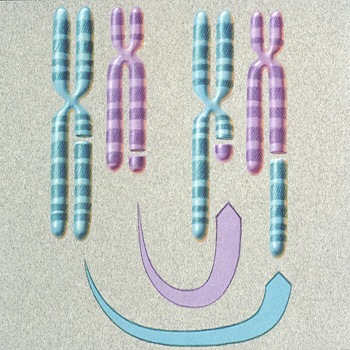
(a) is a type of chromosomal mutation when part of the chromosome breaks off and attaches to another chromosome.
Duplication
Deletion
Translocation
Match the following chromosomal mutations to their correct image

deletion

duplication

inversion

translocation
Match the following chromosomal mutations with their correct description
deletion
gene is removed
duplication
mutated gene is displayed twice
inversion
order of a gene is reversed
translocation
gene from one chromosome breaks off and attaches to another chromosome

