
 Worksheets
Ring Leader: Lesson 3
Total questions: 15
Worksheet time: 8mins
Which of the following best describes path planning?
The process of guessing and checking your way to a challenge solution with your robot
Identifying general steps needed to accomplish a task, like ‘drive forward then turn left’
The process of decomposing a project into the smallest possible behaviors that you can then attach code to
A cycle of defining, developing solutions, and optimizing your project or robot for competition
Path planning is than guessing and checking to solve a coding challenge or accomplish a task with your robot.
Less effective
Equally as effective
Which of the following shows the steps to path planning in the correct sequence?
Attach code to behaviors, test your code, iterate on your project
Identify vague steps needed to complete the task, then guess and check to complete your project
Talk to your team about what your robot needs to do, take turns adding blocks to the project, start the project
Identify the task of the robot, break that task down into the smallest possible behaviors, attach code to each of those behaviors
[Spin for] blocks are used to code which of the following in VEXcode EXP?
A Bumper Switch
A Touch LED
A Drivetrain
An individual motor or motor group
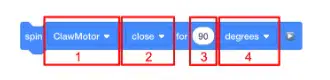
Which part of this [Spin for] block do you use to change the direction the ClawMotor moves?
1
2
3
4
Where can you label your motor and the direction it spins in VEXcode EXP, to make it easier to code your robot?
Robot configuration
Drivetrain
Help
Toolbox
In a challenge, the movement of the robot is entirely controlled by . a. Driver controlled; code b. Autonomous; the driver’s Controller c. Robot; debugging your project d. Autonomous; code
Robot; debugging your project
Autonomous; code
Which of the following is NOT a consideration when preparing for an autonomous challenge?
Precise project planning
Frequent testing and debugging of the project
Controller configuration
Careful setup of robot and game element starting locations
Which of the following is NOT a strategy that can be used to help you successfully set up for an autonomous challenge?
Marking the game elements’ starting positions on the Field
Documenting the robot’s starting position in your engineering notebook
Placing game elements in different locations for each run
Which of the following is TRUE about the setup of the Coding Crunch Challenge?
The robot starts with one ring preloaded in the claw.
Four rings go against the walls on one side of the Field.
A small post is attached to the center tile on one side of the Field.
Two robots should be placed facing each other to start the challenge.
The goal of the Coding Crunch Challenge is:
To create a VEXcode EXP project that codes your robot to grab and score both rings on the small post in the fastest time
To create a VEXcode EXP project that codes your robot to stack all 4 Buckyballs behind the small post.
To create a VEXcode EXP project that removes one ring from the Field.
To create a VEXcode EXP project that removes all five rings from the Field as quickly as possible.
How many rings should be placed on the Field when setting up the Coding Crunch Challenge?
4
2
3
6
Which of the following describes how to time a Coding Crunch run?
The timer begins as soon as the Field is set up, and stops when the first ring is scored.
Start the timer after calibration, once the VEXcode EXP project starts, and stop the project once when the second ring is scored, or the max time of two minutes is reached, or use the {When timer} block.
The timer begins when the robot scores the first ring, and stops when the second ring is scored.
The timer begins when the project starts, and stops at three minutes.
Which of the following is true about the Coding Crunch Challenge?
If a ring falls out of the Field, it cannot be scored.
If a ring falls out of the Field, hand-place it back in its starting location, without touching the
robot. The timer does not stop.
If a ring falls out of the Field, the timer is stopped and it is placed in the robot starting location.
If a ring falls out of the Field, the timer is stopped and it is hand placed in its starting location.
How is a ring scored in the Coding Crunch Challenge?
Rings are scored when they are stacked in the holding area on the Field.
Rings can be scored two different ways: by stacking them in the robot starting location or
stacking them on the post.
Rings must be completely around the post, to count as ‘scored.’ Rings are not scored if they are
hanging from the post or still touching the robot.
Rings are scored when they are completely removed from the Field and not touching the robot.

