
Font size
 Worksheets
Resources
Total questions: 36
Worksheet time: 7hrs 20mins

Materials from Earth that can be replaced by nature within a relatively short period of time; for example, trees
Renewable Resources
Nonrenewable Resources
Plant
Animal
A type of living thing that gets its energy from the Sun and is unable to move from place to place on its own
Renewable Resources
Nonrenewable Resources
Plant
Animal
A living thing that can move on its own and that gets its energy from food
Renewable Resources
Nonrenewable Resources
Plant
Animal

Resources that cannot be replaced by natural processes within a lifetime (coal, oil, natural gas, rocks, and minerals)
Renewable Resources
Nonrenewable Resources
Plant
Animal

A nonrenewable natural resource produced from the remains of organisms buried under layers of sediments for millions of years
Coal
Oil
Natural Gas
Conserve
A flammable material, without a definite form, produced from remains of marine organisms buried under layers of sediment found near oil deposits
Coal
Oil
Natural Gas
Conserve
To prevent the loss of something
Coal
Disposal
Natural Gas
Conserve
The act of getting rid of something or throwing it away
Coal
Disposal
Natural Gas
Conserve

To properly dispose of used resources so they can be reprocessed into new products
Solar Energy
Disposal
Recycle
Conserve
Energy that comes directly from the Sun and is converted to usable energy; a renewable resource
Solar Energy
Disposal
Recycle
Conserve
Moving air
Natural Resources
Wind
Water
Physical Properties
A colorless, odorless, and tasteless liquid living things need to survive
Natural Resources
Wind
Water
Physical Properties
Characteristics that can be observed or measured; for example, color, melting point, and conductivity
Natural Resources
Wind
Water
Physical Properties

Resources that are found in the environment and are not made by humans
Natural Resources
Wind
Water
Physical Properties
A resource is considered renewable if it -
can be created only over millions of years
is made of Earths’ materials like rocks and minerals
can be replaced in a relatively short amount of time
is useful to humans in making energy and materials
Which of the following is a non-renewable resource?
Paper
Coal
Milk
Water

Students were asked to generate a list that contained nothing but renewable resources. Which student was the the only one to make a correct list?
Student A
Student B
Student C
Student D
Fossil fuels form when organic matter is buried and then exposed to heat and pressure for millions of years. Fossil fuels are classified as nonrenewable resources because they –
take a long time to form
are used to produce heat
form from organic matter
can be found underground
Drive a big car with no passengers.
Cut off lights when exiting a room.
Brush teeth with hot water.
Ride the bus instead of biking to school.
Things found in nature that people can use...
animals
environment
natural resource
renewable resources
Oil
Coal
Solar Power
Natural Gas
Check all the boxes that are examples of nonrenewable resources
natural gas
oil
sun
water
coal
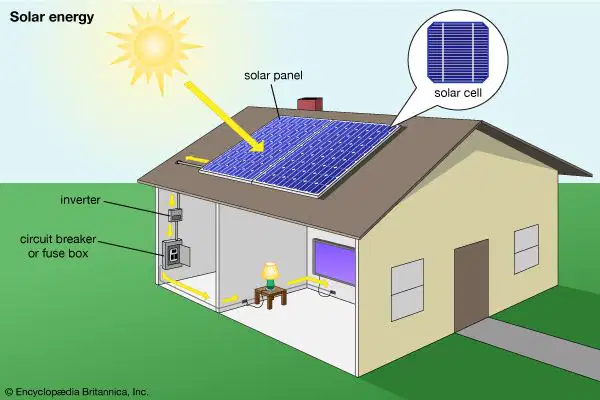
What is one advantage of using solar energy?
It can run out over time
it produces a lot of pollution
it is a clean and unlimited energy source
it is expensive and hard to find
What is a disadvantage of using fossil fuels like oil and natural gas?
They create pollution and can harm the environment.
They are easy to replace.
They do not produce energy.
They are unlimited and will never run out.
What is a disadvantage of wind energy?
It pollutes the air.
It is not a renewable resource.
It does not work when there is no wind.
It produces harmful gases.
Why are energy resources important in modern life?
They are only used for transportation.
They help us produce electricity, heat homes, and power machines.
They are not needed because everything runs without energy.
They make plants grow faster.
What is one benefit of recycling materials like paper, plastic, and metal?
It helps reduce waste in landfills and saves resources.
It increases pollution in the air and water.
It makes natural resources disappear faster.
It uses more energy than throwing things away.
Which of the following is the best way to conserve water?
Leave the faucet running while brushing your teeth.
Take shorter showers and fix leaks.
Pour clean water down the drain for fun.
Water the lawn several times a day.
What is one reason rocks can store water, oil, or gas?
Some rocks have tiny holes that hold them.
Rocks are made of metal.
Rocks are too hard to store anything.
Oil and gas float in the air.

Trees are renewable resources.
True
False
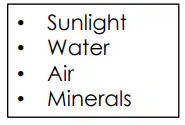
Which list shows only renewable resources?
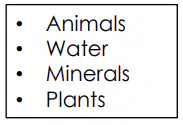
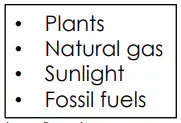
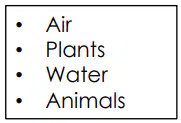
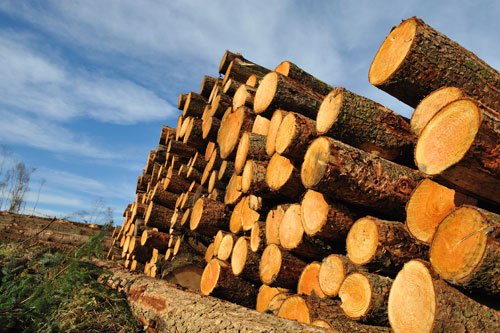
Wood is...
A renewable resource
A nonrenewable resource
Used to make oil
Used to make plastic

Is coal a renewable or nonrenewable natural resource?
Renewable
Nonrenewable

Is water a natural resource?
Yes
No

A Natural Resource comes from Earth. Which items are natural resources? Select ALL that apply...
wood
plastic
bricks
water
wind


