
Font size
 Worksheets
The internet and the World Wide Web (WWW)
Total questions: 15
Worksheet time: 14mins
is used to display content on browsers.
(a)
All websites are written in HTML and hosted on ........................ that
has its own .....................
web server/IP address
server/web site
remoted system/operating system
computer/location in the Internet
To get content pages from a website your browser needs
to know this (a)
Describe the term DNS?
(a)
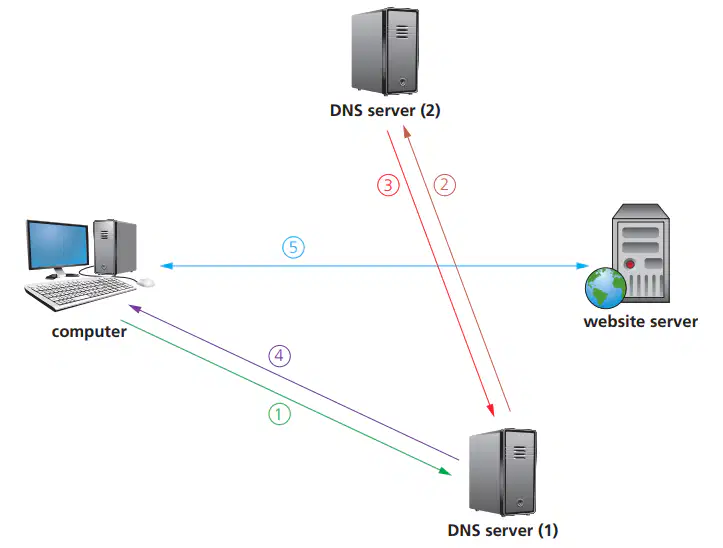
Which option represents stage 1 in the picture?
he user opens their browser and types in the URL (www.hoddereducation.co.uk)
and the browser asks the DNS server (1) for the IP address of the website.
DNS server can’t find www.hoddereducation.co.uk
in its database or its cache, so it sends out a request to a DNS server (2).
The DNS server (2) finds the URL and can map it to 107.162.140.19; this IP
address is sent back to the DNS server (1) which now puts this IP address
and associated URL into its cache/database.
This IP address is then sent back to the user’s computer.
The computer now sets up a communication with the website server and the
required pages are downloaded. HTML files are sent from the website server
to the computer. The browser interprets the HTML, which is used to structure
content, and then displays the information on the user’s computer.
Which option represents stage 3 in the picture?
he user opens their browser and types in the URL (www.hoddereducation.co.uk)
and the browser asks the DNS server (1) for the IP address of the website.
DNS server can’t find www.hoddereducation.co.uk
in its database or its cache, so it sends out a request to a DNS server (2).
The DNS server (2) finds the URL and can map it to 107.162.140.19; this IP
address is sent back to the DNS server (1) which now puts this IP address
and associated URL into its cache/database.
This IP address is then sent back to the user’s computer.
The computer now sets up a communication with the website server and the
required pages are downloaded. HTML files are sent from the website server
to the computer. The browser interprets the HTML, which is used to structure
content, and then displays the information on the user’s computer.
Which option represents stage 5 in the picture?
he user opens their browser and types in the URL (www.hoddereducation.co.uk)
and the browser asks the DNS server (1) for the IP address of the website.
DNS server can’t find www.hoddereducation.co.uk
in its database or its cache, so it sends out a request to a DNS server (2).
The DNS server (2) finds the URL and can map it to 107.162.140.19; this IP
address is sent back to the DNS server (1) which now puts this IP address
and associated URL into its cache/database.
This IP address is then sent back to the user’s computer.
The computer now sets up a communication with the website server and the
required pages are downloaded. HTML files are sent from the website server
to the computer. The browser interprets the HTML, which is used to structure
content, and then displays the information on the user’s computer.
(a) it is used to remember user preferences each time they
visit the website
There are (a) types of cookie
There are two types of cookie:
session cookie
persistent cookie.
section cookie
permanent cookie.
temporary cookies
persistent cookie.
session cookie
persistent cookie
permanent cookie
This type of cookie is stored
in temporary memory on the computer, doesn’t actually collect any information
from the user’s computer and doesn’t personally identify a user.
Session
Persistent
permanent
This type of cookie is keep a user’s items in a virtual shopping basket.
Session
Persistent
permanent
This type of cookie is remember a user’s log in details (so that they can
authenticate the user’s browser).
Session
Persistent
permanent
Persistent cookies are stored ......
hard drive disk
solid state disk
ram
user's account
Choose options related to persistent cookies
allow the website to remember users’ passwords, email addresses and invoice
details, so they won’t have to insert all of this information every time they
visit or every time they purchase something from that website
serve as a memory, enabling the website to recognise users every time they visit it
allow different languages to be used on the web pages automatically as soon
as users log on.
allow progress in online games and quizzes to be stored

