
 Worksheets
Unit 8 Practice Test
Total questions: 15
Worksheet time: 11mins
Name
Class
Date
1.
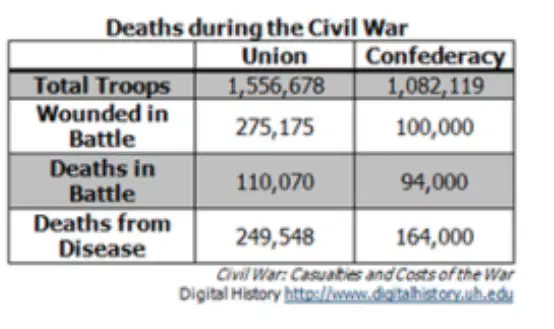
1. What conclusion is evident from the data in this graph?
a)
The Confederacy had better hospital facilities than the North.
b)
The Confederacy lost the war because they had greater casualties.
c)
More soldiers died in battle than were wounded.
d)
Disease caused a greater decline in population than actual fighting.
2.
2. Why did poor white farmers serve and die in the war in disproportionate numbers to their wealthier counterparts?.
a)
The "20 slave" rule prevented poor men from being exempt from the draft.
b)
There was greater support for the war among poorer farmers.
c)
The Confederacy gave away land as an incentive to join the militia so more poor farmers signed up. The Confederacy gave away land as an incentive to join the militia so more poor farmers signed up.
d)
Many wealthy farmers did not support the Confederate cause and refused to fight.
3.
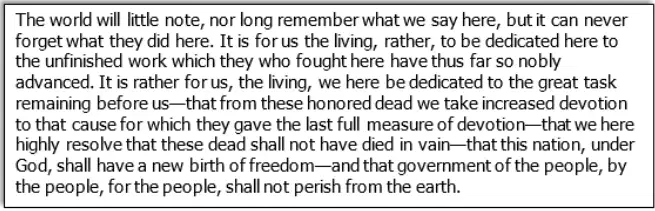
3. This excerpt is from a speech delivered by President Abraham Lincoln on November 19, 1863. Based on this excerpt, what was Lincoln’s main message in this speech?
a)
The Union should surrender in order to preserve American lives.
b)
The Union must shift its goal for the war to ending slavery.
c)
The Union must keep fighting in order to save the nation.
d)
The Union needed to recruit African American soldiers.
4.
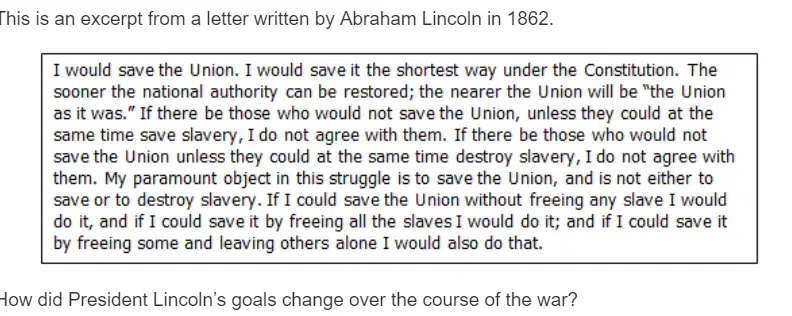
4. This is an excerpt from a letter written by Abraham Lincoln in 1862. How did President Lincoln’s goals change over the course of the war?
a)
He realized that freeing the slaves in the Confederacy could have important political and military effects which would help win the war.
b)
He realized that freeing all slaves in the United States was a moral imperative and should be done at whatever cost to the nation.
c)
He realized the only way to gain support from the British would be to show complete military dominance over the South.
d)
He realized the Union would continue to be successful without the southern states and proposed compromise to end the conflict.
5.
5. What factor most contributed to the outcome of the Civil War?
a)
The North had more resources and people and was able to defeat the South in a war of attrition.
b)
War materials provided by Great Britain gave the North the resources they needed to keep fighting. War materials provided by Great Britain gave the North the resources they needed to keep fighting.
c)
The destruction of southern factories stopped the South's primary sources of revenue for the war.
d)
Newly freed slaves provided the North's armies with unique insights to the weaknesses of the South.
6.
6. What advantage did the South have over the North when the Civil War began?
a)
greater public support for the war
b)
more men eligible to serve in the military
c)
better ability to produce war materials
d)
more railroad lines for shipping goods
7.
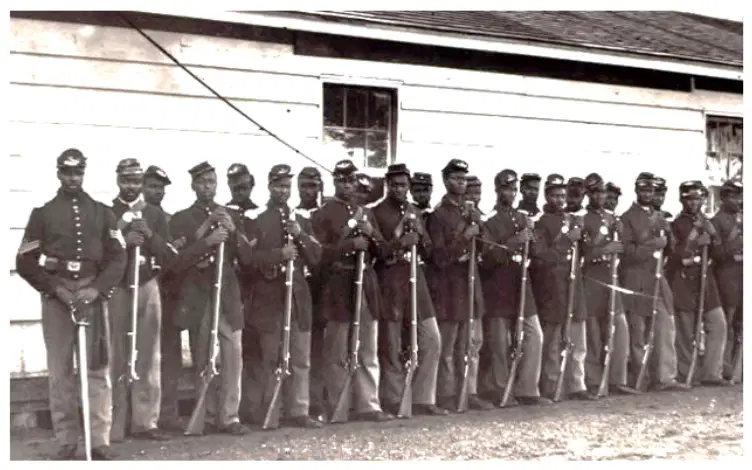
7. This is a photograph of a regiment of the Union Army taken in 1863. What made the service of these soldiers possible?
a)
13th Amendment
b)
Anaconda Plan
c)
Emancipation Proclamation
d)
Gettysburg Address
8.
8. Which statement accurately describes the experience of African American soldiers in the Union army?
a)
African Americans served alongside their white counterparts and were treated fairly.
b)
African Americans served in segregated units and were paid less than their white counterparts.
c)
African Americans served in segregated units but were assigned to important combat positions in all major battles.
d)
African Americans served alongside their white counterparts but were treated as second-class soldiers.
9.
9. Why is the Battle of Vicksburg considered a turning point in the Civil War?
a)
It blocked trade between the Confederacy and its British allies.
b)
It prevented the Confederate army from invading the North.
c)
It destroyed southern farms and cities at the hands of Union soldiers.
d)
It gave Union troops control of the Mississippi River.
10.
10. What advantage did the South have over the North during the Civil War?
a)
Southern states had greater economic resources and better military leadership than the North.
b)
Southern states had better military leadership and used their knowledge of the land against the North.
c)
Southern states had more economic resources and used their knowledge of the land better than the North.
d)
Southern states had greater economic resources and a larger army than the North.
11.
11. Why is the Battle of Gettysburg considered a turning point in the Civil War?
a)
It was the Confederacy's last surge into northern territory.
b)
It ensured that foreign nations would not support the Confederacy.
c)
It showed citizens that the war would last longer than they thought.
d)
It illustrated General Sherman's "total war" approach.
12.
12. How did General Sherman's enactment of the concept of "total war" impact the outcome of the Civil War?
a)
It promoted the destruction of private property, reducing emotional and financial support for the war.
b)
It forced many of the wealthiest southerners to flee to England, resulting in a lack of men to join the army.
c)
It increased anti-slavery sentiments in the South, ending support for the war from the civilian population.
d)
It strengthened the resolve of the southerners, causing them to renew their will to fight.
13.
13. What event ended the Civil War?
a)
the Battle of Gettysburg
b)
the Battle of Fredericksburg
c)
the surrender at Appomattox
d)
the March to the Sea
14.
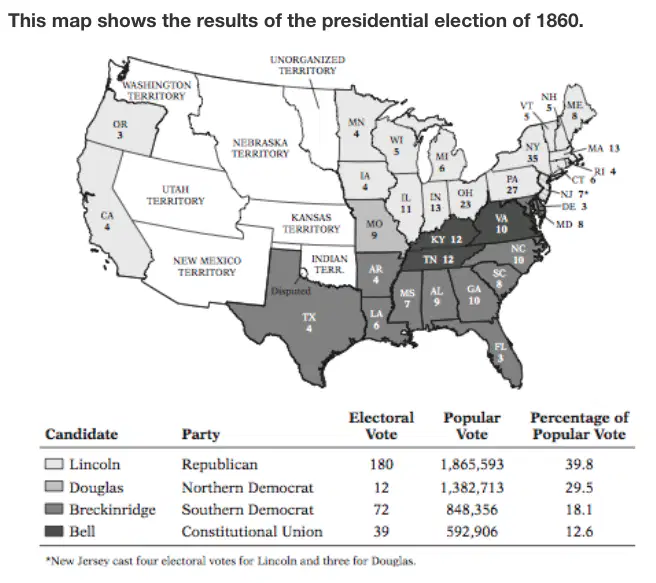
14. Based on this map, which statement about the election of 1860 is true?
a)
Americans were united behind Abraham Lincoln, and he received the majority of the popular vote.
b)
If the Democratic Party had not been divided by sectionalism, Abraham Lincoln would have lost the election.
c)
Northern states were evenly divided on their support for Stephen Douglas and Abraham Lincoln.
d)
The nation was politically divided along geographic lines, and the South opposed the election of Abraham Lincoln.
15.
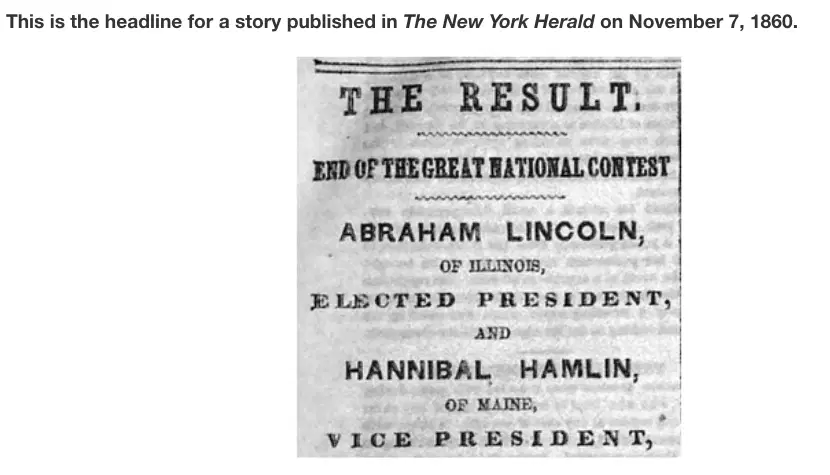
15. How did southern states react to this news?
a)
Senators from southern states called for a recount and resigned when it was not granted.
b)
Representatives from southern states met to discuss the formation of a new political party.
c)
South Carolina seceded from the Union, and several other southern states soon followed.
d)
Southern states immediately declared war, and they launched an attack on Washington, D.C.
100 %

