
 Worksheets
env sci unit 5 review
Total questions: 44
Worksheet time: 7hrs 20mins
______________________ the permanent change in an organisms’ DNA, usually due to exposure radiation, viruses or toxins.
Mutation
Adaptation
Evolution
Recombination
______________________ a species that eats prey killed by other animals.
Scavenger
Predator
Herbivore
Omnivore
______________________ the introduction of new genes into a population due to immigration.
Gene Flow (Migration)
Genetic Drift
Natural Selection
Mutation
______________________ the role or function of a species in an environment.
Niche
Habitat
Ecosystem
Community
______________________ the formation of an ecosystem in an area in which there is no soil or where the soil is incapable of sustaining life (because of recent lava flows, newly formed sand dunes, or rocks left from a retreating glacier).
Primary Succession
Secondary Succession
Tertiary Succession
Climax Community
______________________ a species that has an extremely high impact on its ecosystem by balancing the food chain, and providing niches and habitats to other species.
Keystone Species
Dominant Species
Invasive Species
Endangered Species
______________________ return nutrients to the soil by breaking down dead material.
Decomposer
Producer
Consumer
Scavenger
______________________ the shift of genetic traits in a population toward the characteristics most suited for the environment.
Genetic Drift
Natural Selection
Gene Flow
Mutation
______________________ all of the species living in an area.
Community
Population
Ecosystem
Habitat
______________________ small, fast growing species that are the first to colonize an area.
Pioneer Species
Climax Species
Invasive Species
Endangered Species
______________________ the regrowth of an ecosystem after a major disturbance—such as a devastating flood, wildfire, landslide, or human activity; results in a climax community.
Secondary Succession
Primary Succession
Ecological Restoration
Habitat Fragmentation
______________________ a community of biotic and abiotic components interacting as a system; linked together through nutrient cycles and energy flows.
Ecosystem
Biosphere
Habitat
Biome
The differences in DNA among individuals within species and populations is called
Biodiversity
Genetic diversity
Ecosystem diversity
Species diversity
A species of butterfly that lives in rocky, high-altitude areas and pollinates a specific flower, which in turn is eaten by a certain bird, goes extinct. There is now a vacant in the ecological community.
Habitat
Keystone
Populations with more genetic diversity are less able to cope with environmental change.
True
False
Two populations of a deer species are separated when a glacier forms. After the glacier melts, the two populations have become different species. This is an example of speciation.
True
False
Animals gathering around a water hole in a drought-prone area and establishing hierarchies of access to the water is an example of competition.
True
False
Tigers living in warm climates have thinner coats of fur than tigers living in cool climates. This is a result of
genetic diversity.
species diversity.
ecosystem diversity.
A region that includes tigers, eagles, lizards, fish, rabbits, and many other types of organisms would be described as having a high level of
taxonomic diversity.
genetic diversity.
ecosystem diversity.
species diversity.
Latitude determines climate. Which of the following explains the natural pattern in which species diversity?
species diversity increases toward the equator.
species diversity decreases toward the prime meridian.
species diversity decreases in warmer climates.
species diversity increases toward the poles.
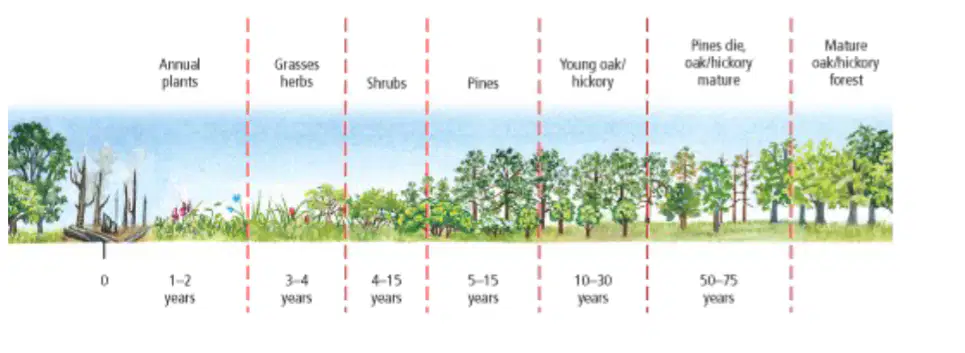
In the years immediately after a fire, a forest will experience a.
primary succession
secondary succession
tertiary succession
a climax community
High levels of biodiversity tend to
have little or no effect on ecosystems.
decrease an ecosystem’s resistance.
make an ecosystem less resilient.
increase the stability of an ecosystem.
Which of the following best describes a successful individual in evolutionary terms?
an individual that possesses traits different from the rest of the population.
an individual that produces many offspring that possess unique traits.
an individual that is well adapted to its environment and produces offspring that survive to pass on its genes.
an individual that is adapted to its environment and produces a few offspring that die quickly.
When the environment changes too quickly for an organism to adapt, what will occur?
Evolution
Speciation
genetic drift
extinction
An interaction in which an individual of one species kills and consumes an individual of another is called
predation.
parasitism.
herbivory.
symbiosis.
A beehive depends on pollen from flowers to survive. Flowers depend on bees to pollinate them. Humans tend bee hives, offering the bees a place to live in exchange for some of their honey. The relationship among these three sets of organisms is
parasitic.
commensalist.
predatory.
mutualistic.
The ultimate source of energy in an ecosystem in which deer eat grass and coyotes eat deer is
the grass.
the sun.
the deer.
chemosynthesis.
In a food web that consists of grass, mice, deer, coyotes, and hawks, which species is likely to have the greatest biomass?
Grass
Mice
Coyotes
hawks
The first level of all food pyramids
consists of producers.
consists of primary consumers.
is chemosynthesis.
is photosynthesis.
A landslide causes part of a mountainside to fall away, leaving bare rock. In the years immediately following the landslide, the area will experience
primary succession.
secondary succession.
A reintroduced population of wolves in a national park is 90 percent grey and 10 percent black, consistent with the wolf population in other regions. After several generations in isolation, the national park's wolf population is 60 percent grey and 40 percent black. The wolf population has likely experienced
genetic drift.
natural selection.
gene flow.
mutation.
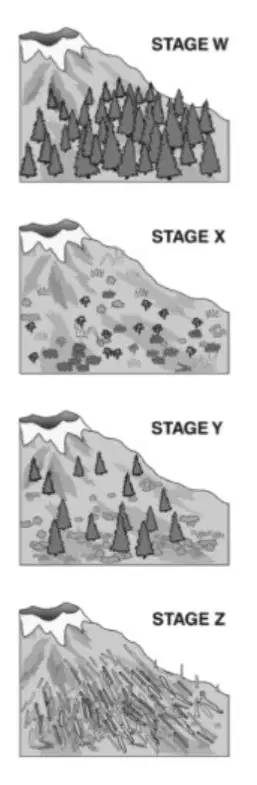
Based on the diagram above, which list shows the sequence of secondary succession that followed the eruption?
X-Y-Z-W
Z-X-Y-W
W-Y-X-Z
Z-Y-W-X
Which most likely causes competition to occur during natural selection?
There is a limited food supply
Organisms in a population are genetically diverse
Fewer offspring are produced in a generation than can survive
The correct order of stages in the primary succession of a dry land environment is illustrated by which of the following?
Bare soil, shrubs, hardwood trees, pine trees
Shrubs, mosses, pine trees, grass
Rock, pine trees, lichen, shrubs
Rock, lichen and mosses, grass, shrubs, trees
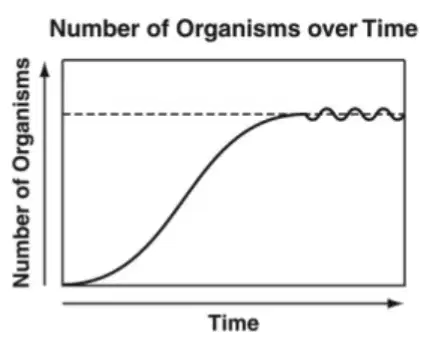
Which environmental concept is best illustrated by the graph?
Natural selection
Logistic growth and carrying capacity
Geographic isolation
Predator-prey relationship
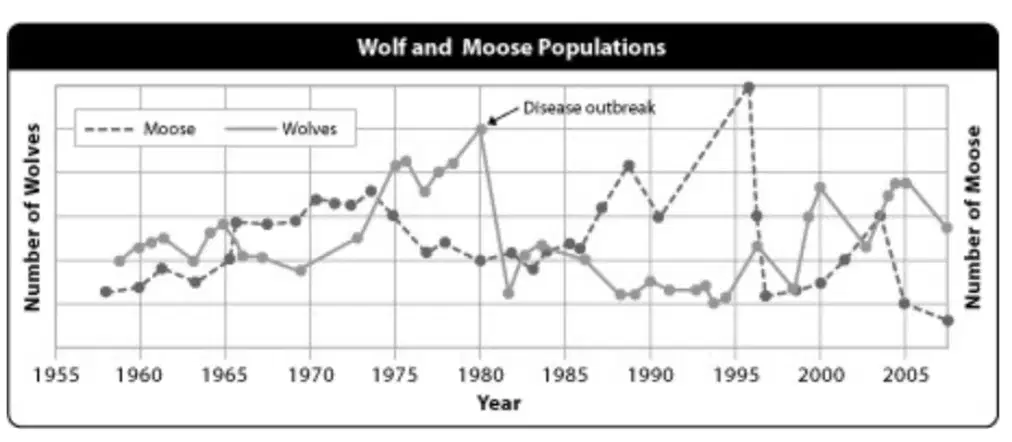
Based on the graph what type of relationship do the wolves and moose have with one another?
predatory
parasitic
symbiotic
mutualistic
In the western United States, at the southern edge of their range, moose are sometimes so severely infested with ticks that they die. The tick/moose relationship is best described as
predatory
parasitic
symbiotic
mutualistic
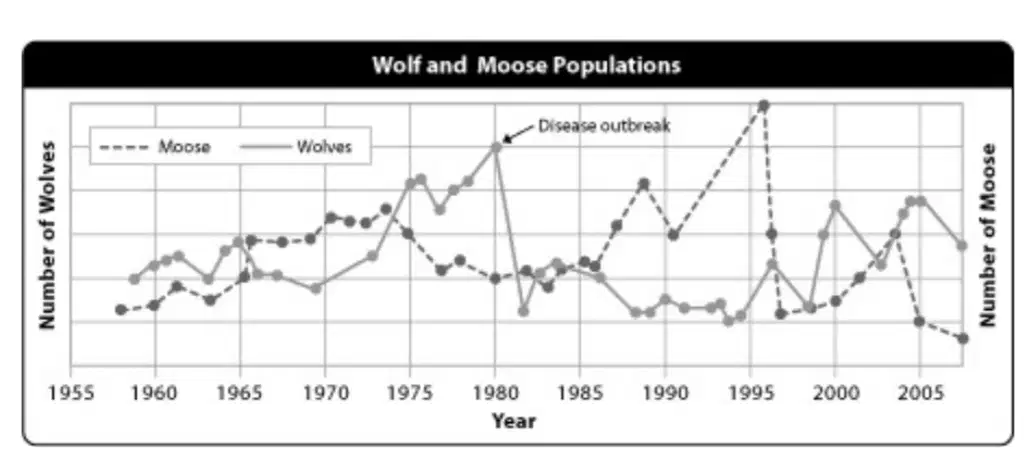
What year did the moose likely become infected with the ticks?
1955
1975
1980
1995
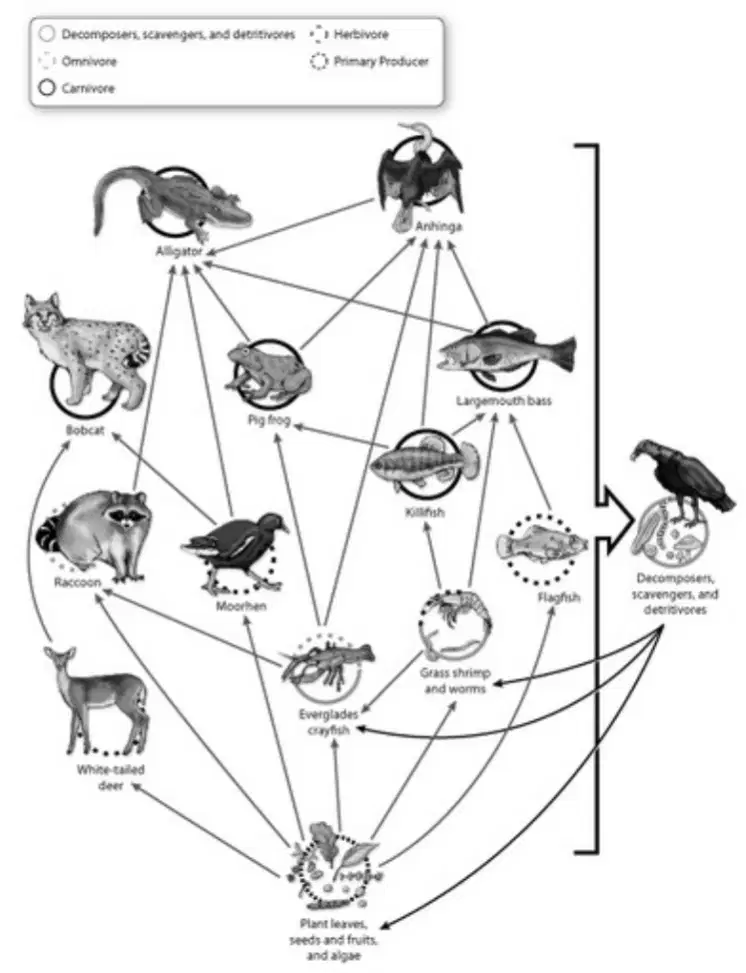
What would happen if alligators were removed from the ecosystem? Explain the effects on each level of the food web.
The ecosystem would remain balanced without alligators.
Prey populations would increase, leading to overconsumption of vegetation.
Predator populations would increase, leading to a decrease in prey species.
There would be no significant impact on the ecosystem.
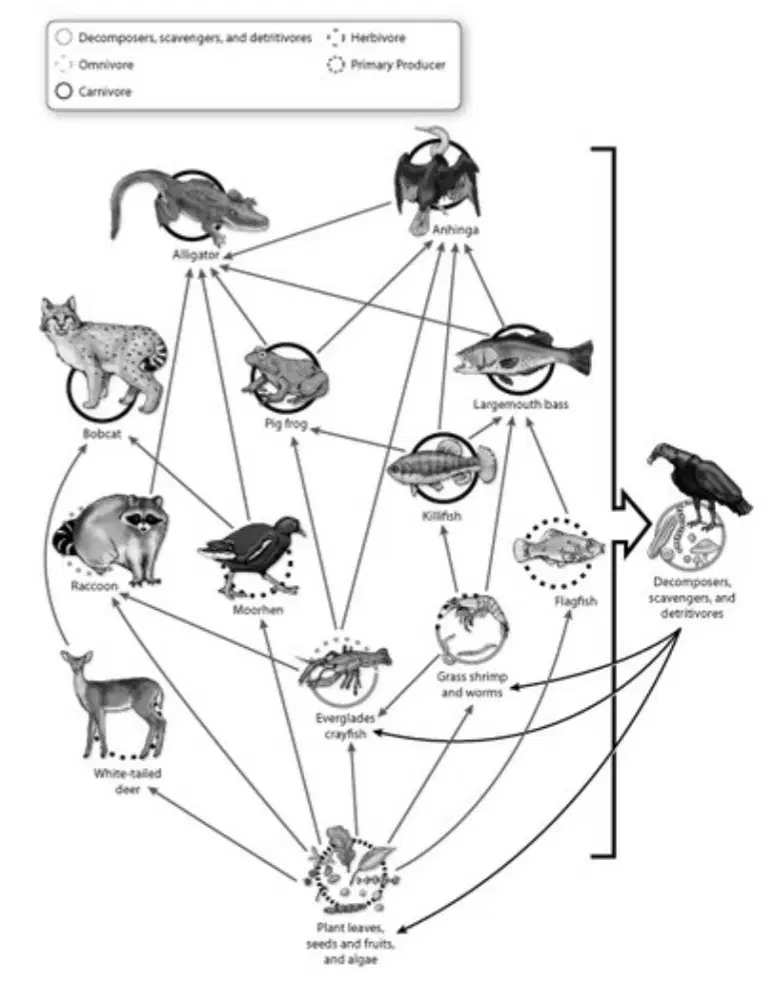
Identify two species in this web that might compete with each other, and explain which resources they compete for.
Species A and Species B compete for food resources.
Species C and Species D compete for water resources.
Species E and Species F compete for shelter.
Species G and Species H compete for sunlight.
Scientists don't know exactly how many species live on Earth because:
the exact number of species is constantly changing due to evolution and extinction.
many species are yet to be discovered and documented.
there is a lack of comprehensive global species database.
all of the above.
Explain the advantages to producing more offspring than might survive. How is this relevant to evolution?
It ensures that at least some offspring survive to adulthood, increasing the chances of passing on genes.
It leads to overpopulation and resource depletion.
It has no impact on evolution.
It decreases genetic diversity.
Wolves were hunted to extinction in Yellowstone National Park in the early 1900’s. The elk population grew quickly once wolves were gone. Around 1950, a species of willow-nesting bird also disappeared from the park. Wolves were reintroduced in the 1990’s and in 2005, 15 years after the reintroduction of wolves to the park, the willow-nesting bird returned. What does this illustrate about the importance of top predators?
Top predators help maintain the balance of ecosystems.
Top predators are not important for the survival of other species.
The presence of top predators leads to the extinction of other species.
Top predators only affect the population of their prey.
Explain why the U.S Forestry Department and local firefighters will perform controlled burns on forest properties. Be sure to list at least TWO reasons.
To reduce the risk of uncontrolled wildfires and promote new growth
To increase the number of trees and decrease biodiversity
To eliminate all wildlife and clear land for development
To pollute the air and increase carbon emissions

