
 Worksheets
Energy Resources Quiz
Total questions: 106
Worksheet time: 53mins
Name
Class
Date
1.
1. Which layer is the thinnest?
a)
Crust
b)
Mantle
c)
Outer Core
d)
Inner Core
2.
2. Which layer is the thickest?
a)
Crust
b)
Mantle
c)
Outer Core
d)
Inner Core
3.
1. The rock cycle is Earth's process of ______________.
a)
changing rocks to different types
b)
smoothing bumpy rocks
c)
destroying rocks
4.
2. Identify the THREE types of rocks.
a)
Sedimentary
b)
Metamorphic
c)
Clay-based
d)
Igneous
e)
Gravelly
5.
What makes soil considered 'healthy'?
a)
Only organic material from living things
b)
Only sediment from rocks and minerals
c)
A mixture of sediment and organic material
d)
Large amounts of synthetic fertilizers
6.
What percentage of Earth is covered by water?
a)
50%
b)
60%
c)
70%
d)
80%
7.
What is the main component of clean air?
a)
Carbon Dioxide
b)
Oxygen
c)
Nitrogen
d)
Argon
8.
What is air pollution?
a)
A mixture of clean air and water
b)
Substances that contaminate Earth's air
c)
The absence of any gases in the atmosphere
d)
Only smoke from factories
9.
Which of the following is a point source of air pollution?
a)
Vehicle emissions
b)
Factory smokestacks
c)
Dust from construction sites
d)
Wildfires
10.
What is smog?
a)
A type of clean air
b)
A mixture of smoke and fog
c)
A gas released by plants
d)
A weather phenomenon
11.
How does human population growth relate to air pollution?
a)
More people lead to less pollution
b)
More resources are needed, increasing emissions
c)
Population growth has no effect on pollution
d)
It decreases the need for vehicles
12.
Which gas is considered poisonous and is released by cars?
a)
Ozone
b)
Nitrogen
c)
Carbon Dioxide
d)
Water Vapor
13.
What is a nonpoint source of air pollution?
a)
A single factory
b)
A large forest fire
c)
Emissions from many vehicles
d)
A power plant
14.
What happens when pollutants enter the atmosphere?
a)
Air becomes cleaner
b)
Air pollution occurs
c)
Weather improves
d)
Plants grow faster
15.
Which of the following is NOT a type of pollution mentioned?
a)
Noise
b)
Water
c)
Light
d)
Heat
16.
What is the role of nitrogen and oxygen in the atmosphere?
a)
They are pollutants
b)
They are essential for life
c)
They cause smog
d)
They are only found in factories
17.
What critical thinking conclusion can be drawn about the relationship between population growth and air pollution?
a)
As populations grow, air pollution automatically decreases
b)
There is no connection between population size and pollution levels
c)
Larger populations typically lead to increased resource use and pollution
d)
Air pollution only occurs in small communities
18.
Why is the mixture of gases in Earth's atmosphere significant for life?
a)
Life has evolved to thrive in any gas mixture
b)
Organisms have adapted specifically to the current gas proportions
c)
Only oxygen matters for life on Earth
d)
The gas mixture has no effect on living things
19.
How does smog formation demonstrate the interaction between different types of pollution?
a)
It's only caused by factory smoke
b)
It results from a combination of emissions and natural weather conditions
c)
It's purely a natural phenomenon
d)
It only occurs at night
20.
What makes ozone particularly concerning as an air pollutant?
a)
It's a poisonous form of oxygen
b)
It's completely harmless
c)
It only affects plants
d)
It disappears quickly
21.
How would analyzing a city's pollution sources help in creating effective solutions?
a)
By identifying whether sources are mainly point or nonpoint
b)
By ignoring all pollution sources
c)
By only focusing on natural causes
d)
By assuming all sources are the same
22.
What inference can be made about controlling nonpoint source pollution versus point source pollution?
a)
Nonpoint sources are easier to control
b)
Point sources are impossible to control
c)
Nonpoint sources may be harder to control due to multiple origins
d)
Both types are equally easy to control
23.
How does the composition of clean air (99% nitrogen and oxygen) relate to pollution impacts?
a)
The 1% other gases don't matter
b)
Even small changes to the air composition can have significant effects
c)
Only changes to nitrogen matter
d)
Pollution can't affect such a large percentage
24.
What conclusion can be drawn about the effectiveness of controlling factory emissions versus car emissions?
a)
Factory emissions are impossible to control
b)
Car emissions are more challenging due to multiple sources
c)
Only factory emissions matter
d)
Neither can be controlled
25.
How might reducing one type of pollution source affect overall air quality?
a)
It would have no effect
b)
It would completely solve all air quality issues
c)
It would help but other sources would still contribute to pollution
d)
Air quality only depends on weather
26.
What role does human behavior play in both causing and potentially solving air pollution?
a)
Humans have no impact on air pollution
b)
Human choices and actions directly affect pollution levels
c)
Only natural processes affect air pollution
d)
Air pollution is not affected by human decisions
27.
Which type of water is most critical for land-based living organisms?
a)
Saltwater
b)
Freshwater
c)
Mineral water
d)
Seawater
28.
What are the primary human activities that contribute to water pollution?
a)
Farming, industry, urban waste
b)
Sports, tourism, construction
c)
Mining, logging, recreation
d)
Transportation, education, entertainment
29.
How does water pollution typically spread through the environment?
a)
Through wind currents
b)
Via the water cycle
c)
Through underground tunnels
d)
By human transportation
30.
What is sewage?
a)
Industrial waste
b)
Water and human waste from sinks and toilets
c)
Ocean pollution
d)
Rainwater runoff
31.
Why are oil spills problematic for the environment?
a)
They are visually unappealing
b)
They require expensive clean-up efforts
c)
They only affect marine life
d)
They have no long-term consequences
32.
How do humans typically use freshwater resources?
a)
Drinking only
b)
Drinking, crops, cleaning, cooling, transportation
c)
Industrial manufacturing
d)
Recreational purposes
33.
What happens when rainwater flows over land?
a)
It disappears
b)
It can dissolve and carry materials into water sources
c)
It creates new land formations
d)
It remains unchanged
34.
Water pollution can potentially harm:
a)
Only marine organisms
b)
Living organisms on land
c)
All living organisms on Earth
d)
No organisms
35.
What occurs when untreated sewage is released into rivers?
a)
It becomes a pollution source
b)
It naturally purifies
c)
It helps plant growth
d)
It has no effect
36.
Which human activity has the potential benefit of making land more suitable for farming but can also harm the soil?
a)
Using fertilizers
b)
Building houses
c)
Creating parks
d)
Planting trees
37.
Why might synthetic fertilizers be considered particularly problematic for soil health?
a)
They are made from natural gas
b)
They are too expensive
c)
They contain only organic materials
d)
They evaporate too quickly
38.
What potential environmental risk do landfills pose?
a)
They take up too much space
b)
Pollution may seep out into surrounding soil
c)
They attract too many birds
d)
They are too expensive to maintain
39.
How does mining affect soil resources in TWO ways according to the text?
a)
It creates jobs and increases property values
b)
It removes soil and can pollute soil with discarded materials
c)
It improves soil quality and helps plants grow
d)
It prevents erosion and adds nutrients
40.
Which statement best describes the relationship between human needs and soil pollution?
a)
Human needs have no impact on soil pollution
b)
Human needs often lead to activities that can cause soil pollution
c)
Soil pollution helps meet human needs
d)
Human needs prevent soil pollution
41.
What is the significance of organic material in soil?
a)
It makes soil look prettier
b)
It provides necessary nutrients for plant growth
c)
It makes soil easier to dig
d)
It keeps soil cold
42.
How are air, water, and soil pollution similar?
a)
They only affect animals
b)
They all result from human resource usage
c)
They are easy to clean up
d)
They only occur in cities
43.
What is the main purpose of covering trash with new soil in landfills?
a)
To hide the trash from view
b)
To create new farming land
c)
To prevent pollution from spreading
d)
To make the land more valuable
44.
Which is a direct consequence of unhealthy soil?
a)
Faster plant growth
b)
Better crop yields
c)
Reduced ability for forests and crops to thrive
d)
Improved livestock health
45.
1. Shifting winds cause major rainstorms, flooding streams, lakes, and rivers are interactions between the...
a)
A) hydrosphere and geosphere
b)
B) atmosphere and geosphere
c)
C) geosphere and biosphere
d)
D) atmosphere and hydrosphere
46.
3. Plants reduce soil erosion by protecting the land from weather are interactions between the...
a)
A) hydrosphere and geosphere
b)
B) atmosphere and hydrosphere
c)
C) atmosphere and geosphere
d)
D) geosphere and biosphere
47.
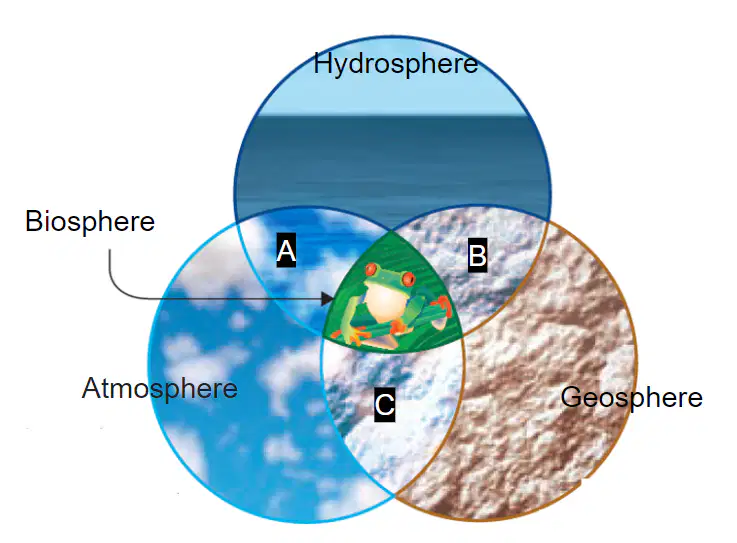
4. Looking at the diagram and answers below, which scenario would fit into letter B?
a)
A. A bird flying in the sky
b)
B. Plants living in the earth
c)
C. Clouds producing rain
d)
D. Waves crashing at the beach
48.
5. When plants take in Carbon Dioxide from the air, which two sphere are interacting?
a)
Geosphere
b)
Atmosphere
c)
Biosphere
d)
Hydrosphere
49.
6. Which of the following does not belong in the geosphere?
a)
A. Sand
b)
B. Volcano
c)
C. Rocks
d)
D. Mushroom
50.
7. Which of the following does not belong in the atmosphere?
a)
A. Rain
b)
B. Clouds
c)
C. Wind
d)
D. Oxygen
51.
8. Flooding moves soil and rock to new places are interactions between the...
a)
A) hydrosphere and geosphere
b)
B) atmosphere and hydrosphere
c)
C) hydrosphere and biosphere
d)
D) geosphere and biosphere
52.
9. Which spheres do humans interact with?
a)
A. Atmosphere
b)
B. Biosphere
c)
C. Geosphere
d)
D. Hydrosphere
e)
E. All of the above
53.
10. Explain how a bird interacts with the hydrosphere, atmosphere, geosphere, and biosphere. Be sure to include all four spheres!
4 lines
54.
3. Heat and pressure melt _________________ rock into magma.
a)
sedimentary
b)
metamorphic
c)
igneous
55.
4. When magma cools, it becomes ___________ rock.
a)
sedimentary
b)
metamorphic
c)
igneous
56.
5. Granite and pumice are both igneous rocks.
a)
True
b)
False
57.
6. How are granite and pumice the same?
a)
They are both formed when smaller rocks are pushed together.
b)
They are both formed when magma/lava cools.
c)
They are both easily broken under pressure.
d)
They are both metamorphic rocks.
58.
7. How are granite and pumice different?
a)
Granite is sedimentary. Pumice is metamorphic.
b)
Granite is formed when magma cools under Earth's surface. Pumice is formed when lava cools above Earth's surface.
c)
Granite is formed when lava cools above Earth's surface. Pumice is formed when magma cools under Earth's surface,
d)
Granite is softer than pumice.
59.
8. Once a rock is on the Earth's surface it is exposed to ___________.
a)
plants and animals
b)
weathering and erosion
c)
construction and mining
60.
9. Igneous rocks begin to break and mix with other ____________.
a)
pebbles
b)
gasses
c)
sediment
61.
10. What moves the sediment around to different places?
a)
erosion
b)
heavy winds
c)
people
62.
11. Chunks of these sediments get squeezed together to form _______________ rocks.
a)
sedimentary
b)
metamorphic
c)
igneous
63.
12. Limestone is a _____________ rock.
a)
sedimentary
b)
metamorphic
c)
igneous
64.
13. Piles of sedimentary rocks combine with heat, pressure, and weight to form ___________ rocks.
a)
sedimentary
b)
metamorphic
c)
igneous
65.
14. Metamorphic rocks melt into ____________.
a)
lava
b)
magma
c)
gasses
66.
15. Physical and ____________ changes cause rocks to change in the rock cycle.
a)
chemical
b)
man-made
c)
natural
67.
16. Select FOUR causes of change for rocks.
a)
Heat
b)
Pressure
c)
Weathing
d)
Erosion
e)
Gravity
68.
17. The rock cycle is never-ending.
a)
True
b)
False
69.
3. Which layer is solid iron?
a)
Crust
b)
Mantle
c)
Outer Core
d)
Inner Core
70.
4. Which layer is liquid metal?
a)
Crust
b)
Mantle
c)
Outer Core
d)
Inner Core
71.
5. What increases as the depth increases inside the Earth?
a)
Space and time
b)
Temperature and density
c)
Ice and gases
72.
6. Which layer is the plastic layer of the mantle?
a)
Asthenosphere
b)
Mantle
c)
Outer Core
d)
Inner Core
73.
7. Which parts make up the lithosphere?
a)
Inner and outer core
b)
Outer core and lower mantle
c)
Upper mantle and crust
d)
Lithosphere and Asthenosphere
74.
8. Which layer is the thickest?
a)
Crust
b)
Mantle
c)
Outer Core
d)
Inner Core
75.
9. Which layer is the dense metal center?
a)
Crust
b)
Mantle
c)
Core
76.
10. Which layer is a plastic, solid later of the mantle that is made of rock that flows slowly with tectonic plates moving on top of it?
a)
Crust
b)
Mantle
c)
Lithosphere
d)
Asthenosphere
77.
What is the primary source of energy used globally?
a)
Fossil Fuels
b)
Solar Energy
c)
Wind Energy
d)
Nuclear Energy
78.
Which of the following is NOT a fossil fuel?
a)
Natural Gas
b)
Coal
c)
Oil
d)
Solar Energy
79.
What percentage of global energy sources comes from oil?
a)
21%
b)
27%
c)
33%
d)
11%
80.
Which energy source contributes the least to global energy production?
a)
Nuclear
b)
Water
c)
Solar
d)
Coal
81.
How are fossil fuels formed?
a)
From living organisms
b)
From solar energy
c)
From wind
d)
From nuclear reactions
82.
What is the role of energy resources in society?
a)
To provide entertainment
b)
To power homes and businesses
c)
To create waste
d)
To reduce pollution
83.
Which of the following energy sources is renewable?
a)
Natural Gas
b)
Coal
c)
Solar
d)
Oil
84.
What is the main challenge with using fossil fuels?
a)
They are unlimited
b)
They are environmentally friendly
c)
They contribute to pollution
d)
They are inexpensive
85.
What type of energy do we get from the sun?
a)
Nuclear
b)
Solar
c)
Wind
d)
Fossil
86.
Which energy source is primarily used for electricity generation?
a)
Natural Gas
b)
Solar
c)
Wind
d)
All of the above
87.
Why is managing energy resources vital?
a)
Only for individual health
b)
Only for community development
c)
For the health and well-being of individuals, communities, nations, and the planet
d)
Only for national security
88.
What is the relationship between ancient organisms and fossil fuels?
a)
Ancient organisms ate fossil fuels
b)
Remains of ancient organisms became fossil fuels over time through heat and pressure
c)
Fossil fuels created ancient organisms
d)
Ancient organisms had no connection to fossil fuels
89.
Based on the pie chart, approximately what percentage of global energy comes from renewable sources (solar, wind, and water combined)?
a)
13%
b)
6%
c)
21%
d)
33%
90.
Which statement best explains why we eat food?
a)
Because it tastes good
b)
Because our body needs energy to function
c)
Because everyone else eats
d)
Because it's a habit
91.
What is the most used fossil fuel according to the pie chart?
a)
Natural gas
b)
Coal
c)
Oil
d)
Nuclear
92.
What conclusion can you draw about fossil fuels vs. alternative energy sources?
a)
Alternative energy sources are more widely used
b)
Fossil fuels make up less than half of global energy
c)
Fossil fuels dominate global energy usage
d)
All energy sources are used equally
93.
Which statement best defines fuel?
a)
Any liquid that burns
b)
Resources that provide energy in the form of heat, light, motion, or electricity
c)
Only oil and gas
d)
Materials that come from ancient organisms
94.
What percentage of global energy sources are NOT fossil fuels?
a)
19%
b)
81%
c)
33%
d)
27%
95.
Which is NOT mentioned as a major fossil fuel in the text?
a)
Coal
b)
Natural gas
c)
Oil
d)
Uranium
96.
What caused ancient organism remains to transform into fossil fuels?
a)
Sunlight and water
b)
Heat and pressure
c)
Cold and time
d)
Wind and erosion
97.
1. Chemically and physically BREAKING DOWN rocks is called
a)
Cooling
b)
Weathering and Erosion
c)
Heat and Pressure
98.
2. How sediments become SEDIMENTARY rocks
a)
Cooling
b)
Compaction and Cementation
c)
Heat and Pressure
99.
3. After MELTING and turning into magma. Magma must do this to become an igneous rock
a)
Cooling
b)
Compaction and Cementation
c)
Heat and Pressure
100.
4. Rocks with bands of minerals that have been HEATED and squeezed (PRESSURE) into parallel lines
a)
Metamorphic
b)
Sedimentary
c)
Igenous
101.
5. Rocks made of bits and pieces (SEDIMENTS) of other rocks
a)
Sedimentary
b)
Metamorphic
c)
Igneous
102.
6. Sandstone is made of sediments that have been COMPACTED and CEMENTED together, this is what type of rock:
a)
Metamorphic
b)
Sedimentary
c)
Igneous
103.
7. Magma turns in ______________________when it leaves a volcano.
a)
Dust
b)
Ice
c)
Lava
104.
8. This rock is found near a volcano
a)
Metamorphic
b)
Sedimentary
c)
Igneous
105.
9. The THINNEST layer of the Earth and part of the lithosphere
a)
Mantle
b)
Crust
c)
Inner Core
106.
10. The MOST DENSE solid layer of the Earth
a)
Mantle
b)
Crust
c)
Inner Core
100 %

